
Context:
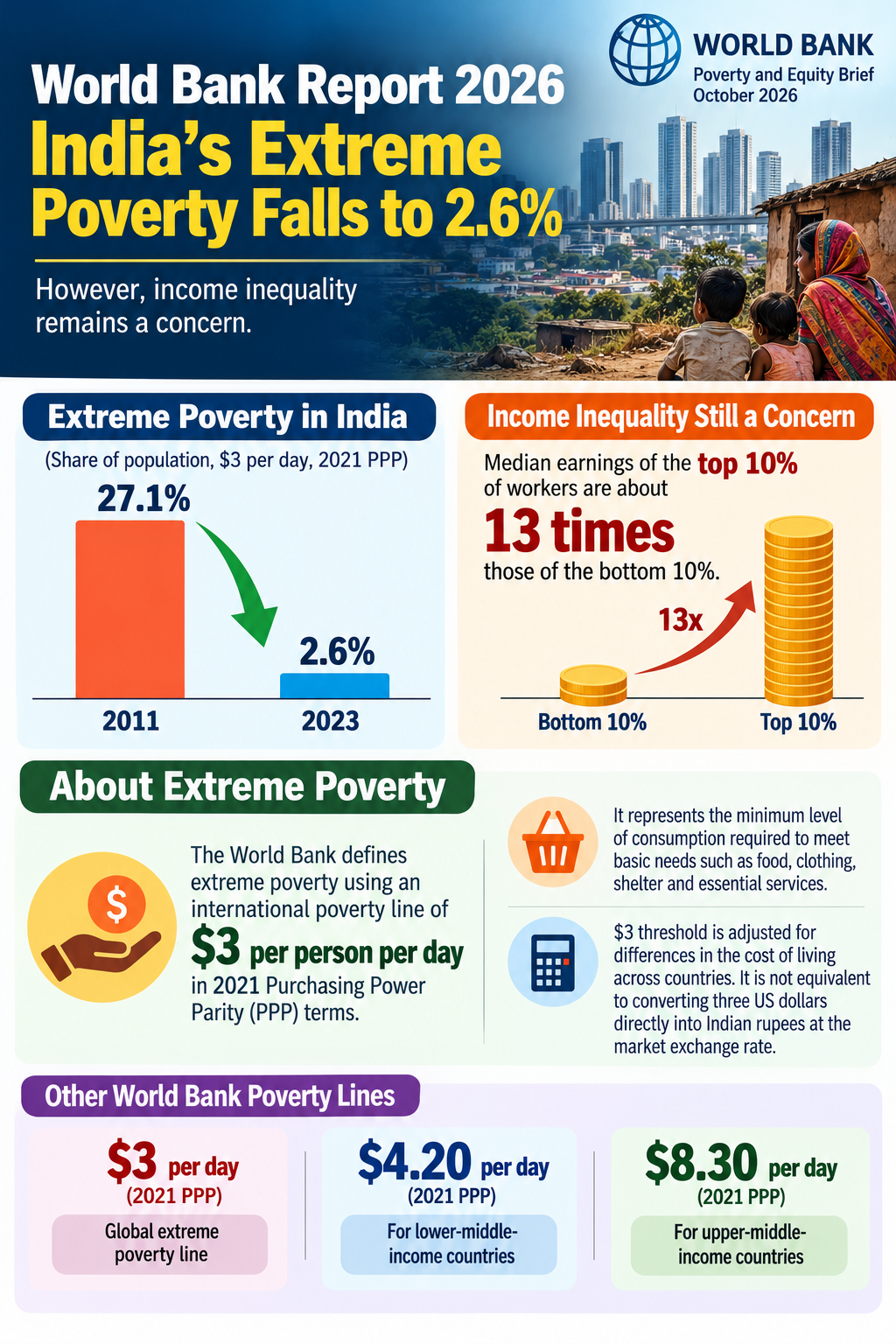
Recent, World Bank's October 2026 Poverty and Equity Brief highlighted that India's extreme poverty rate declined significantly from 27.1% in 2011 to 2.6% in 2023. However, income disparities remain a concern, as the median earnings of the top 10% of workers are approximately 13 times those of the bottom 10%.
About Extreme Poverty:
-
-
- The World Bank defines extreme poverty using an international poverty line of $3 per person per day in 2021 Purchasing Power Parity (PPP) terms.
- It represents the minimum level of consumption required to meet basic needs such as food, clothing, shelter and essential services.
- The $3 threshold is adjusted for differences in the cost of living across countries. It is not equivalent to converting three US dollars directly into Indian rupees at the market exchange rate.
- The World Bank also uses a $4.20 per day poverty line for lower-middle-income countries and an $8.30 per day line for upper-middle-income countries.
- The World Bank defines extreme poverty using an international poverty line of $3 per person per day in 2021 Purchasing Power Parity (PPP) terms.
-
Key Findings of the Report:
-
-
- Sharp Decline in Monetary Poverty:
- Decline in Multidimensional Poverty:
- Persistent Income Inequality:
- Employment Growth Without Proportionate Wage Growth:
- Rural–Urban and Regional Disparities:
- Sharp Decline in Monetary Poverty:
-
Reasons behind Poverty Reduction in India:
The World Bank identified strong consumption growth, rising employment, particularly among women, and expanded social transfers, including food subsidies, as important drivers of poverty reduction. Government initiatives such as MGNREGA, the National Food Security Act, PM Jan Dhan Yojana, Direct Benefit Transfer (DBT), PM Awas Yojana and Ayushman Bharat have also contributed to improving household welfare and access to basic services.
Conclusion:
India's reduction in extreme poverty represents significant progress towards inclusive development. However, poverty reduction alone does not guarantee economic equality. The focus must shift towards creating productive employment, improving real wages, reducing regional disparities and ensuring equitable access to opportunities.



