
Why in News?
Recently, The National Statistics Office (NSO) has released its report "Labour Market Dynamics in Million-plus Cities", based on the Periodic Labour Force Survey (PLFS) 2025. For the first time, the report provides labour market estimates for 46 Indian cities with a population exceeding one million (Census 2011).
Key Findings of the Report:
Higher Share of Women in Regular Salaried Employment:
Women in India's million-plus cities are more likely to be employed in stable salaried jobs.
-
-
- 65.1% of employed women in million-plus cities have regular/salaried jobs.
- This is significantly higher than 50.9% in urban India.
- Among men in million-plus cities, 56.4% are in regular salaried employment.
- 65.1% of employed women in million-plus cities have regular/salaried jobs.
-
This indicates that large urban centres provide relatively better access to formal employment for women.
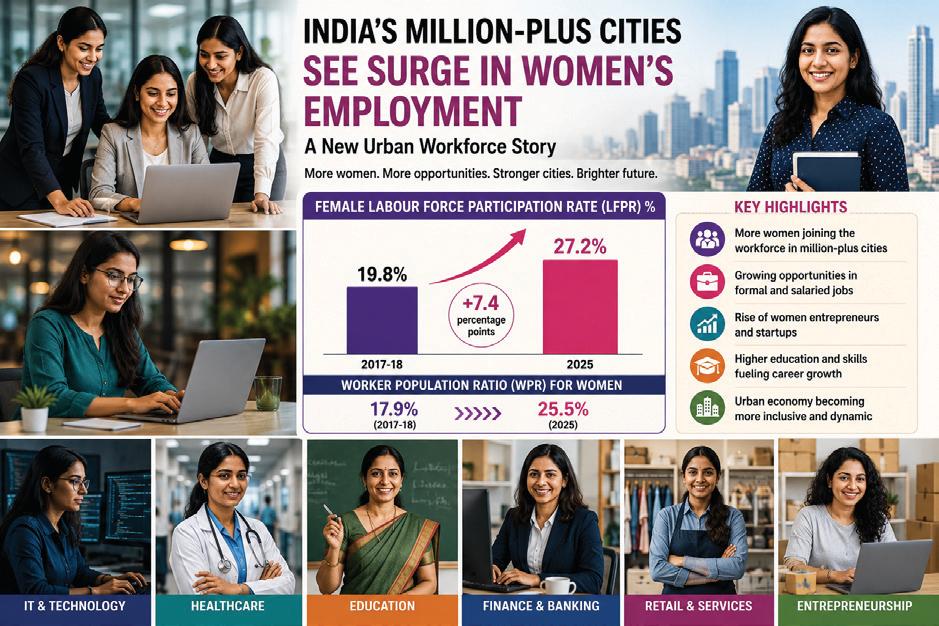
Worker Population Ratio (WPR) Remains Low:
Despite better quality employment, women's workforce participation remains low.
|
Category |
Million-plus Cities |
Urban India |
|
Male WPR |
72.6% |
73.0% |
|
Female WPR |
25.5% |
25.9% |
Thus, only about one in four women in major cities is employed.
What is Worker Population Ratio (WPR)?
The Worker Population Ratio (WPR) is the percentage of employed persons in the total population.
Formula
WPR = (Number of Employed Persons ÷ Total Population) × 100
Importance
-
- Measures the extent of employment in an economy.
- Indicates labour market utilisation.
- Helps assess gender disparities in employment.
- Used by NSO through the Periodic Labour Force Survey (PLFS).
- Measures the extent of employment in an economy.
Difference Between WPR and LFPR:
|
Worker Population Ratio (WPR) |
Labour Force Participation Rate (LFPR) |
|
Includes only employed persons |
Includes employed and unemployed persons actively seeking work |
|
Measures actual employment |
Measures labour market participation |
|
Always lower than or equal to LFPR |
Always equal to or higher than WPR |
Gender Pay Gap Continues:
Although salaries are higher in India's largest cities, women continue to earn substantially less than men.
Average Monthly Salary (Regular Jobs)
|
Area |
Men |
Women |
|
Urban India |
₹27,984 |
₹21,664 |
|
Million-plus Cities |
₹30,707 |
₹23,707 |
Women earn only about 77.2% of men's salaries in both urban India and million-plus cities.
Cities Showing Near Gender Pay Parity:
Some cities have either achieved or exceeded gender pay parity in regular salaried employment:
-
- Prayagraj – Women earn 131.2% of men's salaries.
- Srinagar – 124%.
- Lucknow – 117.1%.
- Patna – 111.1%.
- Meerut – 105.9%.
- Varanasi – 102.4%.
- Prayagraj – Women earn 131.2% of men's salaries.
Among metros, Greater Mumbai performs best, with women earning 98.2% of male salaries.
Compared to urban India:
-
- Regular salaried jobs: 58.5% (Million-plus cities) vs 47.6% (Urban India)
- Self-employed and casual workers: 41.4% vs 52.4%
- Regular salaried jobs: 58.5% (Million-plus cities) vs 47.6% (Urban India)
This reflects greater formalisation of employment in larger cities.
Challenges Highlighted by the Report:
High NEET Population:
Among women aged 30–59:
-
- 67% in million-plus cities are NEET (Not in Employment, Education or Training).
- Across urban India, the figure is 65%.
- 67% in million-plus cities are NEET (Not in Employment, Education or Training).
Primary Reasons for Low Female Participation:
-
- Childcare responsibilities
- Household work
- Lack of flexible employment
- Social and cultural norms
- Safety and mobility concerns
- Childcare responsibilities
Policy Significance:
The findings are important for:
-
- SDG 5 (Gender Equality)
- SDG 8 (Decent Work and Economic Growth)
- Women's economic empowerment
- Urban employment planning
- Inclusive economic growth
- SDG 5 (Gender Equality)
Higher female labour force participation can significantly boost India's GDP and demographic dividend.
Way Forward:
-
- Expand affordable childcare facilities.
- Promote flexible and remote work opportunities.
- Improve workplace safety and public transport.
- Strengthen skilling and digital literacy programmes for women.
- Enforce equal pay and anti-discrimination laws.
- Increase women's participation in formal employment through targeted incentives.
- Expand affordable childcare facilities.
Conclusion:
The NSO's latest report presents a mixed picture of women's employment in India's largest cities. While million-plus cities offer greater access to formal salaried jobs, female workforce participation remains low and wage disparities continue. Addressing structural barriers such as unpaid care work, safety concerns, and unequal opportunities is essential for achieving inclusive urban development and harnessing India's full economic potential.



