
Context:
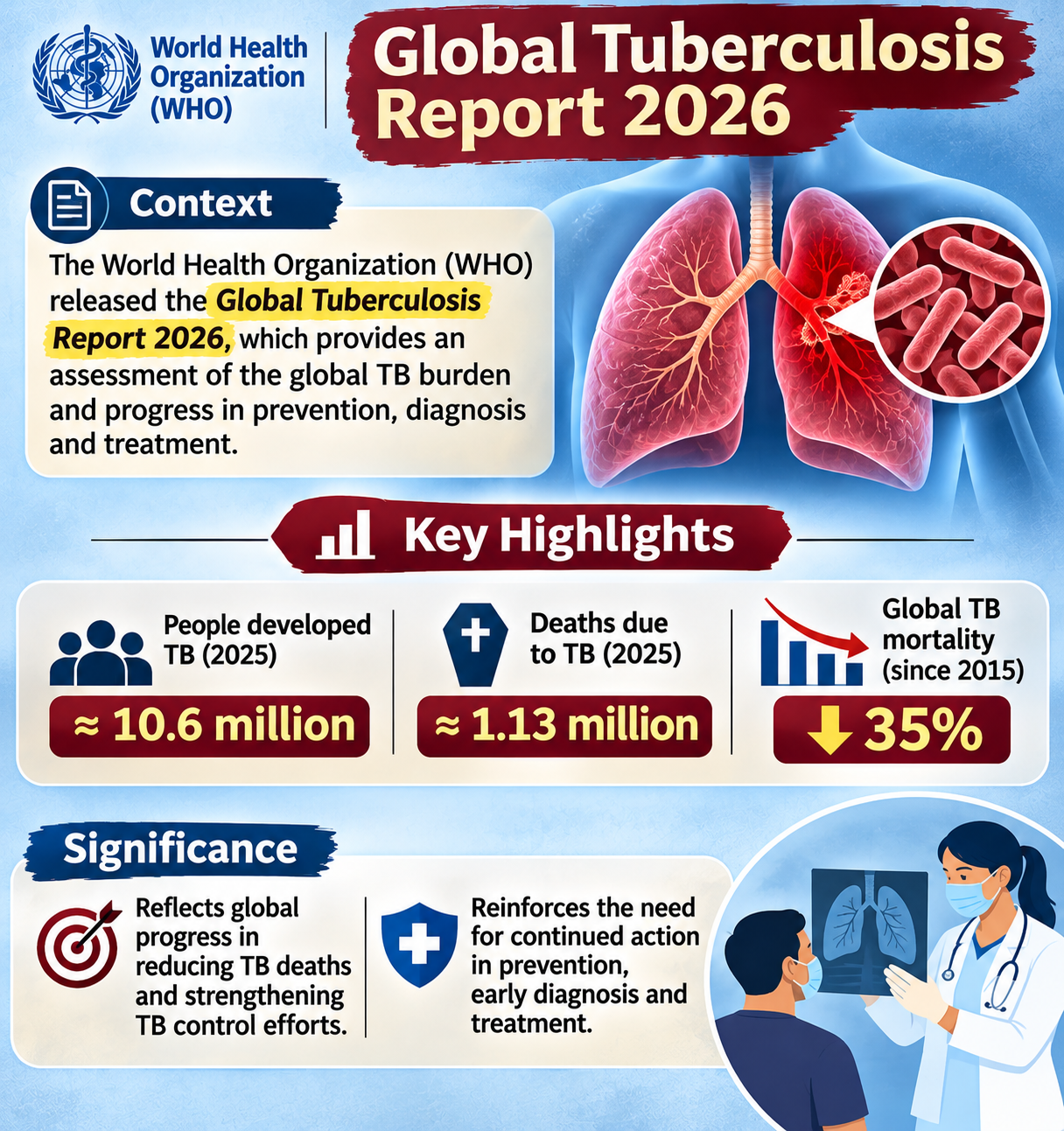
Recently, the World Health Organization (WHO) released the Global Tuberculosis Report 2026, providing an assessment of the global TB burden and progress in prevention, diagnosis and treatment. The report highlights that approximately 10.6 million people developed TB and 1.13 million died from the disease in 2025. Global TB mortality has declined by 35% since 2015.
Historical Background:
-
-
- Tuberculosis has been one of the world's oldest and deadliest infectious diseases. The WHO declared TB a global public health emergency in 1993. In 2014, WHO adopted the End TB Strategy, aiming to end the global TB epidemic by 2035.
- The Sustainable Development Goals (SDGs), adopted in 2015, also incorporated TB elimination under Target 3.3, which aims to end the TB epidemic by 2030.
- India launched the National Tuberculosis Programme in 1962 and subsequently introduced the Revised National Tuberculosis Control Programme in 1993. In 2020, it was renamed the National Tuberculosis Elimination Programme (NTEP), with an initial national elimination target of 2025.
- Tuberculosis has been one of the world's oldest and deadliest infectious diseases. The WHO declared TB a global public health emergency in 1993. In 2014, WHO adopted the End TB Strategy, aiming to end the global TB epidemic by 2035.
-
Key Findings of WHO Global TB Report 2026:
The report presents the following important statistics:
|
Indicator |
Global statistics (2025) |
|
People developing TB |
10.6 million |
|
TB-related deaths |
1.13 million |
|
Decline in mortality since 2015 |
35% |
|
Decline in TB incidence since 2015 |
14% |
|
Newly diagnosed and reported cases |
8.4 million |
|
Estimated undiagnosed/unreported cases |
2.2 million |
|
Rifampicin-resistant TB cases |
3.7 lakh |
|
Treatment success rate for drug-sensitive TB |
90% |
The report estimates that 5.7 million men, 3.7 million women and 1.2 million children and young adolescents developed TB in 2025. Treatment of TB patients has prevented approximately 86 million deaths between 2000 and 2025.
Global Distribution of TB Burden:
-
-
- The global TB burden remains concentrated in a limited number of countries. According to WHO, 30 high-burden countries accounted for 88% of people who developed TB in 2025.
- The eight countries accounting for approximately 67% of global TB cases were:
- India – 25%.
- Indonesia – 10%.
- Philippines – 6.8%.
- China – 6.5%.
- Pakistan – 6.4%.
- Nigeria – 4.9%.
- Democratic Republic of the Congo – 3.9%.
- Bangladesh – 3.7%.
- India – 25%.
- India remains the country with the highest TB burden globally.
- The global TB burden remains concentrated in a limited number of countries. According to WHO, 30 high-burden countries accounted for 88% of people who developed TB in 2025.
-
India's Performance and Achievements:
-
-
- India has recorded significant progress in TB control. According to the report, TB mortality declined by 38% between 2015 and 2025, compared to the global decline of 35%.
- The estimated mortality rate decreased from 28 deaths per lakh population in 2015 to 18 per lakh in 2025. India also achieved a 94% treatment success rate among drug-susceptible TB patients.
- Under the TB Mukt Bharat Abhiyaan, more than 25 crore people were covered through intensified screening, over 11 crore chest X-rays were conducted and 48.64 lakh TB cases were detected, including 14.97 lakh asymptomatic cases. Approximately 96% of TB programme funding requirements are met through domestic resources.
- India has recorded significant progress in TB control. According to the report, TB mortality declined by 38% between 2015 and 2025, compared to the global decline of 35%.
-
Major Challenges Highlighted by the Report:
-
-
- Slow progress: Global TB incidence declined by only 14% between 2015 and 2025, against the 50% reduction milestone for 2025.
- Diagnostic gaps: Around 2.2 million people with TB remained undiagnosed or unreported in 2025.
- Drug-resistant TB: Only 42% of estimated rifampicin-resistant TB patients received treatment in 2025.
- Financial constraints: International donor funding declined by 14% to US$0.94 billion in 2025.
- Inadequate research: Global TB research funding stood at US$1.2 billion in 2023, less than one-fourth of the US$5 billion annual target for 2027.
- Social determinants: Poverty, malnutrition, overcrowding and HIV increase vulnerability to TB.
- Slow progress: Global TB incidence declined by only 14% between 2015 and 2025, against the 50% reduction milestone for 2025.
-
WHO Recommendations:
-
-
- WHO emphasises the need to strengthen primary healthcare, expand rapid molecular diagnostics, improve treatment access and address drug-resistant TB. Governments should increase domestic healthcare investment and protect essential TB services from international funding cuts.
- Greater investment in research and development is necessary for new vaccines, diagnostics and shorter treatment regimens. Community participation, nutritional support, public-private partnerships and digital surveillance should also be strengthened.
- WHO emphasises the need to strengthen primary healthcare, expand rapid molecular diagnostics, improve treatment access and address drug-resistant TB. Governments should increase domestic healthcare investment and protect essential TB services from international funding cuts.
-



