
West Asia Conflict and Rising Poverty in India
Context:
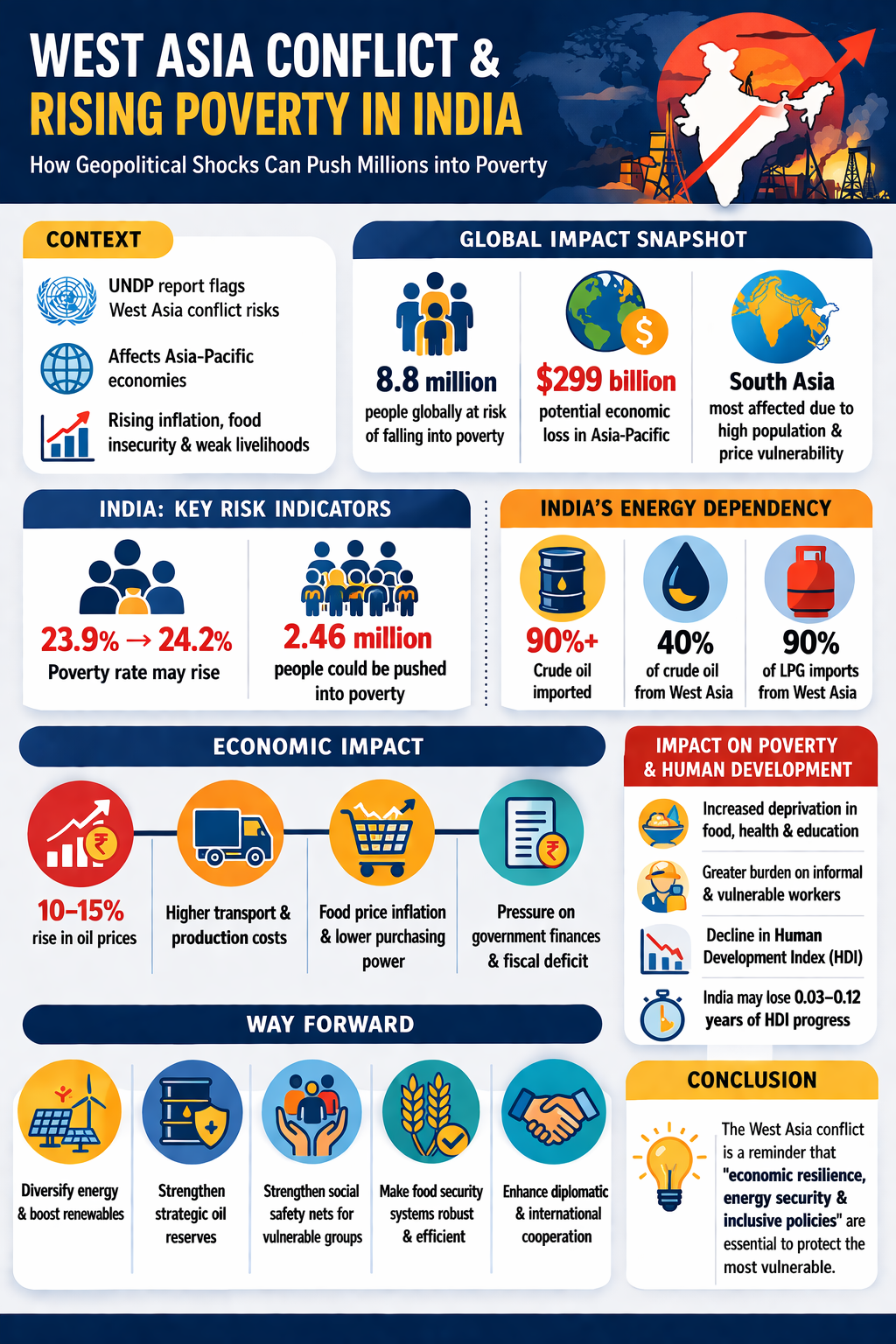
Recently, a report by the United Nations Development Programme (UNDP) has highlighted that the ongoing West Asia conflict could push about 2.5 million people in India into poverty. This report underlines the broader human development impacts of military escalation in the Middle East on Asia-Pacific economies, including rising inflation, food insecurity, and weakening livelihoods.
Key Findings of the UNDP Report:
-
-
- Around 8.8 million people globally are at risk of falling into poverty
- Asia-Pacific could face economic losses of up to $299 billion
- South Asia is the most affected region due to high population and vulnerability to price shocks
- India’s poverty rate may rise from 23.9% to 24.2%
- About 2.46 million people in India could be pushed into poverty
- Around 8.8 million people globally are at risk of falling into poverty
-
Impact on India:
India is particularly vulnerable due to heavy dependence on West Asian energy imports:
-
-
- More than 90% of crude oil is imported
- Over 40% of crude oil and 90% of LPG imports come from West Asia
- More than 90% of crude oil is imported
-
Economic Impact:
-
-
- Rise in oil prices (10–15%) leading to inflation
- Increased transport and input costs affecting industries
- Rise in food prices and decline in household purchasing power
- Pressure on government finances and fiscal deficit
- Rise in oil prices (10–15%) leading to inflation
-
Impact on Poverty and Human Development:
-
-
- According to the report, the crisis will worsen multidimensional poverty:
- Increased deprivation in food, health, and education
- Greater burden on vulnerable and informal sector workers
- Decline in the Human Development Index (HDI)
- Increased deprivation in food, health, and education
- India may lose about 0.03–0.12 years of HDI progress, indicating a setback in development gains.
- According to the report, the crisis will worsen multidimensional poverty:
-
Way Forward:
-
-
- India needs to adopt a multi-dimensional strategy to deal with this crisis. First, energy sources should be diversified, including promoting renewable energy and strengthening strategic oil reserves to reduce the impact of external shocks.
- At the same time, it is important to strengthen social safety nets for vulnerable sections to protect livelihoods during inflation and economic stress. The food security system must also be made more effective and robust to ensure access to essential food items despite rising prices.
- To control inflation, the government must maintain fiscal discipline and follow prudent economic policies. Finally, diplomatic efforts at regional and international levels should be enhanced to resolve such global crises, ensuring peace and economic stability.
- India needs to adopt a multi-dimensional strategy to deal with this crisis. First, energy sources should be diversified, including promoting renewable energy and strengthening strategic oil reserves to reduce the impact of external shocks.
-
Conclusion:
The West Asia conflict shows how external geopolitical shocks can derail domestic development. For India, this crisis is a reminder of the need for economic resilience, energy security, and inclusive policies to protect the most vulnerable sections of society.



