
Weakening of Atlantic Meridional Overturning Circulation (AMOC)
Context:
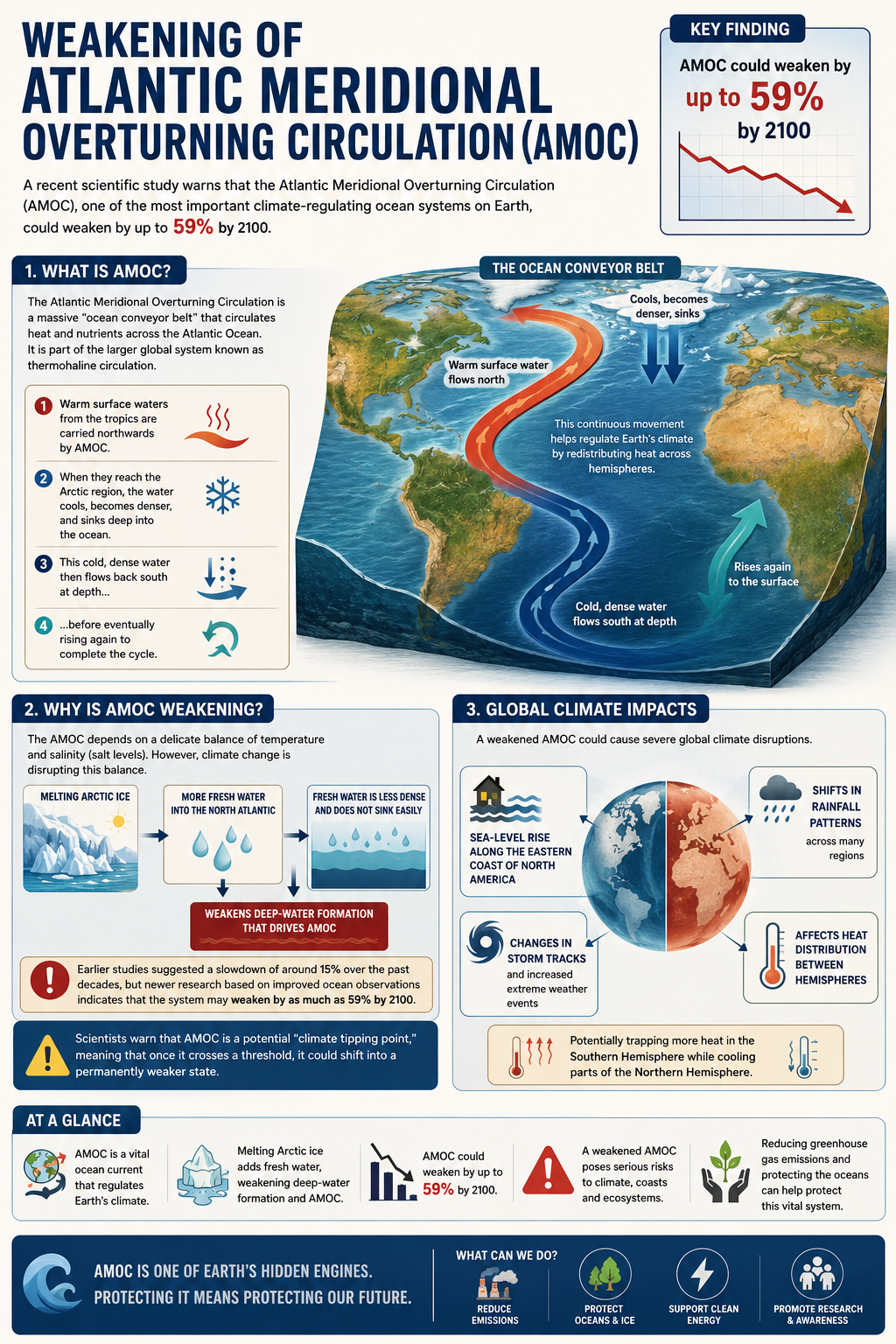
A recent scientific study warns that the Atlantic Meridional Overturning Circulation (AMOC), one of the most important climate-regulating ocean systems on Earth, could weaken by up to 59% by 2100.
About AMOC:
-
-
- The Atlantic Meridional Overturning Circulation can be understood as a massive “ocean conveyor belt” that circulates heat and nutrients across the Atlantic Ocean. It is part of the larger global system known as thermohaline circulation.
- Warm surface waters from the tropics are carried northwards by AMOC. When they reach the Arctic region, the water cools, becomes denser, and sinks deep into the ocean.
- This cold, dense water then flows back south at depth before eventually rising again to complete the cycle. This continuous movement helps regulate Earth’s climate by redistributing heat across hemispheres.
- The Atlantic Meridional Overturning Circulation can be understood as a massive “ocean conveyor belt” that circulates heat and nutrients across the Atlantic Ocean. It is part of the larger global system known as thermohaline circulation.
-
Reasons for AMOC is Weakening:
-
-
- The AMOC depends on a delicate balance of temperature and salinity (salt levels). However, climate change is disrupting this balance. Rapid melting of Arctic ice is releasing large amounts of fresh water into the North Atlantic. Fresh water is less dense and does not sink easily, weakening the deep-water formation process that drives AMOC.
- Earlier studies suggested a slowdown of around 15% over the past decades, but newer research based on improved ocean observations indicates that the system may weaken by as much as 59% by 2100. Scientists warn that AMOC is a potential “climate tipping point,” meaning that once it crosses a threshold, it could shift into a permanently weaker state.
- The AMOC depends on a delicate balance of temperature and salinity (salt levels). However, climate change is disrupting this balance. Rapid melting of Arctic ice is releasing large amounts of fresh water into the North Atlantic. Fresh water is less dense and does not sink easily, weakening the deep-water formation process that drives AMOC.
-
Global Climate Impacts:
A weakened AMOC could cause severe global climate disruptions. It may lead to sea-level rise along the eastern coast of North America, shifts in rainfall patterns, and changes in storm tracks. It also affects heat distribution between hemispheres, potentially trapping more heat in the Southern Hemisphere while cooling parts of the Northern Hemisphere.
Link with El Niño and Global Weather Systems:
-
-
- AMOC is closely connected to other global climate systems, including the El Niño–Southern Oscillation. ENSO is a periodic climate pattern in the Pacific Ocean with warm (El Niño), cool (La Niña), and neutral phases occurring every 2–7 years.
- A weaker AMOC can alter global ocean heat distribution, making ENSO events more unpredictable and extreme. This increases the chances of irregular rainfall patterns across continents, including Asia.
- AMOC is closely connected to other global climate systems, including the El Niño–Southern Oscillation. ENSO is a periodic climate pattern in the Pacific Ocean with warm (El Niño), cool (La Niña), and neutral phases occurring every 2–7 years.
-
Implications for India:
-
-
- Although AMOC is located in the Atlantic, its effects can influence the Indian monsoon indirectly through global atmospheric circulation changes.
- A disrupted AMOC can alter heat distribution across oceans, potentially affecting monsoon timing, intensity, and reliability.
- Since India’s agriculture, drinking water supply, and hydropower systems depend heavily on monsoon rainfall, even small shifts can have large socio-economic consequences.
- Although AMOC is located in the Atlantic, its effects can influence the Indian monsoon indirectly through global atmospheric circulation changes.
-
Conclusion:
The AMOC is a key part of Earth’s climate system, distributing heat globally. Its weakening due to climate change poses serious risks. For India, the main concern is its impact on monsoon patterns, which affect food security, water supply, and rural livelihoods. Strengthening climate resilience and improving forecasting systems is essential for preparing for these long-term changes.



