
Context:
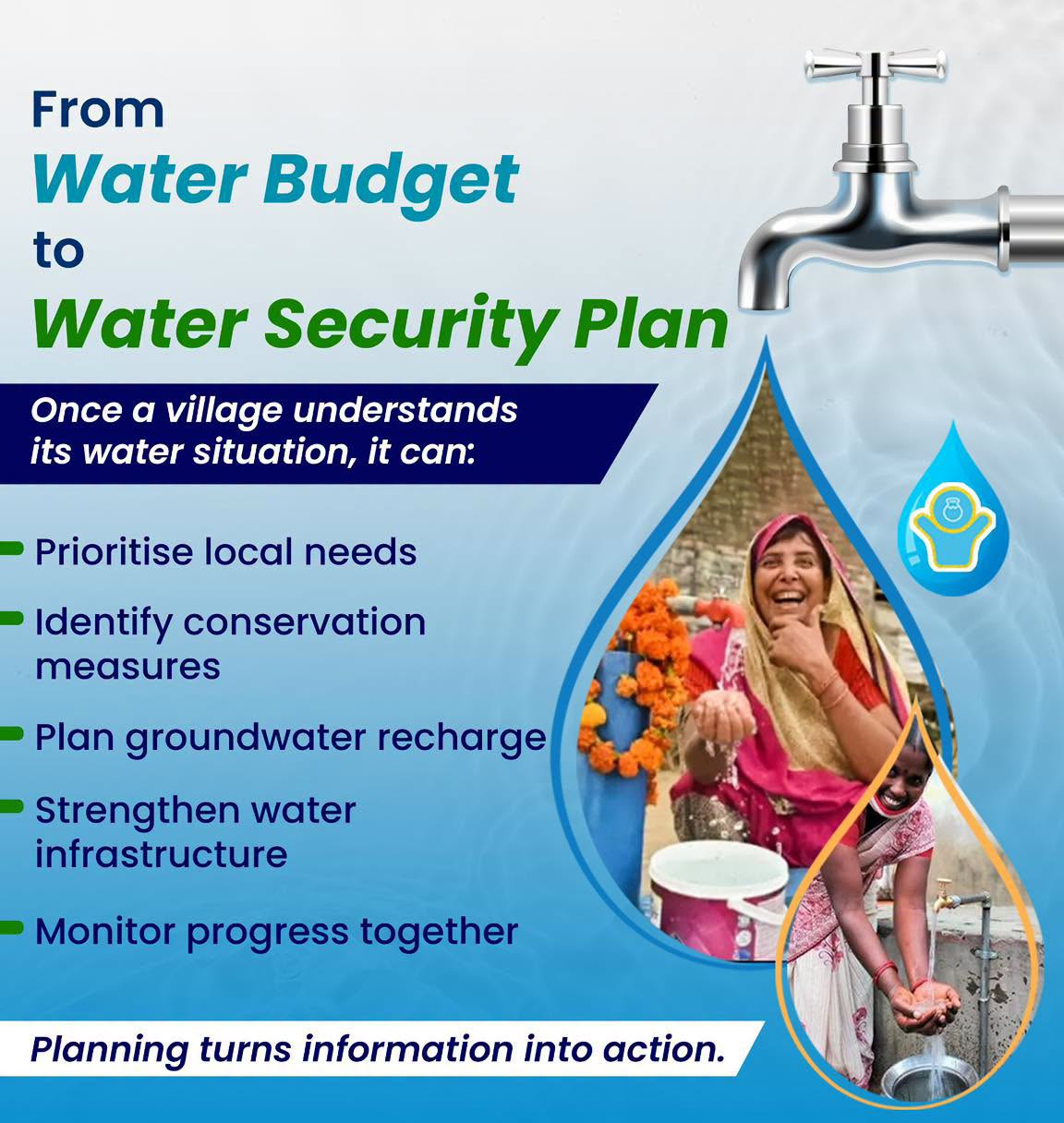
Climate change, erratic monsoons, excessive groundwater extraction, and rising water demand have made water security a major challenge in rural India. To address this issue, the government has launched an initiative to prepare Water Budgets and Water Security Plans at the Gram Panchayat level. Recently, the Ministry of Panchayati Raj launched a national-level Master Trainers Training Programme to help Gram Panchayats prepare these plans.
What is a Water Budget?
A Water Budget is a scientific assessment of the available water resources in a village and its total water demand means, a water budget estimates how much water comes into a village, how much is used and how much can be conserved.
It includes:
-
-
- Quantity of rainfall received
- Availability of groundwater and surface water
- Domestic water requirements
- Water consumption for agriculture and livestock
- Scope for water conservation and groundwater recharge
- Quantity of rainfall received
-
Why is a Water Budget Needed?
-
-
- Addressing the Groundwater Crisis: Groundwater levels are declining in many rural areas due to over-extraction, unplanned irrigation, and increasing population, putting severe pressure on water resources.
- Promoting Efficient Water Use: A water budget enables villages to plan water use according to actual needs, preventing unnecessary extraction and ensuring sustainable management.
- Improving Agricultural Water Management: Since agriculture is the largest consumer of water in India, water budgeting promotes:
- Low water-intensive crops
- Micro-irrigation techniques
- Better crop planning
- Low water-intensive crops
- Strengthening Water Conservation: It provides a scientific basis for measures such as:
- Revival of ponds
- Rainwater harvesting
- Check dams
- Groundwater recharge
- Revival of ponds
- Addressing the Groundwater Crisis: Groundwater levels are declining in many rural areas due to over-extraction, unplanned irrigation, and increasing population, putting severe pressure on water resources.
-
About Master Trainers Training Programme:
The initiative aims to create a national pool of Master Trainers at the State, District, and Block levels. These trainers will assist Gram Panchayats in preparing:
-
-
- Technically sound
- Evidence-based
- Community-driven
- Technically sound
-
Water Security Plans.
-
-
- The programme seeks to strengthen the water management capacity of Gram Panchayats and ensure long-term water security.
- On this occasion, the Ministry also released the "Jal-Paryapt Panchayat Training Manual (Phase I & II)," which provides practical guidance for preparing participatory, scientific, and climate-resilient water security plans.
- The programme seeks to strengthen the water management capacity of Gram Panchayats and ensure long-term water security.
-
Key Features of the Training Programme:
-
-
- Scientific Water Management
- Preparation of water budgets
- Assessment of water resources and demand
- Identification of water conservation measures
- Preparation of water budgets
- Technological Innovations
- Data-driven planning
- Monitoring of water resources
- Climate-resilient water management strategies
- Data-driven planning
- Community-Based Planning
- Ensuring community participation
- Preparing inclusive water security plans
- Developing village-level implementation strategies
- Ensuring community participation
- Scientific Water Management
-
Phase I of the Programme:
The first phase will cover:
-
-
- 10 States
- 100 Districts
- 100 Blocks
- 1,000 Gram Panchayats
- 10 States
-
States Included:
-
-
- Bihar
- Chhattisgarh
- Jharkhand
- Karnataka
- Madhya Pradesh
- Maharashtra
- Odisha
- Rajasthan
- Tamil Nadu
- West Bengal
- Bihar
-
The first batch includes participants from Bihar, Chhattisgarh, Jharkhand, Madhya Pradesh, and West Bengal. These Master Trainers will support Panchayats in preparing Water Security Plans during the upcoming People's Plan Campaign (PPC).
Conclusion:
The initiative to prepare a Water Budget for every village is a significant step towards establishing a decentralised, scientific, and participatory water management system in India. It will empower Gram Panchayats to play a proactive role in water conservation and management while contributing to the vision of a water-secure, climate-resilient, and sustainable rural India.



