
Context:
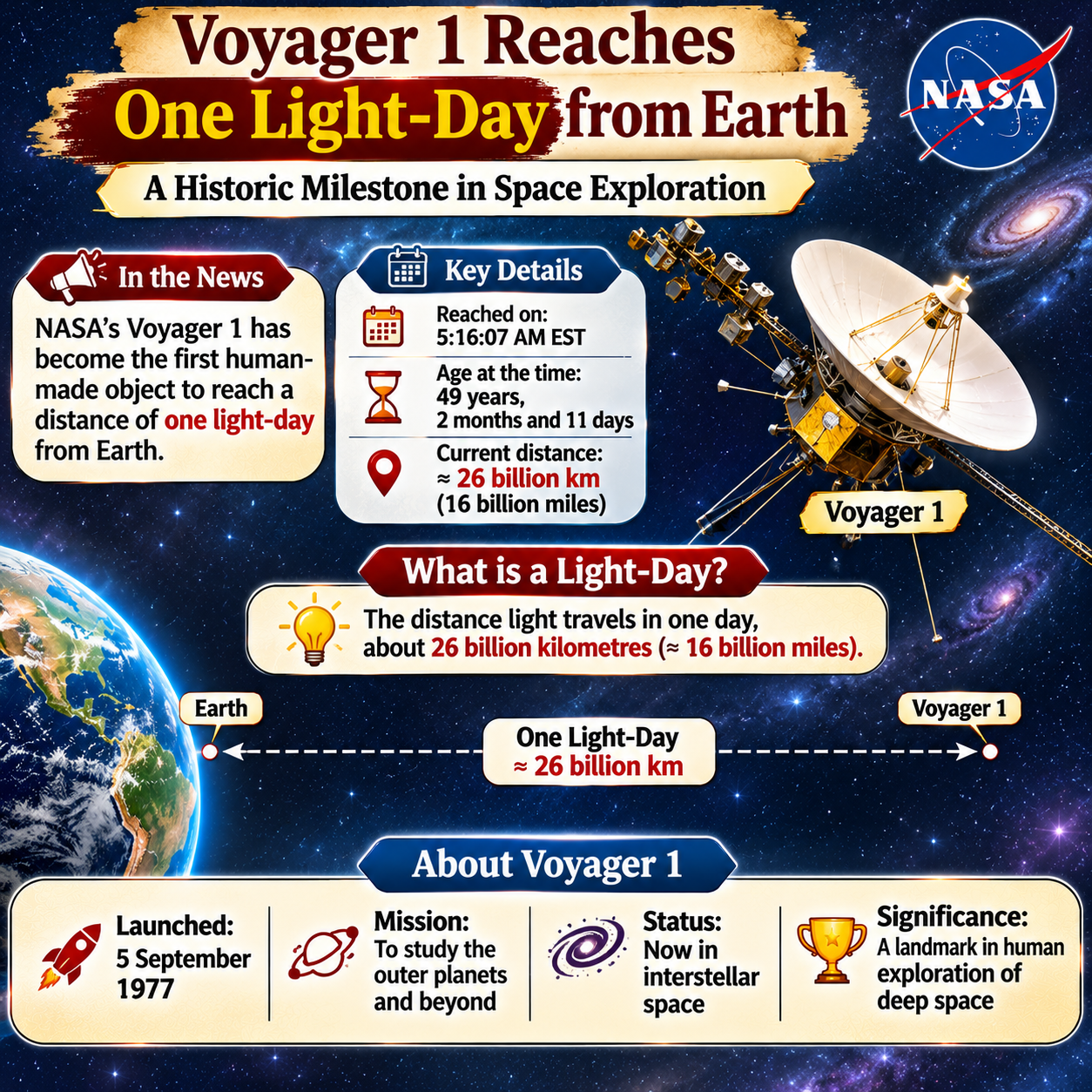
Recently, NASA's historic spacecraft Voyager 1 became the first human-made object to reach a distance of one light-day from Earth, marking a remarkable milestone in space exploration. The spacecraft reached this distance at 5:16:07 AM EST, when it was 49 years, 2 months and 11 days old. It is currently approximately 26 billion kilometres (16 billion miles) away from Earth.
What is Voyager 1?
-
-
- Voyager 1 is an unmanned interstellar space probe launched by NASA on 5 September 1977 from Kennedy Space Center, Florida. Initially, the mission aimed to explore the outer planets, particularly Jupiter and Saturn.
- It studied Jupiter's atmosphere, moons and magnetic field, and provided important observations of Saturn's rings and its largest moon, Titan.
- Voyager 1 crossed the heliopause on 25 August 2012, becoming the first human-made spacecraft to enter interstellar space.
- Voyager 1 is an unmanned interstellar space probe launched by NASA on 5 September 1977 from Kennedy Space Center, Florida. Initially, the mission aimed to explore the outer planets, particularly Jupiter and Saturn.
-
Meaning and Significance of One Light-Day:
-
-
- A light-day is an astronomical unit of distance representing the distance travelled by light in 24 hours. It is approximately 25.9 billion kilometres or 16 billion miles, equivalent to nearly 173.14 Astronomical Units (AU). One AU represents the average distance between Earth and the Sun.
- At this distance, radio signals travelling at the speed of light take approximately 24 hours to reach Voyager 1, while its response takes another 24 hours to return. Thus, communication involves a delay of nearly 48 hours. Despite travelling at approximately 61,000 kilometres per hour, Voyager 1 took nearly 49 years to achieve this milestone.
- A light-day is an astronomical unit of distance representing the distance travelled by light in 24 hours. It is approximately 25.9 billion kilometres or 16 billion miles, equivalent to nearly 173.14 Astronomical Units (AU). One AU represents the average distance between Earth and the Sun.
-
Mission Journey and Scientific Contributions:
-
-
- Voyager 1 has provided valuable information about the outer Solar System and interstellar space, including observations of cosmic rays, magnetic fields and interstellar plasma.
- It carries the Golden Record, containing sounds, music, images and greetings representing Earth's life and cultural diversity, intended as a symbolic message to potential extraterrestrial civilisations.
- The spacecraft is currently moving through the constellation Ophiuchus from Earth's perspective and is travelling towards the vicinity of star Gliese 445 (AC+79 3888) in the constellation Ursa Minor.
- Voyager 1 has provided valuable information about the outer Solar System and interstellar space, including observations of cosmic rays, magnetic fields and interstellar plasma.
-
Current Status and Future Prospects:
Voyager 1 is powered by Radioisotope Thermoelectric Generators (RTGs), which convert heat produced by radioactive decay into electricity. However, its power supply is declining by approximately four watts annually, requiring NASA to gradually switch off scientific instruments to extend the mission.
Significance for Science and Humanity:
Voyager 1 demonstrates the importance of long-term scientific research, advanced communication technologies and innovation in space engineering. Its observations help scientists understand the heliosphere, interstellar space, cosmic radiation and magnetic fields. The mission also reflects international scientific curiosity and humanity's desire to explore the unknown.
Conclusion:
Voyager 1's achievement represents a historic milestone in human space exploration. Even after nearly five decades, it continues to transmit valuable scientific information from beyond the heliosphere. The mission expands our understanding of the universe and provides important lessons for future deep-space and interstellar exploration.