
About VB-G RAM G Act 2025 Replaces MGNREGA:
Recently, The Viksit Bharat – Guarantee for Rozgar and Aajeevika Mission (Gramin) [VB-G RAM G] Act, 2025 has come into force across India, replacing the Mahatma Gandhi National Rural Employment Guarantee Act (MGNREGA).
About the Act:
The VB-G RAM G Act, 2025 is a comprehensive rural employment legislation aimed at modernising India's wage employment system. It seeks to strengthen livelihood security, create durable rural assets, enhance transparency through digital governance, and promote climate-resilient development. The Act marks a shift from welfare-oriented employment generation to productivity-driven rural development, aligning with the vision of Viksit Bharat @2047 under the guiding principle of "Rozgar Bhi, Samman Bhi."
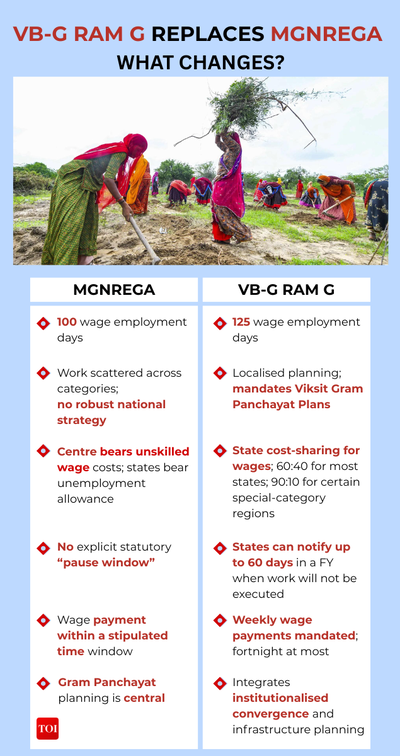
Key Features:
-
- Enhanced Employment Guarantee: Increased from 100 to 125 days of guaranteed wage employment per eligible rural household annually.
- Revised Wage Structure: Minimum notified wage fixed at ₹300 per day, with the national average increasing to ₹327.4 per day.
- Digital Governance: Biometric authentication, geo-tagging, GIS-based planning, National Mobile Monitoring System (NMMS), real-time dashboards, and Direct Benefit Transfer (DBT) for transparency.
- Decentralised Planning: Gram Panchayats prepare Viksit Gram Panchayat Plans (VGPPs) through Gram Sabha participation.
- Timely Wage Payments: Wages to be paid within 15 days, with 0.05% daily compensation for delays.
- Worker Welfare: Mandatory provision of drinking water, shade, first aid, and childcare facilities at worksites.
- Transparency Measures: Mandatory social audits and mobile-based monitoring.
- Seasonal Flexibility: States may suspend works for up to 60 days during peak agricultural seasons.
- Enhanced Employment Guarantee: Increased from 100 to 125 days of guaranteed wage employment per eligible rural household annually.
Revised Wage Rates Across States:
-
-
- The Government has revised wage rates, ensuring that no notified daily wage is below ₹300, with the national average wage increasing from ₹298.8 to ₹327.4 per day, representing an increase of over 10%.
- The revised wage structure significantly benefits States that earlier paid below ₹300 under MGNREGA. Twenty-one States and Union Territories have had their wages increased to at least ₹300 per day. Major increases include Uttar Pradesh (+₹48), Bihar (+₹45), Madhya Pradesh (+₹39), and Rajasthan (+₹19). Other States recording wage hikes exceeding 15% include Arunachal Pradesh, Nagaland, Himachal Pradesh, Uttarakhand, Jharkhand, Assam, Tripura, Sikkim, and West Bengal.
- States already paying above ₹300 witnessed relatively smaller increases. Haryana continues to have the highest wage rate at ₹409, followed by Goa (₹406) and Kerala (₹401).
- The Government has revised wage rates, ensuring that no notified daily wage is below ₹300, with the national average wage increasing from ₹298.8 to ₹327.4 per day, representing an increase of over 10%.
-
Benefits of the act:
The Act strengthens livelihood security through higher employment and wages, while promoting the creation of durable infrastructure such as irrigation systems, rural roads, and water conservation structures. It supports climate resilience, improves transparency through digital governance, empowers women by providing childcare and better workplace facilities, and strengthens local governance through Gram Panchayat-led planning.
Conclusion:
The VB-G RAM G Act, 2025 marks a paradigm shift in rural employment policy by combining enhanced employment guarantees with higher wages, digital transparency, and sustainable rural development. Its effective implementation through adequate funding, strong Centre–State coordination, and empowered Panchayati Raj Institutions will be crucial in transforming rural livelihoods and achieving inclusive growth.



