
Context:
The Government of India is planning to launch Vehicle-to-Vehicle (V2V) safety technology to reduce road accident fatalities and improve traffic management. In a recent meeting of the Parliamentary Consultative Committee, Union Minister of Road Transport and Highways, Nitin Gadkari, stated that the Department of Telecommunications (DoT) has allocated the 30 GHz radio frequency specifically for the development of this system.
Significance:
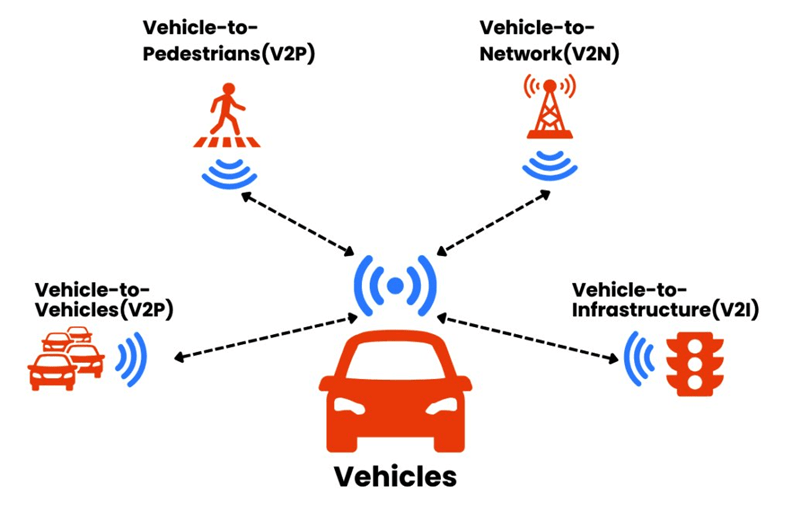
V2V is a wireless communication technology under the Intelligent Transport System (ITS) framework. It enables vehicles to "talk" to each other by sharing real-time information such as speed, location, acceleration, and braking.
Key Benefits:
-
-
-
- Collision Prevention: It alerts drivers to "black spots," obstacles, parked vehicles, heavy fog, or sudden braking by nearby vehicles.
- Fatality Reduction: The technology is expected to significantly reduce road accident deaths in India, a country that currently leads the world in traffic-related fatalities.
- Collision Prevention: It alerts drivers to "black spots," obstacles, parked vehicles, heavy fog, or sudden braking by nearby vehicles.
-
-
Background:
The need for such an intervention is highlighted by stark statistics:
-
-
-
- Global Share: India recorded 1,68,491 road accident deaths in 2022, accounting for 11% of global fatalities despite having only 1% of the world’s vehicles.
- Human Error: Driver error is a primary factor, responsible for approximately 78% of accidents, necessitating technological support to minimize risks.
- Global Share: India recorded 1,68,491 road accident deaths in 2022, accounting for 11% of global fatalities despite having only 1% of the world’s vehicles.
-
-
Implementation:
-
-
-
- On-Board Units (OBUs): These units will be installed in vehicles to facilitate seamless V2V communication.
- Phased Rollout: Initially, the technology will be deployed in new vehicles, with long-term plans to retrofit older models.
- Global Precedent: Similar systems are already successfully implemented in the US, Germany, Japan, and China.
- On-Board Units (OBUs): These units will be installed in vehicles to facilitate seamless V2V communication.
-
-
Challenges in Implementation:
Despite its promise, V2V faces several hurdles:
-
-
-
- Data Privacy and Security: The collection of extensive vehicle and driver data raises risks regarding misuse and cyberattacks.
- Technology Penetration: Achieving uniform adoption is difficult due to India's vehicle diversity, the cost of equipment, and frequency limitations.
- Regulatory Framework: Robust guidelines are required to ensure system reliability and prevent accidents caused by miscommunication or technical glitches.
- Data Privacy and Security: The collection of extensive vehicle and driver data raises risks regarding misuse and cyberattacks.
-
-
Complementary Measures: The 4Es Approach:
V2V technology is not a standalone solution; it must be integrated with India’s existing 4Es approach to road safety:
|
Pillar |
Key Initiatives |
|
Education |
Awareness campaigns, National Road Safety Month, and specialized driving institutes. |
|
Engineering |
Road safety audits, black spot rectification, and mandatory features like Airbags, ABS, and speed limiters. |
|
Enforcement |
Implementation of the Motor Vehicles (Amendment) Act, 2019 and e-challan monitoring. |
|
Emergency Care |
Good Samaritan protection, enhanced accident compensation, and highway ambulance facilities. |
Additional initiatives such as the Vehicle Scrapping Policy, Bharat New Car Assessment Program (BNCAP), and automated fitness certification further strengthen this infrastructure.
Way Forward:
While V2V technology represents a revolutionary step in reducing road fatalities, its effectiveness depends on a robust regulatory framework, widespread technological adoption, and public awareness. Coupled with infrastructure improvements and the 4Es approach, V2V can transform Indian roads from high-risk zones into safer corridors, marking a critical move toward smart mobility.



