
Context:
Recently, Air Chief Marshal Ashutosh Dixit, after taking charge as the 29th Chief of Air Staff (CAS), outlined the ‘VAYU’ vision to strengthen and modernise the Indian Air Force (IAF). The framework focuses on restoring combat strength, promoting self-reliance, adopting emerging technologies and enhancing jointness among the three armed forces.
Background:
-
-
- India faces a complex security environment due to regional geopolitical tensions, the two-front security challenge and emerging warfare technologies. The Indian Air Force (IAF) faces a shortage of fighter squadrons against the sanctioned strength of 42.
- The growing use of drones, artificial intelligence, cyber warfare and precision-guided weapons is transforming modern warfare. Further, dependence on foreign suppliers for aircraft engines and advanced technologies affects strategic autonomy. The retirement of MiG-21 squadrons and the planned phasing out of more aircraft by 2029–30 have increased capability gaps, while delays in the induction of LCA Tejas have added to the challenge.
- India faces a complex security environment due to regional geopolitical tensions, the two-front security challenge and emerging warfare technologies. The Indian Air Force (IAF) faces a shortage of fighter squadrons against the sanctioned strength of 42.
-
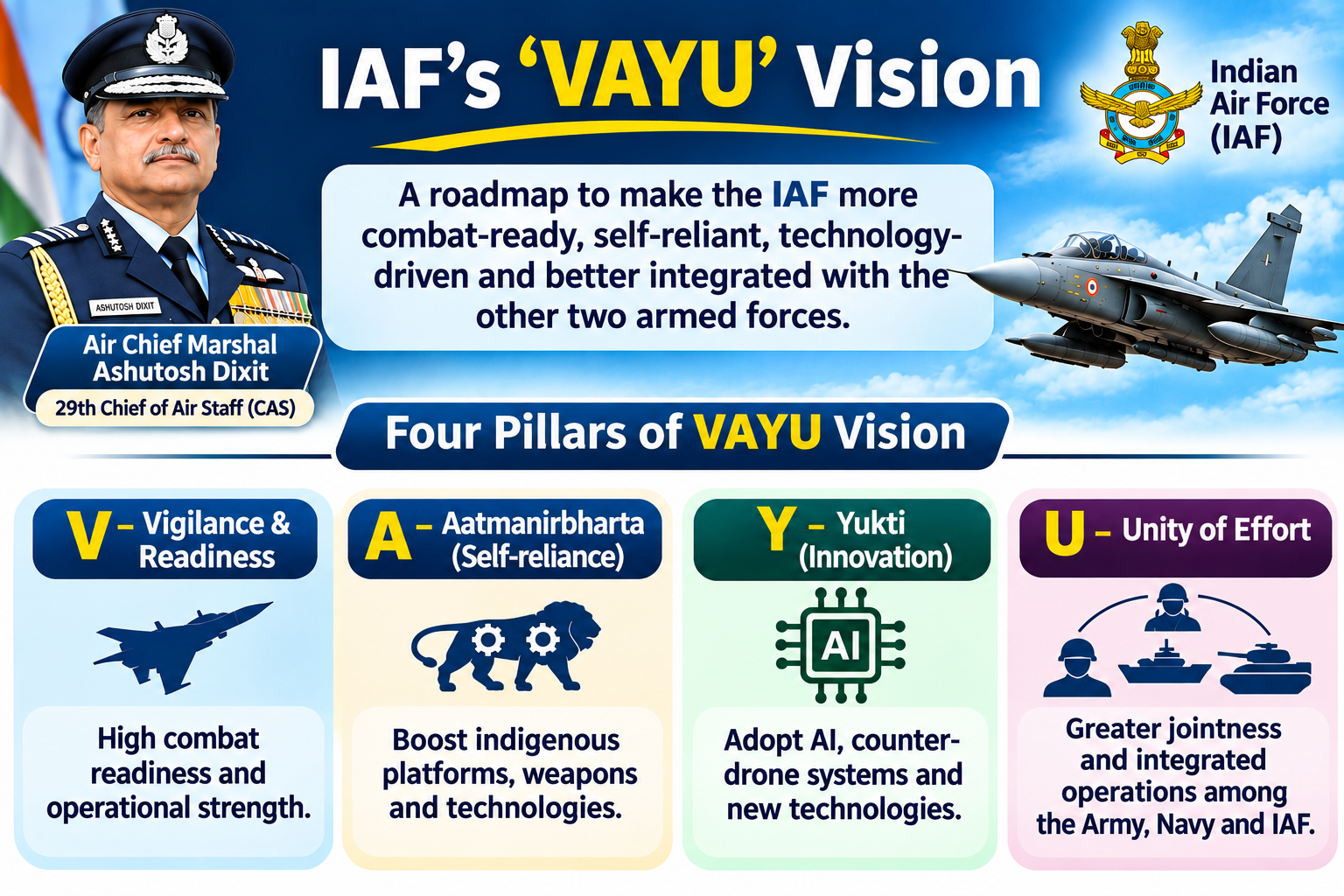
Four Pillars of VAYU Vision:
-
-
- V – Vigilance and Readiness
- Ensuring every squadron, radar, air defence unit and air warrior remains ready for immediate response.
- Restoring the IAF's combat strength towards the sanctioned level.
- Ensuring every squadron, radar, air defence unit and air warrior remains ready for immediate response.
- A – Aatmanirbharta (Self-reliance)
- Promoting indigenous platforms such as Tejas Mk1/Mk1A and Advanced Medium Combat Aircraft (AMCA).
- Strengthening indigenous weapons, sensors and defence technologies.
- Reducing dependence on foreign suppliers.
- Promoting indigenous platforms such as Tejas Mk1/Mk1A and Advanced Medium Combat Aircraft (AMCA).
- Y – Yukti (Ingenuity and Innovation)
- Developing networked, AI-enabled command and control systems.
- Strengthening layered counter-drone defence.
- Promoting innovation in military doctrine, maintenance, force protection and resilience.
- Exploring near-space as an operational domain.
- Developing networked, AI-enabled command and control systems.
- U – Unity of Effort
- Enhancing coordination among the Army, Navy and Air Force.
- Adopting integrated military planning and operations.
- Aligning with the JAI vision: Jointness, Aatmanirbharta and Innovation.
- Enhancing coordination among the Army, Navy and Air Force.
- V – Vigilance and Readiness
-
Significance for National Security:
-
-
- Strategic Deterrence: Credible air power helps deter conflicts and respond to external threats.
- Technological Superiority: Prepares India for future multi-domain warfare.
- Strategic Autonomy: Strengthens indigenous defence manufacturing.
- Jointness: Improves coordination and operational effectiveness among armed forces.
- Economic Growth: Promotes defence start-ups, MSMEs and domestic industries.
- Strategic Deterrence: Credible air power helps deter conflicts and respond to external threats.
-
Challenges:
-
-
- Shortage of fighter squadrons and delays in aircraft procurement.
- Dependence on foreign technology, particularly advanced engines.
- High financial requirements for modernisation.
- Limited indigenous capabilities in stealth technology and advanced avionics.
- Increasing threats from drones, electronic warfare and precision weapons.
- Shortage of fighter squadrons and delays in aircraft procurement.
-
Way Forward:
-
-
- Accelerate indigenous projects such as Tejas Mk1A, Tejas Mk2 and AMCA.
- Strengthen collaboration between DRDO, HAL, private industries and defence start-ups.
- Invest in AI, cyber security, space and counter-drone technologies.
- Improve aircraft maintenance, spare-parts availability and operational readiness.
- Promote jointness through integrated military planning and interoperability.
- Accelerate indigenous projects such as Tejas Mk1A, Tejas Mk2 and AMCA.
-
Conclusion:
The VAYU vision reflects India's ambition to develop a technologically advanced, operationally ready and self-reliant Air Force. Its successful implementation will strengthen national security, strategic autonomy and India's position as an emerging defence manufacturing hub.