
Context
A team of researchers at Nanjing University, China, has developed a novel sensor that uses sound waves instead of chemical interactions to detect helium. The findings were published in Applied Physics Letters (December 2025) under the title “A sensor for helium leakage detection and orientation based on a two‑dimensional acoustic topological material”.
About Helium:
-
-
- Helium is a colourless, odourless, inert gas widely used in industries — from cooling magnetic resonance imaging (MRI) machines to aerospace engineering and semiconductor manufacturing. Despite its ubiquity in high‑technology applications, helium is a scarce and expensive resource globally.
- Detecting and locating even small leaks is critical to avoid wastage, ensure safety, and maintain industrial efficiency. Traditional gas sensors, which rely on chemical reactions, struggle to detect helium because of its chemical stability and inability to interact with typical sensor materials.
- Helium is a colourless, odourless, inert gas widely used in industries — from cooling magnetic resonance imaging (MRI) machines to aerospace engineering and semiconductor manufacturing. Despite its ubiquity in high‑technology applications, helium is a scarce and expensive resource globally.
-
How the Sensor Works:
-
-
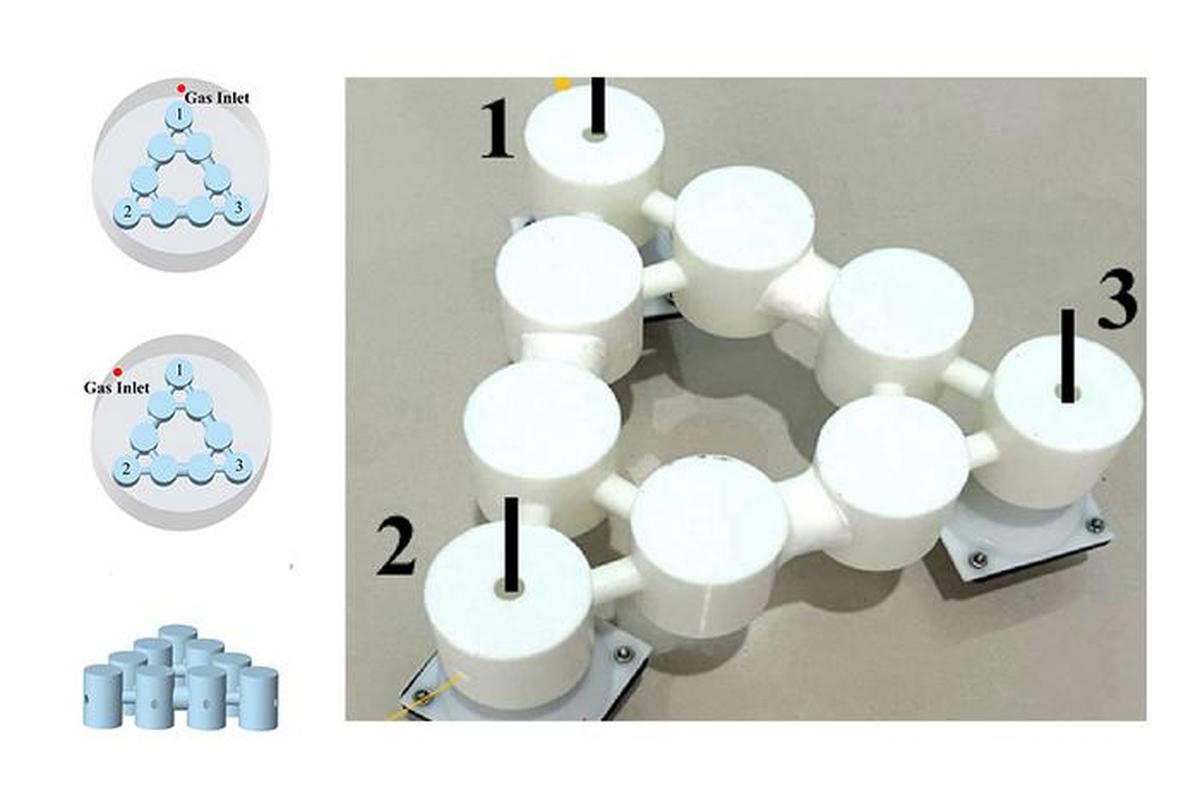
- The sensor uses acoustic topological materials in a Kagome lattice (interlaced triangles and hexagons) to trap sound. Nine cylinders connected by tubes let air and helium in. Speakers introduce sound, and microphones measure signals at three corners.
- Detection: Helium changes the speed and frequency of trapped sound waves, which is measured to determine its concentration.
- The sensor uses acoustic topological materials in a Kagome lattice (interlaced triangles and hexagons) to trap sound. Nine cylinders connected by tubes let air and helium in. Speakers introduce sound, and microphones measure signals at three corners.
-
Advantages over Conventional Sensors:
Robustness and Stability
-
-
- The sensor does not rely on chemical reactions, making it ideal for detecting inert gases like helium.
- It remains unaffected by external conditions (temperature, humidity) that typically destabilise chemical sensors.
- The topological design ensures that the sound‑trapping mechanism is resilient even with structural imperfections and gas input openings are large for rapid measurements.
- The sensor does not rely on chemical reactions, making it ideal for detecting inert gases like helium.
-
Directional Detection
A unique feature of the triangular configuration is its ability to triangulate the source of a leak:
-
-
- By comparing how quickly frequency shifts occur at each corner, the device can locate the direction of the helium influx.
- This adds a spatial detection capability, unlike most point sensors.
- By comparing how quickly frequency shifts occur at each corner, the device can locate the direction of the helium influx.
-
Applications:
-
-
- Helium leak detection is essential in high‑value sectors such as aerospace, healthcare (MRI systems), and semiconductor fabrication.
- The new device promises a much cheaper and faster alternative to mass‑spectrometry‑based detectors, which are expensive and bulky.
- Helium leak detection is essential in high‑value sectors such as aerospace, healthcare (MRI systems), and semiconductor fabrication.
-
Conclusion:
This innovation shifts gas sensing from chemical to acoustic‑topological methods, enabling sensitive, stable, and directional detection of helium, with potential to improve resource conservation and industrial safety.



