
Why in News?
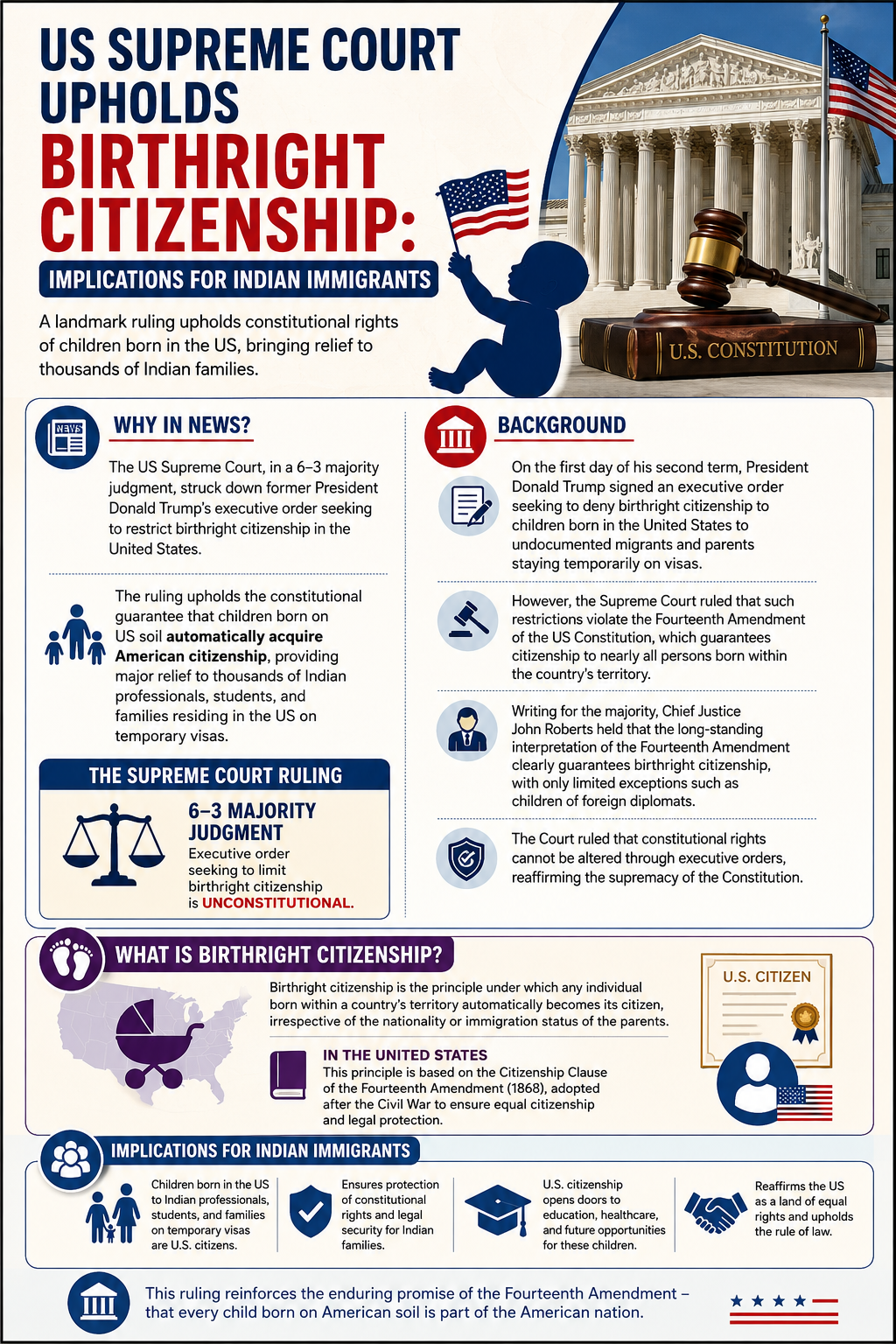
The US Supreme Court, in a 6–3 majority judgment, struck down former President Donald Trump's executive order seeking to restrict birthright citizenship in the United States. The ruling upholds the constitutional guarantee that children born on US soil automatically acquire American citizenship, providing major relief to thousands of Indian professionals, students, and families residing in the US on temporary visas.
Background:
-
-
- On the first day of his second term, President Donald Trump signed an executive order seeking to deny birthright citizenship to children born in the United States to undocumented migrants and parents staying temporarily on visas. However, the Supreme Court ruled that such restrictions violate the Fourteenth Amendment of the US Constitution, which guarantees citizenship to nearly all persons born within the country's territory.
- Writing for the majority, Chief Justice John Roberts held that the long-standing interpretation of the Fourteenth Amendment clearly guarantees birthright citizenship, with only limited exceptions such as children of foreign diplomats. The Court ruled that constitutional rights cannot be altered through executive orders, reaffirming the supremacy of the Constitution.
- On the first day of his second term, President Donald Trump signed an executive order seeking to deny birthright citizenship to children born in the United States to undocumented migrants and parents staying temporarily on visas. However, the Supreme Court ruled that such restrictions violate the Fourteenth Amendment of the US Constitution, which guarantees citizenship to nearly all persons born within the country's territory.
-
What is Birthright Citizenship?
Birthright citizenship is the principle under which any individual born within a country's territory automatically becomes its citizen, irrespective of the nationality or immigration status of the parents. In the United States, this principle is based on the Citizenship Clause of the Fourteenth Amendment (1868), adopted after the Civil War to ensure equal citizenship and legal protection.
Why is the Ruling Significant for Indians?
-
-
- The judgment is particularly important for the Indian diaspora, one of the fastest-growing immigrant communities in the United States.
- Nearly 3.2 million documented Indian immigrants live in the US.
- More than 400,000 Indian professionals work on H-1B visas, while many others are employed through L-1 visas or pursue higher education on F-1 student visas.
- Over 1.2 million Indians remain in the employment-based Green Card backlog, often waiting decades for permanent residency.
- The ruling guarantees that children born in the US to Indian visa holders, students, visitors, and even undocumented migrants will continue to receive automatic US citizenship.
- Nearly 3.2 million documented Indian immigrants live in the US.
- This provides long-term legal certainty to families facing prolonged immigration delays.
- The judgment is particularly important for the Indian diaspora, one of the fastest-growing immigrant communities in the United States.
-
Implications:
The ruling strengthens constitutional protections, upholds judicial review, and limits executive overreach in matters of citizenship. It provides stability for immigrant families, particularly Indians affected by lengthy visa and Green Card waiting periods. The judgment also reinforces the United States' long-standing commitment to equal citizenship and legal certainty.
Conclusion:
The Supreme Court's decision is a landmark affirmation of constitutionalism, equality, and the rule of law. For the Indian diaspora, it offers reassurance that the citizenship rights of US-born children remain protected despite uncertainties surrounding immigration policies.



