
Context:
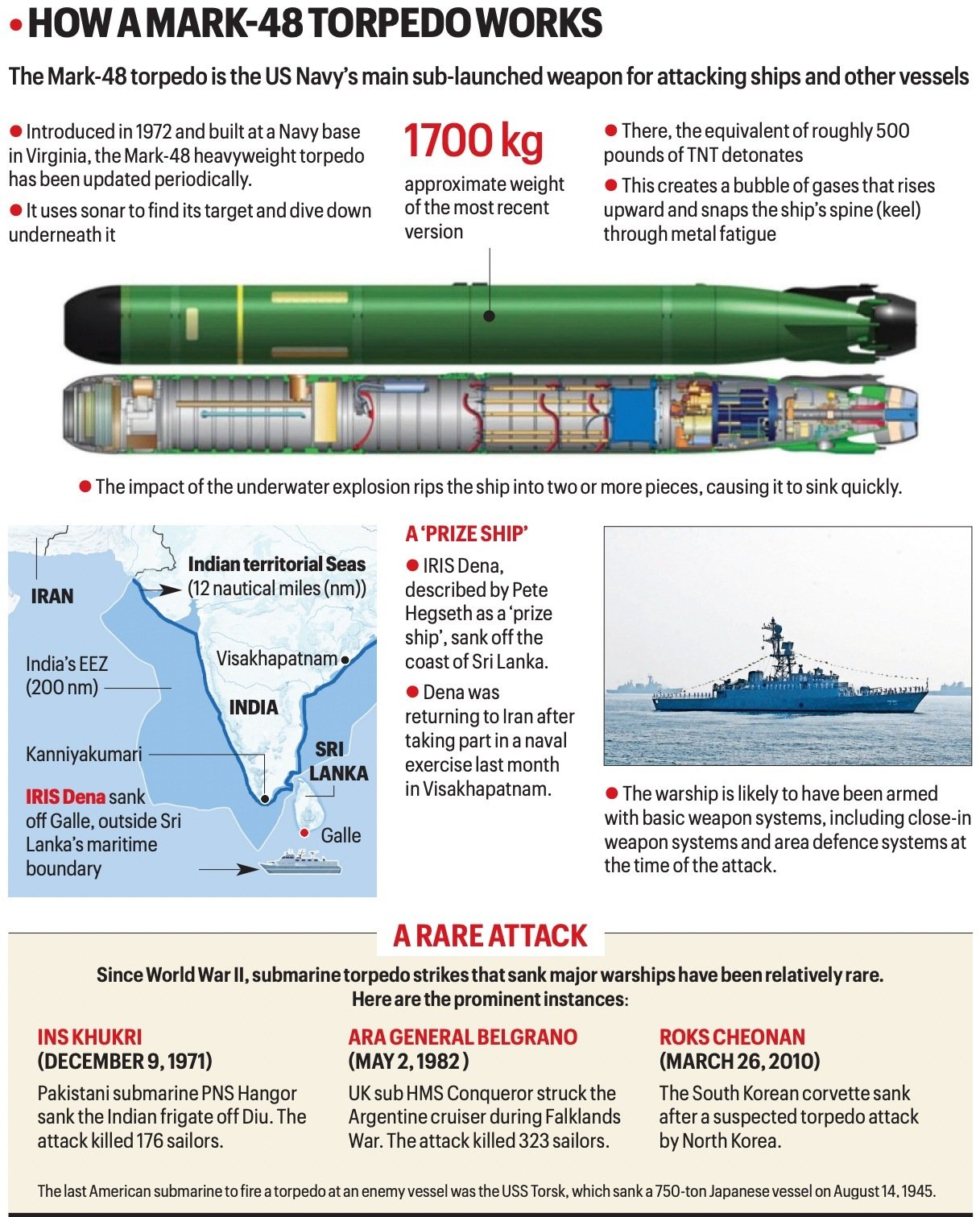
Recently, an Iranian Navy frigate IRIS Dena was torpedoed and sunk by a United States Navy submarine in the Indian Ocean near the southern coast of Sri Lanka, outside Sri Lanka’s territorial waters. The warship had just participated in MILAN-2026, a multilateral naval exercise hosted by India, and was returning to Iran when the attack occurred.
Strategic Background:
The strike occurred amid a wider US-Israel conflict with Iran in 2026, which expanded beyond the Middle East into maritime domains. U.S. officials justified the action as part of broader military operations against Iran, while Iran termed the attack illegal and provocative.
Implications for the Indian Ocean Region:
-
-
- The Indian Ocean Region (IOR) is strategically vital because:
- It hosts major global shipping lanes.
- Nearly 80% of global maritime oil trade passes through this region.
- It hosts major global shipping lanes.
- The incident shows how extra-regional conflicts can spill into the IOR, affecting regional security dynamics.
- The Indian Ocean Region (IOR) is strategically vital because:
-
Key International Maritime Conventions:
-
-
-
United Nations Convention on the Law of the Sea (UNCLOS)
- Adopted in 1982 and in force since 1994, UNCLOS defines the rights and responsibilities of states in the oceans.
- Maritime Zones under UNCLOS:
- Territorial Sea: Extends up to 12 nautical miles; the coastal state has full sovereignty.
- Exclusive Economic Zone (EEZ): Extends up to 200 nautical miles; the state has rights over living and non-living resources.
- Territorial Sea: Extends up to 12 nautical miles; the coastal state has full sovereignty.
- Adopted in 1982 and in force since 1994, UNCLOS defines the rights and responsibilities of states in the oceans.
- High Seas: Areas beyond national jurisdiction, open to navigation, research, fishing, and cable laying.
- UNCLOS promotes freedom of navigation, conservation of marine biodiversity and dispute settlement. However, it mainly governs peacetime maritime conduct and does not explicitly regulate naval warfare.
- UNCLOS promotes freedom of navigation, conservation of marine biodiversity and dispute settlement. However, it mainly governs peacetime maritime conduct and does not explicitly regulate naval warfare.
-
Law of Naval Warfare:
- Applies during armed conflicts at sea.
- Operates alongside UNCLOS but governs military operations.
- Under this law, enemy warships may be legitimate targets, even outside territorial waters.
- Applies during armed conflicts at sea.
-
-
Diplomatic Dilemma for India:
-
-
- India faces a complex diplomatic situation because:
- The Iranian warship was an invited participant in an Indian naval exercise.
- India maintains strategic relations with both the United States and Iran.
- The Iranian warship was an invited participant in an Indian naval exercise.
- The incident occurred in India’s maritime neighbourhood, raising questions about India’s role as a net security provider in the IOR.
- India faces a complex diplomatic situation because:
-
Broader Strategic Implications:
-
-
- Militarisation of the Indian Ocean: Growing naval presence by the United States, China, and regional powers indicates that the Indian Ocean is becoming a key theatre of geopolitical competition.
- Security of Multilateral Naval Exercises: The incident raises concerns about:
- Safety of participating warships
- Security assurances during multinational naval exercises
- Safety of participating warships
- Risk to Global Maritime Trade: The Indian Ocean is critical for energy supplies and international trade routes. Any escalation could threaten Sea Lines of Communication (SLOCs).
- Militarisation of the Indian Ocean: Growing naval presence by the United States, China, and regional powers indicates that the Indian Ocean is becoming a key theatre of geopolitical competition.
-
Conclusion:
The torpedoing of IRIS Dena near Sri Lanka marks a significant maritime security event in the Indian Ocean. It highlights the spillover of geopolitical conflicts into new maritime theatres and creates diplomatic challenges for regional powers like India. Strengthening multilateral maritime cooperation and adherence to international law will be crucial to maintain stability in the region.



