
Context:
Recently, the United States, Denmark and Greenland signed a new defence agreement during the UN General Assembly in New York. The agreement expands the US military presence in Greenland while reaffirming Denmark's sovereignty and Greenland's right to self-determination. It updates the existing 1951 US-Denmark defence agreement.
Key Provisions of deal:
-
-
- Two New Defence Areas: The agreement permits the US to establish two defence areas at:
- Narsarsuaq — southern Greenland, a former World War II base and airport.
- Mestersvig — eastern Greenland, a remote location currently associated with Danish military operations.
- The precise modalities and technical arrangements require agreement among the parties.
- Narsarsuaq — southern Greenland, a former World War II base and airport.
- Expansion of Pituffik Space Base: The US already operates the Pituffik Space Base in north-western Greenland. The new agreement allows Washington to modernise and expand its activities there.
- No Transfer of Sovereignty: Importantly, the agreement does not transfer Greenlandic territory to the United States. It reaffirms Denmark's sovereignty and territorial integrity while recognising Greenland's right to self-determination. The pact therefore represents a defence expansion rather than territorial acquisition.
- Restriction on Non-NATO Military Presence: The agreement bars states outside NATO from establishing manned or unmanned military installations or maintaining a persistent military presence in Greenland, strengthening the island's integration into the broader NATO security framework.
- Two New Defence Areas: The agreement permits the US to establish two defence areas at:
-
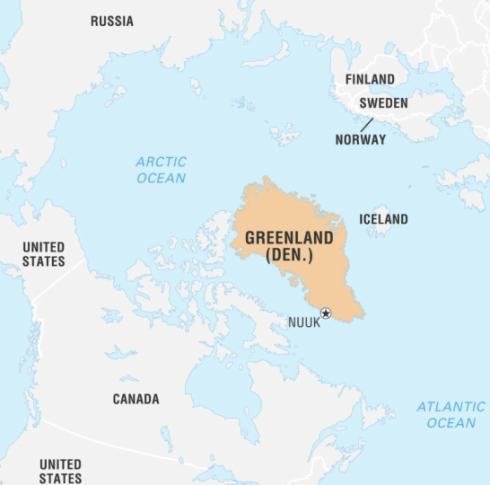
Greenland: Geography and Key Facts
-
-
- Greenland is the world’s largest non-continental island, situated between the Arctic and Atlantic Oceans. It covers about 2.16 million sq km, with roughly 80% covered by the Greenland Ice Sheet, the world’s second-largest ice sheet after Antarctica.
- Its ice-free coastal belt contains rugged mountains, deep fjords and rocky terrain. Gunnbjørn Fjeld (3,694 m) is its highest point. Greenland has a polar/subarctic climate, including midnight sun and polar night.
- Capital: Nuuk
- Population: About 56,000–57,000
- Political status: Self-governing territory within the Kingdom of Denmark; Denmark retains key responsibilities including defence and foreign affairs.
- Capital: Nuuk
- Greenland is the world’s largest non-continental island, situated between the Arctic and Atlantic Oceans. It covers about 2.16 million sq km, with roughly 80% covered by the Greenland Ice Sheet, the world’s second-largest ice sheet after Antarctica.
-
Why is Greenland Strategically Important?
-
-
- Geostrategic Location: Greenland lies between North America and Europe, making it important for Arctic surveillance, missile warning, air defence and control of North Atlantic approaches.
- Arctic Competition: Melting sea ice is increasing the accessibility of Arctic routes and resources, intensifying strategic competition involving the U.S., Russia, China and NATO.
- Natural Resources: Greenland possesses significant potential for rare earth elements and other minerals, increasing its economic and geopolitical importance.
- Climate Change: Rapid Arctic warming is transforming shipping, resource access and security calculations while creating major environmental concerns.
- Geostrategic Location: Greenland lies between North America and Europe, making it important for Arctic surveillance, missile warning, air defence and control of North Atlantic approaches.
-
Implications for India:
The development is relevant to India’s Arctic Policy, which focuses on climate change, scientific research, sustainable resource utilisation and greater participation in Arctic governance. Growing militarisation may complicate the balance between Arctic security and peaceful scientific cooperation.
Conclusion:
The U.S.–Denmark–Greenland agreement reflects the growing importance of the Arctic as a zone of security, resources, climate change and great-power competition. Greenland’s geography makes it central to the evolving strategic architecture of the High North.



