
Context:
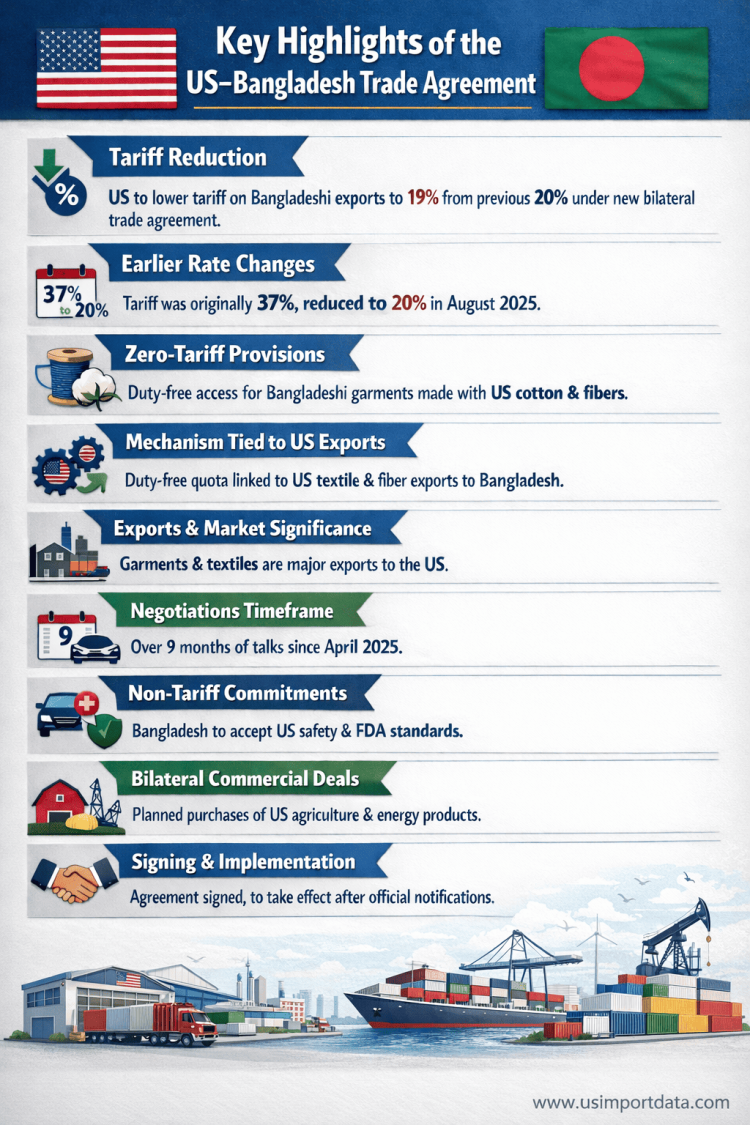
The recently signed US–Bangladesh Agreement on Reciprocal Trade has triggered concerns among Indian textile and apparel exporters. The agreement provides a mechanism for zero reciprocal tariff access for specified volumes of Bangladeshi textile and apparel exports to the US, subject to the use of US-origin textile inputs such as cotton and man-made fibres (MMF). This development comes at a time when Indian exporters were expecting improved competitiveness in the U.S. market following an interim India–U.S. trade understanding.
Why the Concern for India?
-
-
- Yarn Dependence: India exported $1.47 billion worth of cotton yarn (570 million kg) to Bangladesh in FY 2024–25, making it India’s largest yarn export destination.
- U.S. Market Exposure: Nearly 20% of Bangladesh’s garment exports and 26% of India’s cotton apparel exports go to the U.S.
- If Bangladesh increases procurement of U.S. cotton to avail zero-tariff access, demand for Indian yarn and cotton could decline. Indian industry leaders have raised concerns about traceability mechanisms, fearing potential misuse of origin claims.
- Yarn Dependence: India exported $1.47 billion worth of cotton yarn (570 million kg) to Bangladesh in FY 2024–25, making it India’s largest yarn export destination.
-
Impact on Competitiveness:
-
-
- Bangladesh is a dominant global apparel exporter, especially in cotton-based garments such as T-shirts and women’s wear. Preferential tariff access could:
- Reduce India’s price competitiveness in 100% cotton garments.
- Shift supply chains toward U.S. cotton.
- Increase Bangladesh’s apparel exports to the U.S. at India’s expense.
- Reduce India’s price competitiveness in 100% cotton garments.
- Bangladesh is a dominant global apparel exporter, especially in cotton-based garments such as T-shirts and women’s wear. Preferential tariff access could:
-
About Indian Apparel Sector:
-
-
- Global Rank: 6th largest exporter of textiles and apparel.
- Exports: $35.9 billion in FY 2023–24 (Apparel = 42%).
- Major Markets: USA (25%), EU, UAE, UK, Germany.
- Employment: 4.5 crore direct and 10 crore indirect — the second-largest employer after agriculture.
- Global Rank: 6th largest exporter of textiles and apparel.
-
Structural Challenges:
-
-
- Fragmentation: Over 80% of MSMEs lack scale compared to Bangladesh’s mega-factories.
- Synthetic Gap: Global demand is shifting toward MMF, while India remains cotton-heavy.
- High Cost of Capital: ~9% in India versus ~4.5% in Vietnam.
- Tariff Disadvantages: Bangladesh enjoys duty-free access in key markets.
- Fragmentation: Over 80% of MSMEs lack scale compared to Bangladesh’s mega-factories.
-
Government Initiatives:
-
-
- PM MITRA Parks: Integrated textile infrastructure.
- PLI Scheme (Textiles): Boosts MMF and technical textiles.
- AEPC: Export facilitation.
- Samarth Scheme: Skill development.
- PM MITRA Parks: Integrated textile infrastructure.
-
Way Forward:
India should negotiate reciprocal tariff provisions with the United States similar to those secured by Bangladesh to maintain competitive parity in the U.S. market. Simultaneously, there is a need to accelerate diversification into man-made fibres (MMF) and value-added garments in order to align with shifting global demand patterns. Strengthening traceability mechanisms and promoting the branding of Indian cotton can enhance credibility and market positioning. Additionally, improving scale through cluster integration and reducing the cost of capital will be crucial to enhancing efficiency and long-term competitiveness in the global apparel value chain.
Conclusion:
The U.S.–Bangladesh trade agreement highlights the fragility of India’s export competitiveness in a highly tariff-sensitive sector. While immediate disruption may be limited, sustained strategic reforms in trade diplomacy, product diversification, and supply chain efficiency are essential to safeguard India’s position in global apparel markets.



