
Context:
Recently, the National Payments Corporation of India (NPCI) announced a new Merchant Discount Rate (MDR) framework for UPI transactions, effective from 15 October 2026. Under the new framework, person-to-person (P2P) UPI transactions are completely MDR-free. Transactions up to ₹2,000 will be free of charges while transactions above ₹2,000 will generally attract 0.4% MDR from Mercent.
What is MDR?
-
-
- Merchant Discount Rate (MDR) is the fee charged for processing a digital payment. It is generally paid by the merchant and shared among participants such as banks, payment processors and payment-app providers.
- UPI and RuPay debit-card transactions had traditionally operated with zero MDR to promote digital-payment adoption.
- Merchant Discount Rate (MDR) is the fee charged for processing a digital payment. It is generally paid by the merchant and shared among participants such as banks, payment processors and payment-app providers.
-
Key Features of the New Framework:
-
-
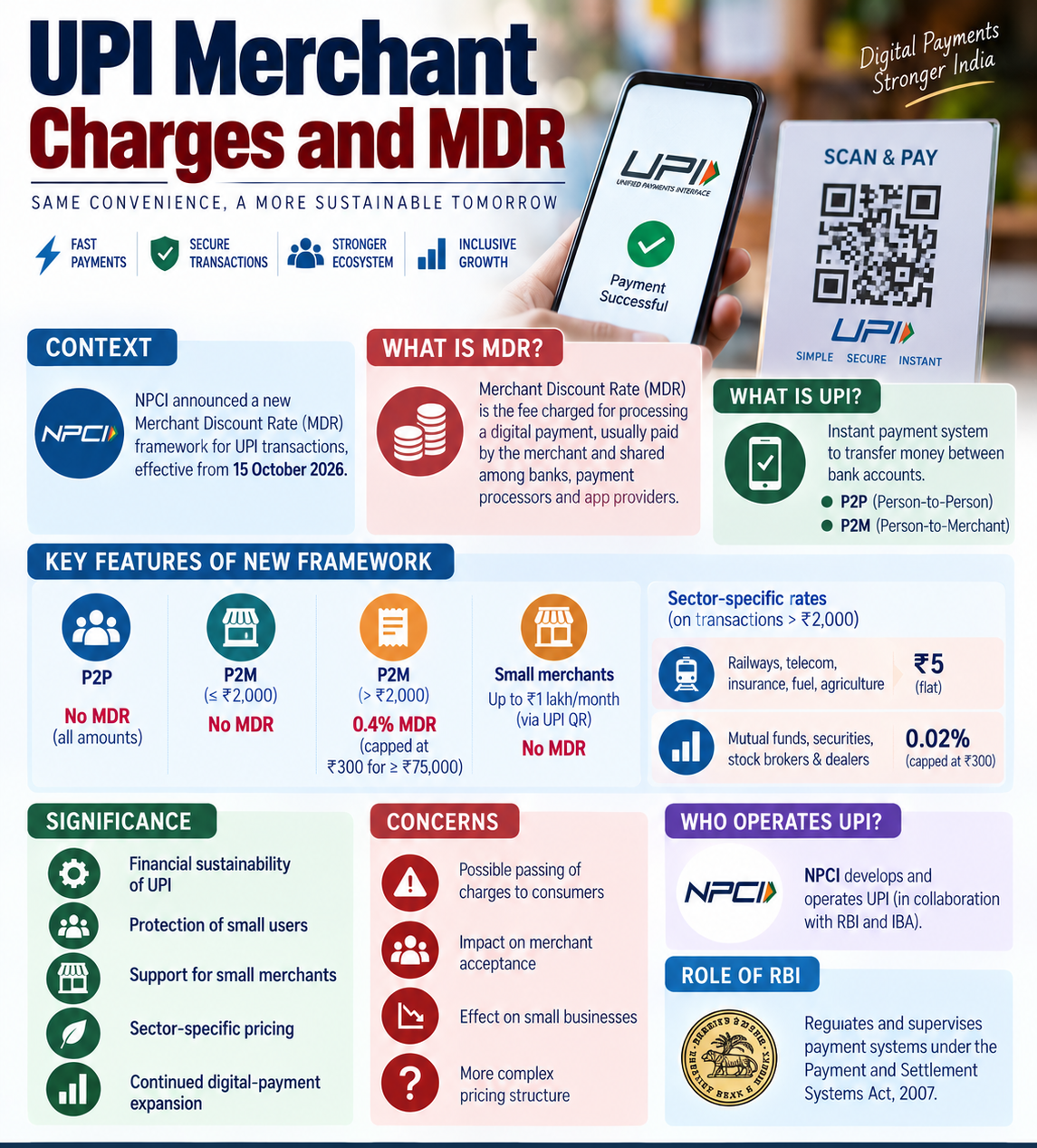
- The new framework keeps Person-to-Person (P2P) UPI transactions completely exempt from MDR, irrespective of transaction value. Person-to-Merchant (P2M) transactions up to ₹2,000 will also remain free, while transactions above ₹2,000 will generally attract 0.4% MDR. For transactions of ₹75,000 or more, the MDR will be capped at ₹300 per transaction. Small P2PM merchants receiving up to ₹1 lakh per month through UPI QR will remain exempt from MDR on their UPI transactions.
- The framework also provides sector-specific rates. Railways, telecom, insurance, fuel and agriculture-input sectors will pay a flat ₹5 MDR on transactions above ₹2,000, while mutual funds, securities, stock brokers and dealers will attract 0.02% MDR, capped at ₹300. The government has also advised banks to ensure that merchants do not pass the MDR cost on to customers, thereby protecting consumers from additional charges on UPI payments.
- The new framework keeps Person-to-Person (P2P) UPI transactions completely exempt from MDR, irrespective of transaction value. Person-to-Merchant (P2M) transactions up to ₹2,000 will also remain free, while transactions above ₹2,000 will generally attract 0.4% MDR. For transactions of ₹75,000 or more, the MDR will be capped at ₹300 per transaction. Small P2PM merchants receiving up to ₹1 lakh per month through UPI QR will remain exempt from MDR on their UPI transactions.
-
Significance:
-
-
- Financial Sustainability of UPI: The zero-MDR model created concerns about the ability of banks and payment-service providers to recover the rising cost of maintaining digital-payment infrastructure. The new framework seeks to make the ecosystem more financially sustainable.
- Protection of Small Users: P2P payments and low-value merchant payments remain free. This protects everyday users and small businesses from additional transaction costs.
- Support for Small Merchants: The exemption for small P2PM merchants can encourage street vendors and informal businesses to adopt formal digital-payment systems.
- Sector-Specific Pricing: Different rates for essential sectors and financial-market transactions recognise their different cost structures and policy objectives.
- Continued Digital-Payment Expansion: The government has announced that 5% of MDR collections will be placed in a dedicated fund to promote UPI adoption among small merchants, particularly supporting wider acceptance.
- Financial Sustainability of UPI: The zero-MDR model created concerns about the ability of banks and payment-service providers to recover the rising cost of maintaining digital-payment infrastructure. The new framework seeks to make the ecosystem more financially sustainable.
-
Concerns:
-
-
- Merchants may attempt to indirectly recover MDR from consumers despite the advisory against passing on the cost.
- Additional charges could affect merchant acceptance of UPI in some sectors.
- The long-term impact on small businesses and digital-payment adoption needs monitoring.
- The new pricing structure increases the complexity of the previously simple zero-cost UPI model.
- Merchants may attempt to indirectly recover MDR from consumers despite the advisory against passing on the cost.
-
What is UPI?
Unified Payments Interface (UPI) is an instant payment system that enables users to transfer money between bank accounts through mobile applications using a UPI ID, mobile number, QR code or other identifiers.
It facilitates both:
-
-
- Person-to-Person (P2P) payments
- Person-to-Merchant (P2M) payments
- UPI has become a major component of India's Digital Public Infrastructure (DPI).
- Person-to-Person (P2P) payments
-
Who Operates UPI?
UPI was developed by the National Payments Corporation of India (NPCI) in collaboration with the Reserve Bank of India (RBI) and the Indian Banks' Association.
Role of NPCI:
NPCI operates the UPI platform and provides the technological infrastructure through which participating banks and payment applications process transactions.
It:
-
-
- Manages the UPI network
- Sets operational and technical standards
- Facilitates interoperability between banks and payment apps
- Ensures transaction routing and settlement mechanisms
- Manages the UPI network
-
Role of RBI:
-
-
- The RBI is India's central banking and payment-system regulator.
- Under the Payment and Settlement Systems Act, 2007, RBI regulates and supervises payment systems in India. It provides the broader regulatory framework for digital payments, while NPCI operates the UPI infrastructure under RBI oversight.
- Thus, NPCI operates UPI, while RBI regulates the payment ecosystem.
- The RBI is India's central banking and payment-system regulator.
-
Conclusion:
The new MDR framework represents an attempt to balance affordable digital payments with the financial sustainability of the UPI ecosystem. By keeping P2P payments, low-value transactions and small merchants largely outside the MDR framework, India seeks to preserve UPI's role as a mass digital-payment platform while creating a revenue mechanism for sustaining its expanding infrastructure.



