
Context:
Recently, the Union Ministry of Agriculture and Farmers’ Welfare has notified a nationwide ban on paraquat dichloride, a highly toxic herbicide linked to thousands of deaths due to suicide, accidental poisoning, and homicide in India.
What is Paraquat?
-
-
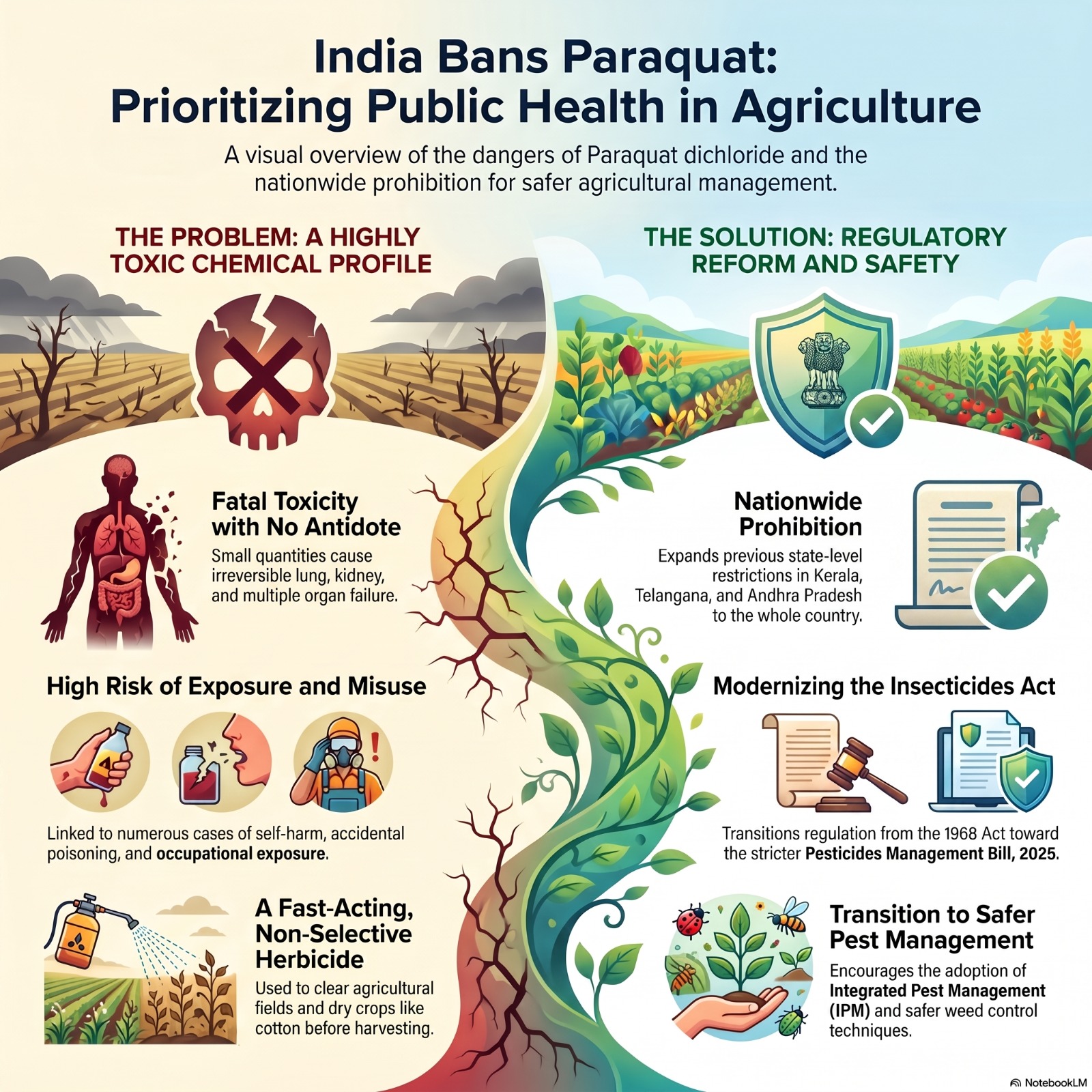
- Paraquat dichloride is a non-selective, fast-acting contact herbicide widely used to control weeds and grasses. It is commonly sprayed after harvesting to clear agricultural fields before sowing the next crop. It is also used for crop desiccation, particularly in crops such as cotton, to dry plants before harvesting.
- Paraquat destroys plant tissues by generating free radicals that damage cell membranes and interrupt photosynthesis. Although it becomes inactive after contact with soil and leaves minimal soil residues, it is extremely dangerous during handling and application.
- Paraquat dichloride is a non-selective, fast-acting contact herbicide widely used to control weeds and grasses. It is commonly sprayed after harvesting to clear agricultural fields before sowing the next crop. It is also used for crop desiccation, particularly in crops such as cotton, to dry plants before harvesting.
-
Why Has Paraquat Been Banned?
-
-
- Paraquat is one of the most toxic herbicides used in agriculture. Even a small quantity can cause irreversible lung damage, kidney failure, multiple organ failure, and death. Importantly, there is no known antidote for paraquat poisoning.
- Medical experts and public health advocates have long demanded a nationwide ban, citing its role in numerous cases of self-harm, accidental poisoning, and occupational exposure among farmers and agricultural workers.
- Paraquat is one of the most toxic herbicides used in agriculture. Even a small quantity can cause irreversible lung damage, kidney failure, multiple organ failure, and death. Importantly, there is no known antidote for paraquat poisoning.
-
Herbicide Regulation in India:
-
-
- Herbicides in India are regulated under the Insecticides Act, 1968, which governs the import, manufacture, sale, transport, distribution, and use of pesticides. All herbicides must be registered with the Central Insecticides Board and Registration Committee (CIB&RC) before being marketed.
- To modernize the regulatory framework, the Draft Pesticides Management Bill (PMB), 2025 has been proposed. It seeks to replace the 1968 Act by introducing stricter monitoring, digital traceability, mandatory reporting of pesticide poisoning cases, and compensation mechanisms for affected individuals.
- Herbicides in India are regulated under the Insecticides Act, 1968, which governs the import, manufacture, sale, transport, distribution, and use of pesticides. All herbicides must be registered with the Central Insecticides Board and Registration Committee (CIB&RC) before being marketed.
-
Centre–State Regulatory Powers:
Under the existing law, state governments can temporarily restrict or suspend the sale and use of hazardous herbicides within their territories for public health reasons, as seen in the earlier bans on paraquat by Kerala, Telangana, and Andhra Pradesh.
Significance of the Ban:
-
-
- The decision is expected to improve the safety of farmers, agricultural workers, and rural communities by reducing exposure to a highly hazardous chemical. It also reflects India's commitment to promoting safer agricultural practices and strengthening pesticide regulation.
- The ban is likely to reduce deaths due to intentional and accidental poisoning while encouraging the adoption of safer weed management practices and Integrated Pest Management (IPM) techniques.
- The decision is expected to improve the safety of farmers, agricultural workers, and rural communities by reducing exposure to a highly hazardous chemical. It also reflects India's commitment to promoting safer agricultural practices and strengthening pesticide regulation.
-
Conclusion:
The ban on paraquat is a significant step towards protecting farmers, public health, and the environment. Its success will depend on effective enforcement, farmer awareness, and the adoption of safer alternatives.



