
Context:
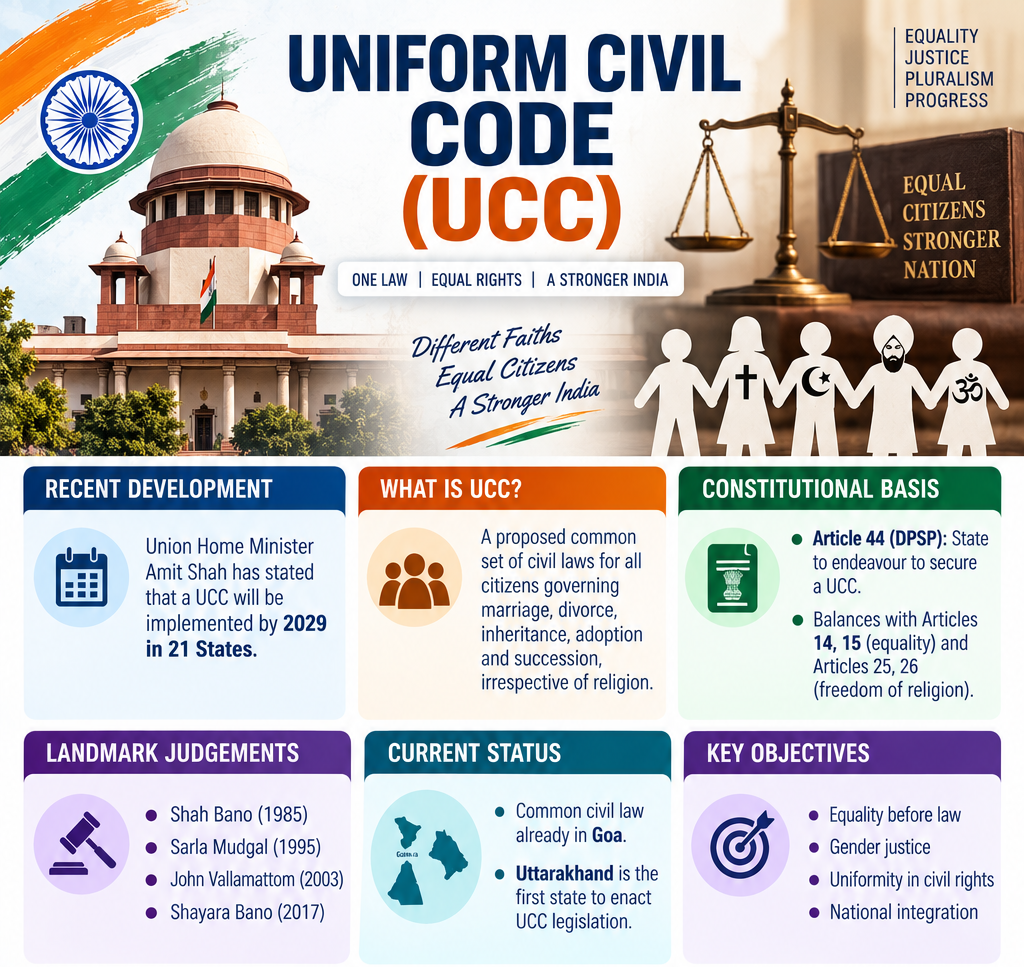
Recently, Union Home Minister Amit Shah has stated that a Uniform Civil Code (UCC) will be implemented by 2029 in 21 States.
What is Uniform Civil Code?
-
-
- The UCC refers to a proposed common set of civil laws governing personal matters such as marriage, divorce, inheritance, adoption and succession for all citizens, irrespective of religion.
- Currently, several of these matters are governed by religion-specific personal laws, such as Hindu personal laws and Muslim personal law under the Muslim Personal Law (Shariat) Application Act, 1937.
- The objective of the UCC is to establish equality before law, gender justice and uniformity in civil rights, while maintaining the constitutional principles of liberty and pluralism.
- The UCC refers to a proposed common set of civil laws governing personal matters such as marriage, divorce, inheritance, adoption and succession for all citizens, irrespective of religion.
-
Constitutional Framework:
-
-
- Article 44, under Part IV (DPSP), directs the State to “endeavour to secure” a Uniform Civil Code (UCC) for all citizens. Under Article 37, DPSPs are non-justiciable, meaning they cannot be directly enforced by courts, but they are fundamental to governance and guide the State in policymaking.
- UCC requires a balance between equality and religious freedom. Articles 14 & 15 promote equality and prohibit discrimination, while Articles 25 & 26 protect freedom of religion and management of religious affairs. Article 21 safeguards life and personal liberty. Thus, the key challenge is to ensure gender justice and equality without weakening India’s religious and cultural pluralism.
- Article 44, under Part IV (DPSP), directs the State to “endeavour to secure” a Uniform Civil Code (UCC) for all citizens. Under Article 37, DPSPs are non-justiciable, meaning they cannot be directly enforced by courts, but they are fundamental to governance and guide the State in policymaking.
-
Landmark Supreme Court Judgements:
-
-
- Shah Bano Case (1985): The Supreme Court upheld a Muslim woman's right to maintenance under Section 125 of the CrPC and highlighted the relevance of Article 44 to national integration.
- Sarla Mudgal Case (1995): The Court held that conversion to Islam merely to contract a second marriage does not automatically dissolve an existing Hindu marriage and reiterated the need to consider a UCC.
- John Vallamattom Case (2003): The Court struck down a discriminatory provision affecting Christian testators and emphasised reform of personal laws.
- Shayara Bano Case (2017): The Supreme Court declared instant triple talaq (talaq-e-biddat) unconstitutional, strengthening the debate over gender-just personal laws.
- Shah Bano Case (1985): The Supreme Court upheld a Muslim woman's right to maintenance under Section 125 of the CrPC and highlighted the relevance of Article 44 to national integration.
-
Current Status:
-
-
- India already has uniform criminal and many commercial laws, but personal laws continue to differ across communities.
- Goa has historically followed a common civil-law framework derived from the Portuguese Civil Code. At the State level, Uttarakhand has become first state for UCC legislation.
- India already has uniform criminal and many commercial laws, but personal laws continue to differ across communities.
-
Arguments in Favour:
-
-
- Promotes gender equality and equal legal rights.
- Strengthens equality before law.
- Can simplify India's complex personal-law framework.
- May promote national integration.
- Can eliminate discriminatory practices within personal laws.
- Promotes gender equality and equal legal rights.
-
Arguments Against:
-
-
- May be perceived as interfering with religious freedom under Article 25.
- India has enormous religious, tribal and regional diversity.
- A single code may not adequately accommodate varied customs.
- Lack of adequate consultation could create social tensions.
- Critics fear that uniformity could become majoritarian imposition rather than genuine equality.
- May be perceived as interfering with religious freedom under Article 25.
-
Way Forward:
UCC should be pursued through wide consultation, constitutional principles and social consensus. The focus should be on eliminating discriminatory practices while respecting legitimate cultural diversity. A phased and inclusive approach, with particular emphasis on gender justice and equality, can make the reform more sustainable.



