
Context:
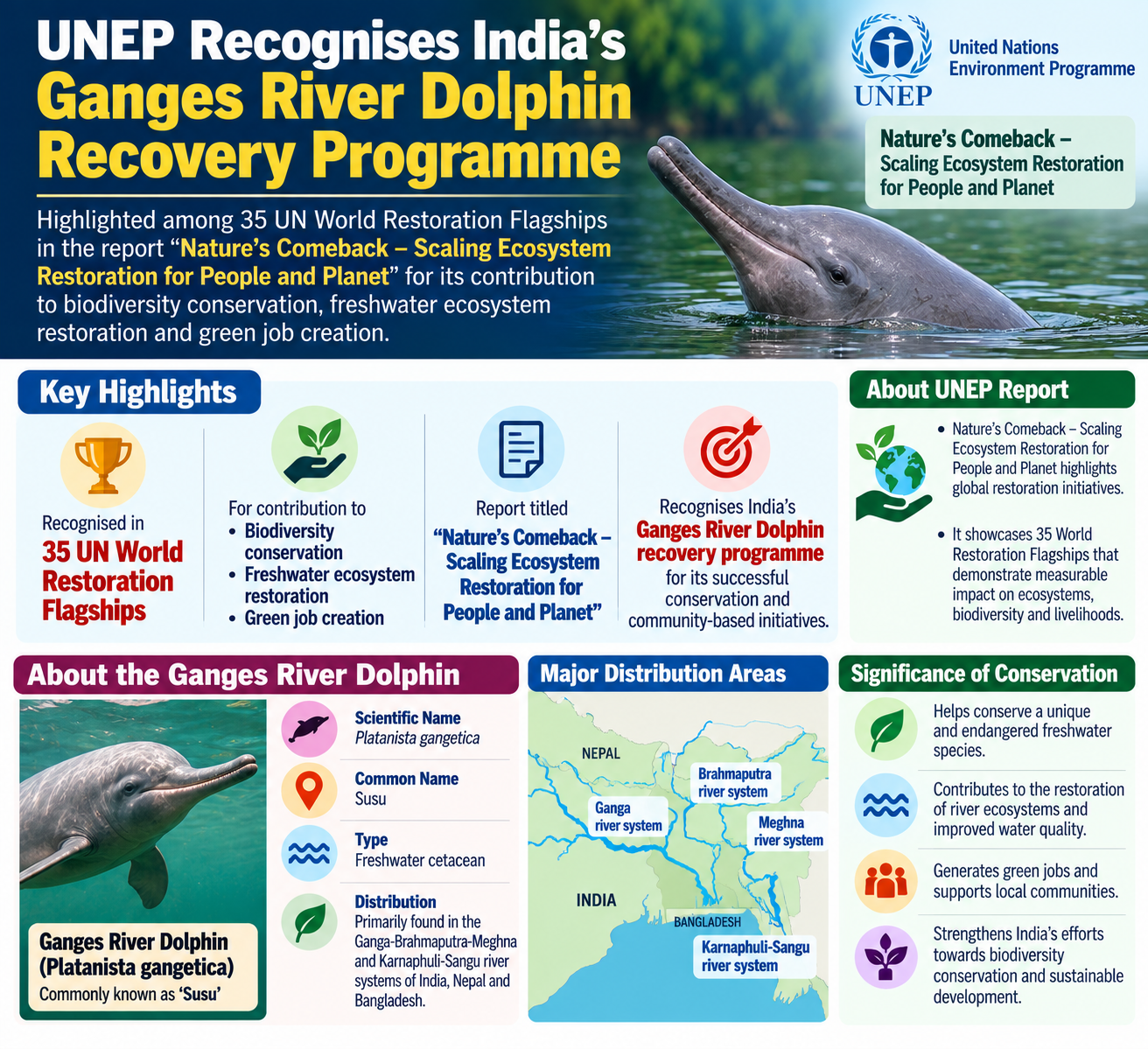
Recently, The United Nations Environment Programme (UNEP) has recognised India's Ganges River Dolphin recovery programme in its report titled Nature’s Comeback – Scaling Ecosystem Restoration for People and Planet. The initiative has been highlighted among 35 UN World Restoration Flagships for its contribution to biodiversity conservation, freshwater ecosystem restoration and green job creation.
About the Ganges River Dolphin:
The Ganges River Dolphin (Platanista gangetica), popularly known as 'Susu', is a freshwater cetacean found primarily in the Ganga-Brahmaputra-Meghna and Karnaphuli-Sangu river systems of India, Nepal and Bangladesh.
-
-
- It is India's National Aquatic Animal, declared in 2009.
- It is classified as Endangered on the IUCN Red List.
- It is listed under Schedule I of the Wildlife (Protection) Act, 1972.
- It is included in Appendix I of CITES.
- Being functionally blind, it uses echolocation to navigate and locate prey.
- The dolphin acts as an indicator species, reflecting the ecological health of river ecosystems.
- It is India's National Aquatic Animal, declared in 2009.
-
About India's Ganges Dolphin Recovery Programme:
India has undertaken several initiatives to conserve this endangered species.
-
-
- Comprehensive Action Plan (2022–2047): It provides a long-term framework for dolphin conservation through habitat protection, population monitoring, scientific research and community participation.
- Project Dolphin (2020): Launched to strengthen the conservation of riverine and marine dolphins by addressing habitat degradation, fishing-related mortality and other threats.
- Community participation: Local communities, fishers and conservation volunteers contribute to monitoring, rescue operations and awareness campaigns. Such participation can create employment in conservation-related activities and promote sustainable livelihoods.
- Habitat restoration: Efforts focus on improving river water quality, maintaining environmental flows and reducing threats from pollution and habitat fragmentation. The Vikramshila Gangetic Dolphin Sanctuary in Bihar is an important protected habitat.
- Comprehensive Action Plan (2022–2047): It provides a long-term framework for dolphin conservation through habitat protection, population monitoring, scientific research and community participation.
-
Significance for India:
The recognition is significant in three dimensions:
-
-
- Ecological: Strengthens freshwater biodiversity conservation and river ecosystem restoration.
- Economic: Promotes green employment, eco-tourism and sustainable livelihood opportunities.
- Social: Encourages community-led conservation and improves public awareness about river protection.
- Ecological: Strengthens freshwater biodiversity conservation and river ecosystem restoration.
-
Key Findings of the UNEP Report:
The report, jointly published by UNEP, the Food and Agriculture Organization (FAO) and the Secretariat of the Convention on Biological Diversity (CBD), presents the first comprehensive global assessment of ecosystem restoration.
Major findings include:
-
-
- Around 252 million hectares across 149 countries are under restoration.
- These activities have generated more than one million green jobs.
- Asia accounts for 192.2 million hectares of documented restoration.
- Freshwater ecosystems account for only 11 million hectares under restoration, indicating the need for greater attention.
- The report also highlights that restoring 15% of global priority areas could potentially capture 30% of CO₂-equivalent emissions since the Industrial Revolution and help avoid 60% of species extinctions.
- Around 252 million hectares across 149 countries are under restoration.
-
Conclusion:
UNEP's recognition highlights India's efforts to integrate biodiversity conservation with sustainable development. The Ganges Dolphin recovery programme demonstrates that ecosystem restoration can protect endangered species while supporting employment and community livelihoods. Going forward, India must adopt an integrated river-basin management approach to ensure long-term ecological security and achieve the objectives of the UN Decade on Ecosystem Restoration (2021–2030).