
Context:
Recently, The United Nations Conference on Trade and Development (UNCTAD) released its Trade and Development Report 2026, highlighting the impact of geopolitical tensions, trade fragmentation and technological changes on the global economy. The report also draws attention to the growing concentration of strategic investments in developed regions.
Key Findings of the Report:
-
-
- Global economic slowdown: Global GDP growth is projected at 2.6% in 2026, compared with 2.9% in 2025.
- Trade growth: Global trade in goods and services reached a record value of approximately $35 trillion in 2025.
- Geoeconomic fragmentation: Trade policies are increasingly influenced by national security, strategic competition and geopolitical alliances.
- Unequal AI benefits: The gains from artificial intelligence are concentrated among a limited number of countries and corporations.
- Financial vulnerability: High borrowing costs, debt burdens and energy-price shocks disproportionately affect developing economies.
- Global economic slowdown: Global GDP growth is projected at 2.6% in 2026, compared with 2.9% in 2025.
-
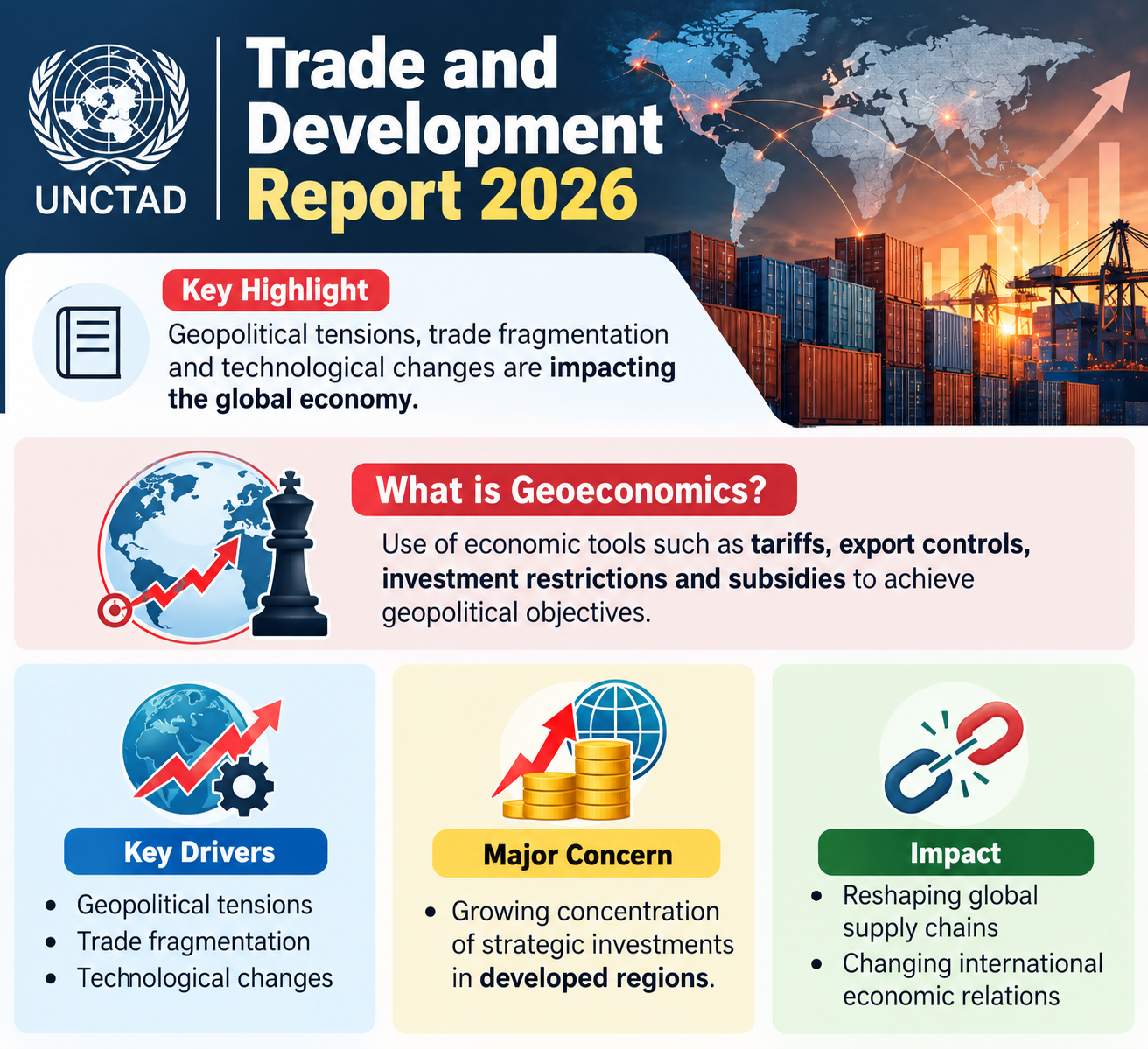
What is Geoeconomics?
Geoeconomics refers to the use of economic instruments, such as tariffs, export controls, investment restrictions and subsidies, to achieve geopolitical objectives. It is reshaping global supply chains and international economic relations.
India’s Position in Global Greenfield Investment:
-
-
- According to the investment findings cited in the report, India accounted for 5.7% of global greenfield investments during 2020–2025, compared with China’s 2.8%, Malaysia’s 4% and Indonesia’s 3.8%.
- Greenfield investment refers to establishing a new business operation or facility in another country.
- Strategic sectors increased their share of global greenfield investment from 16% in 2020 to 44% in 2025. AI infrastructure and related technologies, semiconductors, and energy-transition technologies attracted significant investment.
- However, strategic investment remains concentrated in Europe and North America, highlighting the challenges faced by developing countries in accessing capital and advanced technologies.
- According to the investment findings cited in the report, India accounted for 5.7% of global greenfield investments during 2020–2025, compared with China’s 2.8%, Malaysia’s 4% and Indonesia’s 3.8%.
-
Major Challenges:
-
-
- Trade fragmentation: Tariffs, export restrictions and geopolitical tensions disrupt global supply chains.
- Technology divide: Developing countries face limited access to advanced technologies, research and skilled workers.
- Investment concentration: Capital is concentrated in economies with strong infrastructure and established industrial ecosystems.
- Financial constraints: High borrowing costs and debt burdens restrict development expenditure.
- Unequal development: Least developed countries risk remaining excluded from high-value global production networks.
- Trade fragmentation: Tariffs, export restrictions and geopolitical tensions disrupt global supply chains.
-
Significance for India:
-
-
- India can benefit through manufacturing expansion, employment generation, technology transfer, export growth and reduced dependence on imported strategic goods. Initiatives such as Make in India, Production Linked Incentive schemes, the India Semiconductor Mission and the National Green Hydrogen Mission can support these objectives.
- Nevertheless, attracting investment must be accompanied by domestic value addition, skill development and stronger research capabilities.
- India can benefit through manufacturing expansion, employment generation, technology transfer, export growth and reduced dependence on imported strategic goods. Initiatives such as Make in India, Production Linked Incentive schemes, the India Semiconductor Mission and the National Green Hydrogen Mission can support these objectives.
-
Way Forward:
-
-
- Improve infrastructure, logistics and ease of doing business.
- Promote research and development and advanced manufacturing.
- Strengthen MSMEs and integrate them into global value chains.
- Develop industry-oriented skills and technical education.
- Maintain predictable investment policies.
- Enhance regional cooperation and sustainable industrial development.
- Improve infrastructure, logistics and ease of doing business.
-
Conclusion:
The UNCTAD report highlights how geopolitics is reshaping global trade, investment and development. India should leverage its investment potential to build resilient supply chains, strengthen technological self-reliance and promote inclusive economic growth.



