
Context:
Recently, The United Nations’ Fund for Responding to Loss and Damage (FRLD) has agreed to earmark $20 million for Nepal following devastating floods in August 2026. The decision marks a significant milestone in international climate finance, as the Fund has set aside resources specifically in response to a sudden-onset disaster for the first time. However, Nepal must submit a formal project proposal before the money can be disbursed.
Background:
-
-
- On 26 August 2026, severe flooding in Nepal’s Bhotekoshi–Trishuli region followed an ice-and-rock avalanche in the Himalayan border region near Tibet, China.
- The disaster affected approximately 60,000 people across 15,000 households.
- Official reports indicated more than 1,400 deaths, with thousands still missing.
- Estimated direct economic losses reached approximately $2.7 billion, while recovery and reconstruction requirements could exceed $4.7 billion.
- The disaster highlights the vulnerability of Himalayan communities to floods, glacial hazards and other climate-related risks.
- On 26 August 2026, severe flooding in Nepal’s Bhotekoshi–Trishuli region followed an ice-and-rock avalanche in the Himalayan border region near Tibet, China.
-
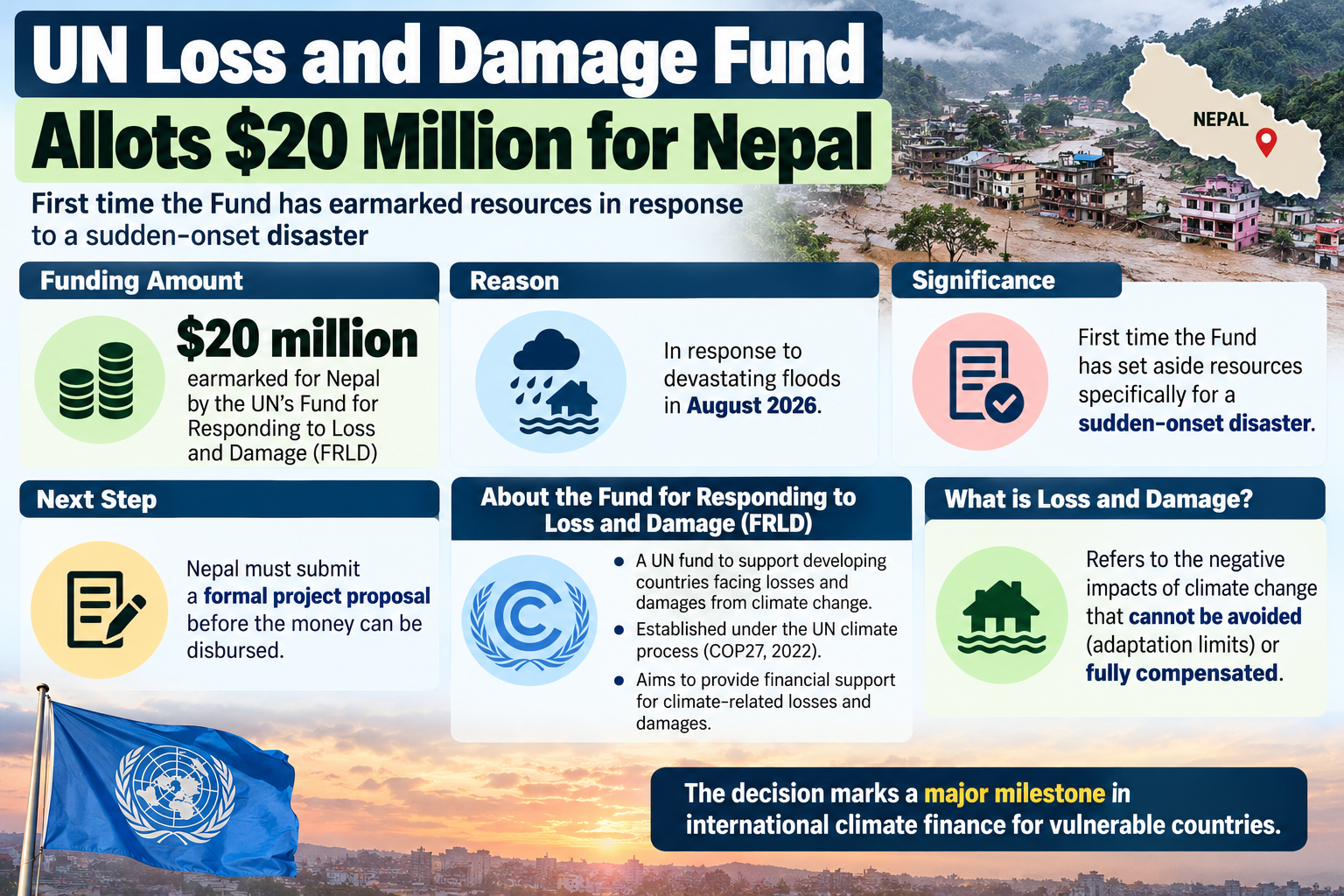
What Is the Loss and Damage Fund?
Established at COP27 in 2022 and operationalised at COP28 in 2023, the FRLD supports developing countries facing the economic and non-economic consequences of climate change that cannot be avoided through mitigation or adaptation alone.
Its key objectives include:
-
-
- Supporting recovery and reconstruction after climate-related disasters.
- Addressing both economic losses, such as damaged infrastructure, and non-economic losses, such as loss of lives, cultural heritage and livelihoods.
- Strengthening climate justice by assisting vulnerable countries with limited resources to manage climate impacts.
- The Fund is hosted by the World Bank.
- Supporting recovery and reconstruction after climate-related disasters.
-
Significance of the Decision:
-
-
- Climate justice: Nepal contributes relatively little to global greenhouse gas emissions but faces severe climate risks, highlighting the principle of common but differentiated responsibilities and respective capabilities (CBDR-RC).
- Institutional credibility: The allocation demonstrates the Fund’s potential to respond to sudden disasters rather than relying exclusively on lengthy project-based processes.
- Support for vulnerable countries: It provides an important precedent for least developed countries (LDCs), small island developing states (SIDS) and other climate-vulnerable nations.
- Himalayan resilience: The disaster underscores the need for early-warning systems, climate-resilient infrastructure and regional cooperation on glacial and flood risks.
- Climate justice: Nepal contributes relatively little to global greenhouse gas emissions but faces severe climate risks, highlighting the principle of common but differentiated responsibilities and respective capabilities (CBDR-RC).
-
Challenges and Concerns:
-
-
- Inadequate financing: The $20 million allocation represents less than 1% of Nepal’s estimated disaster losses.
- Delayed disbursement: Earmarking funds does not mean immediate payment; Nepal must complete the required proposal and approval process.
- Funding gap: Pledges to the Fund remain insufficient compared with the scale of developing countries’ needs.
- Accountability: Transparent allocation, effective utilisation and monitoring are essential to ensure assistance reaches affected communities.
- Inadequate financing: The $20 million allocation represents less than 1% of Nepal’s estimated disaster losses.
-
Conclusion:
The Nepal allocation is an important step towards operationalising climate justice, but its limited scale exposes the gap between global commitments and actual needs. A well-funded, accessible and responsive Loss and Damage Fund is essential to ensure that vulnerable developing countries can recover from climate disasters without bearing a disproportionate economic burden.