
Context:
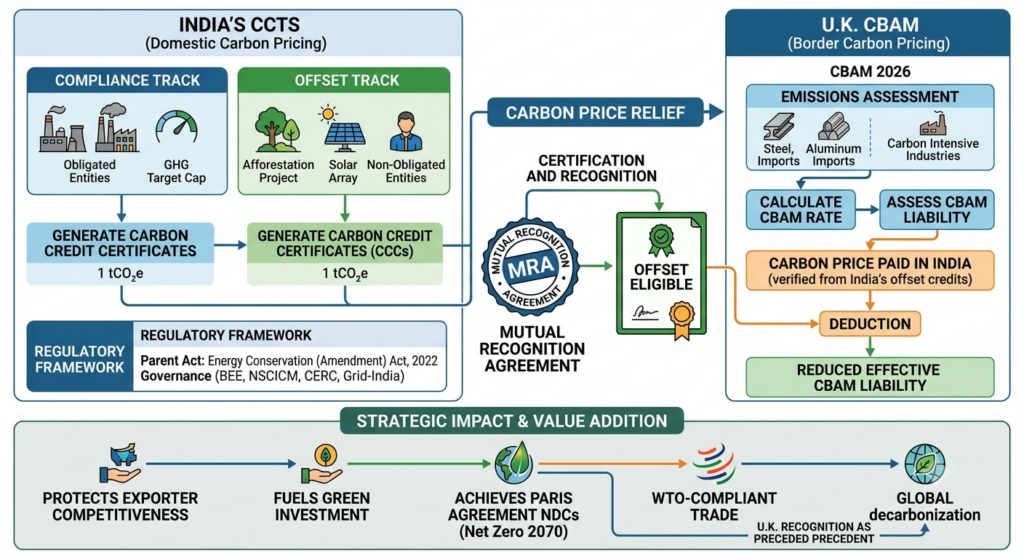
Recently, the United Kingdom (UK) recognised India’s Carbon Credit Trading Scheme (CCTS) as a qualifying carbon-pricing mechanism under its Carbon Border Adjustment Mechanism (CBAM). This could reduce the effective CBAM liability on eligible Indian exports by allowing credit for the carbon price already paid in India.
What is the Carbon Credit Trading Scheme (CCTS)?
-
-
- India’s CCTS is a domestic carbon-market mechanism aimed at reducing greenhouse gas emissions and assigning an economic value to carbon emissions. It was enabled through amendments to the Energy Conservation Act, 2001, and notified by the Ministry of Power.
- The scheme primarily follows an emissions-intensity approach. Entities performing better than prescribed emissions-intensity targets can earn Carbon Credit Certificates (CCCs), while those failing to meet the targets may need to purchase credits.
- India’s CCTS is a domestic carbon-market mechanism aimed at reducing greenhouse gas emissions and assigning an economic value to carbon emissions. It was enabled through amendments to the Energy Conservation Act, 2001, and notified by the Ministry of Power.
-
What is CBAM?
-
-
- The Carbon Border Adjustment Mechanism (CBAM) imposes a carbon-related cost on certain carbon-intensive imports. Its main objective is to prevent carbon leakage, where industries shift production to countries with weaker climate regulations.
- The UK plans to implement CBAM from 2027, covering carbon-intensive products such as iron and steel, aluminium, fertilisers, cement, ceramics, glass and hydrogen.
- The Carbon Border Adjustment Mechanism (CBAM) imposes a carbon-related cost on certain carbon-intensive imports. Its main objective is to prevent carbon leakage, where industries shift production to countries with weaker climate regulations.
-
Significance for India:
The UK’s recognition of India’s CCTS is significant for Indian exporters, as UK importers of eligible Indian goods may claim carbon-price relief corresponding to the qualifying carbon price already paid under India’s CCTS.
This can:
-
-
- Reduce the effective carbon cost on Indian exports.
- Improve the competitiveness of Indian carbon-intensive products.
- Help prevent double carbon taxation.
- Provide international recognition to India’s emerging carbon-market framework.
- Strengthen India–UK cooperation in climate policy and carbon markets.
- Reduce the effective carbon cost on Indian exports.
-
However, the extent of relief will depend on the effective carbon price actually borne by the goods and compliance with the UK’s evidence and verification requirements.
Way Forward:
-
-
- India should strengthen the CCTS and its Monitoring, Reporting and Verification (MRV) framework, accelerate industrial decarbonisation, and promote clean technologies.
- It should also pursue mutual recognition of credible carbon-pricing mechanisms, engage constructively with major trading partners, and ensure that climate-related trade measures remain consistent with WTO principles.
- India should strengthen the CCTS and its Monitoring, Reporting and Verification (MRV) framework, accelerate industrial decarbonisation, and promote clean technologies.
-
Conclusion:
The UK’s recognition of CCTS will boost Indian export competitiveness and promote decarisation. India should use this opportunity to develop a credible and transparent carbon market while ensuring that climate measures do not become trade barriers.



