
Context:
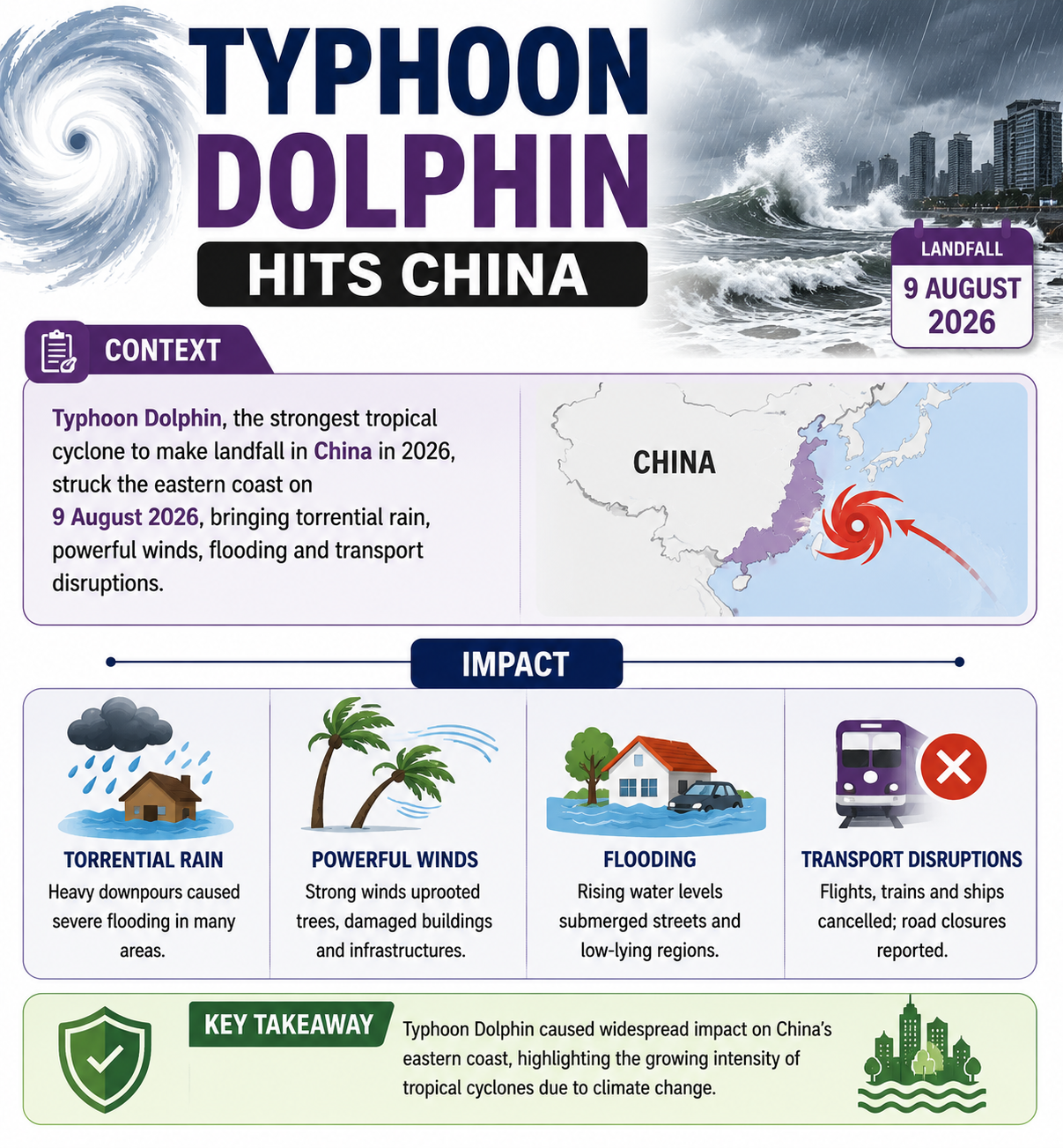
Recently, Typhoon Dolphin, the strongest tropical cyclone to make landfall in China in 2026, struck the eastern coast on 9 August 2026, bringing torrential rain, powerful winds, flooding and transport disruptions. More than one million people were evacuated, making it a major case study in disaster management.
What is a Typhoon?
-
-
- A typhoon is a mature tropical cyclone that develops in the western North Pacific Ocean, with maximum sustained wind speeds of at least 74 miles per hour (119 km/h) or more.
- It is a vast, rotating storm system characterized by low atmospheric pressure, strong winds, and powerful thunderstorms.
- Typhoons primarily derive their energy from warm ocean water, atmospheric moisture, and the Coriolis force.
- A mature typhoon typically has a relatively calm central region called the “eye.” Surrounding the eye is the “eyewall,” where the strongest winds and heaviest rainfall occur.
- A typhoon is a mature tropical cyclone that develops in the western North Pacific Ocean, with maximum sustained wind speeds of at least 74 miles per hour (119 km/h) or more.
-
Names of Typhoons and Other Tropical Cyclones:
Tropical cyclones are essentially the same type of atmospheric phenomenon, but they are known by different names in different oceanic regions.
|
Region |
Regional Name |
|
Northwestern Pacific Ocean and South China Sea |
Typhoon |
|
Indian Ocean and South Pacific Ocean |
Cyclone |
|
North Atlantic and Northeastern Pacific Ocean |
Hurricane |
|
Western Australia |
Willy-willy |
-
-
- In other words, typhoons, hurricanes, and cyclones are essentially the same type of tropical cyclone, but they are given different names depending on the region in which they occur.
- Under the World Meteorological Organization (WMO), regional meteorological organizations administer the naming systems for tropical cyclones.
- In other words, typhoons, hurricanes, and cyclones are essentially the same type of tropical cyclone, but they are given different names depending on the region in which they occur.
-
Favourable Conditions:
Typhoons function as heat engines, drawing energy from warm ocean waters and the release of latent heat through condensation. Their formation requires:
-
-
- Warm sea surface: generally above about 26.5–27°C, with sufficient oceanic heat content.
- Coriolis force: provides the rotation; hence tropical cyclones rarely form within about 5° of the Equator.
- Low vertical wind shear: prevents the storm from being disrupted.
- Pre-existing low-pressure disturbance: provides the initial circulation.
- Upper-level divergence: removes air aloft and sustains the surface low-pressure system.
- Warm sea surface: generally above about 26.5–27°C, with sufficient oceanic heat content.
-
Structure of a Typhoon:
A mature typhoon has three major components:
-
-
- Eye: relatively calm central region with sinking air and low pressure.
- Eyewall: ring around the eye containing the strongest winds and heaviest rainfall.
- Spiral rainbands: curved cloud bands producing intense and intermittent rainfall.
- Eye: relatively calm central region with sinking air and low pressure.
-
Relevance to India and the Monsoon:
-
-
- Typhoons are also important for India because powerful tropical cyclones that develop in the western Pacific Ocean can influence regional atmospheric circulation and the transport of moisture.
- Their effects can indirectly extend to:
- the South China Sea,
- Southeast Asia,
- the Bay of Bengal, and
- the Indian monsoon system.
- the South China Sea,
- Under certain conditions, the remnants of tropical cyclones can carry moisture across Southeast Asia toward the Bay of Bengal. This can influence the distribution and intensity of monsoon rainfall in India.
- However, such effects depend on atmospheric circulation, sea-surface temperatures, and other weather conditions.
- Typhoons are also important for India because powerful tropical cyclones that develop in the western Pacific Ocean can influence regional atmospheric circulation and the transport of moisture.
-
Connection with Climate Change:
-
-
- Warming oceans and increasing atmospheric moisture can intensify extreme rainfall. Warmer ocean waters can provide tropical cyclones with greater amounts of energy and moisture.
- However, a single cyclone cannot be directly and entirely attributed to climate change.
- Events such as Typhoon Dolphin demonstrate that, in the future, societies will need to prepare not only for the threat of cyclones but also for interconnected multi-hazard risks, including extreme rainfall, flooding, landslides, and disruptions to transportation.
- Warming oceans and increasing atmospheric moisture can intensify extreme rainfall. Warmer ocean waters can provide tropical cyclones with greater amounts of energy and moisture.
-
Conclusion:
Typhoon Dolphin demonstrates that a tropical cyclone can create cascading hazards—strong winds, extreme rainfall, flooding, landslides and transport disruption. For India, it reinforces the need for integrated multi-hazard disaster management, resilient urban planning and effective early-warning systems.



