
Context:
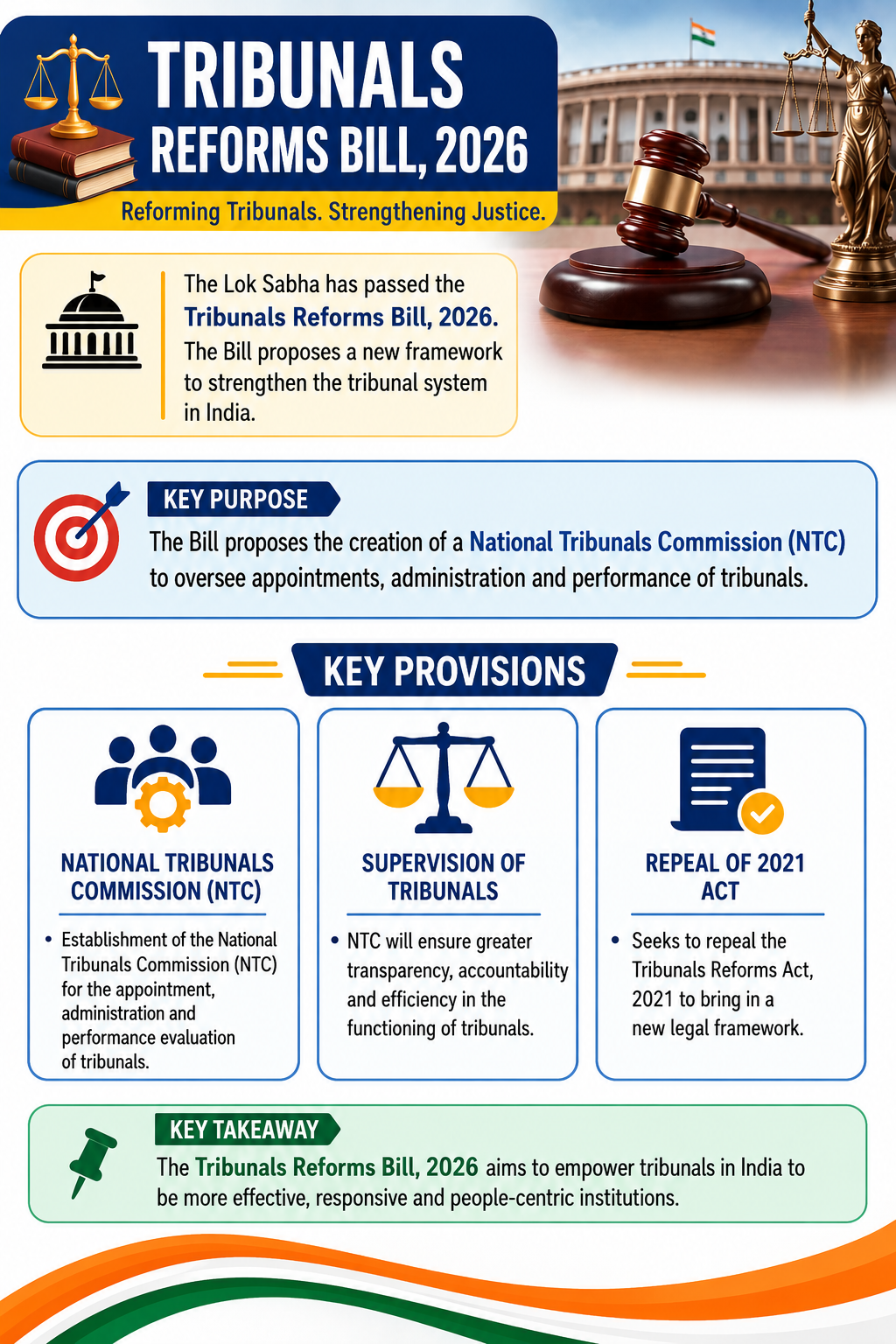
Recently, The Lok Sabha passed the Tribunals Reforms Bill, 2026. The Bill proposes a National Tribunals Commission (NTC) to oversee appointments, administration and performance of tribunals. It seeks to repeal the Tribunals Reforms Act, 2021.
Key Provisions:
-
-
- The Bill establishes a five-member NTC comprising a Chairperson, two judicial members and two technical members. The Chairperson must be a former Supreme Court judge or Chief Justice of a High Court. The Commission will oversee the selection and appointment of tribunal members, review their performance, supervise complaints and maintain a National Tribunals Data Grid.
- The Bill provides a five-year tenure or till 70 years of age, whichever is earlier, and seeks uniformity in qualifications, salaries, allowances, resignation and removal of tribunal members.
- The Bill establishes a five-member NTC comprising a Chairperson, two judicial members and two technical members. The Chairperson must be a former Supreme Court judge or Chief Justice of a High Court. The Commission will oversee the selection and appointment of tribunal members, review their performance, supervise complaints and maintain a National Tribunals Data Grid.
-
About Tribunals:
Tribunals are specialised judicial or quasi-judicial bodies that provide speedy and expert resolution of specific types of disputes. They are established to reduce the burden on regular courts and ensure effective justice in specialised matters. Tribunals are provided for under Articles 323A and 323B of the Indian Constitution. Examples include the Central Administrative Tribunal (CAT) and the National Green Tribunal (NGT).
About Constitutional and Legal Framework:
-
-
- Tribunals derive their constitutional basis primarily from Articles 323A and 323B of the Constitution.
- In L. Chandra Kumar v. Union of India (1997), the Supreme Court held that judicial review by the Supreme Court under Article 32 and High Courts under Articles 226 and 227 is part of the basic structure. Tribunals can supplement, but cannot replace, constitutional courts.
- In Union of India v. R. Gandhi (2010) and Rojer Mathew v. South Indian Bank (2019), the Court stressed the need for independence, adequate tenure and judicial primacy in tribunal appointments.
- The Madras Bar Association cases further strengthened these principles. The Supreme Court struck down provisions relating to tribunal appointments, tenure and service conditions where they were inconsistent with separation of powers and judicial independence. The 2025 judgment also emphasised the need for an independent National Tribunals Commission.
- Tribunals derive their constitutional basis primarily from Articles 323A and 323B of the Constitution.
-
Significance of bill:
The proposed NTC can:
-
-
- bring uniformity and transparency in appointments;
- reduce executive influence;
- address tribunal vacancies and administrative fragmentation;
- improve performance monitoring;
- strengthen specialised and speedy adjudication;
- improve accountability through data-based oversight.
- bring uniformity and transparency in appointments;
-
Conclusion:
The Tribunals Reforms Bill, 2026 is an important step towards rationalising India's tribunal system. Its constitutional legitimacy, however, will ultimately depend on whether the National Tribunals Commission strengthens judicial independence, separation of powers and access to justice, rather than merely centralising administrative control.



