
Context:
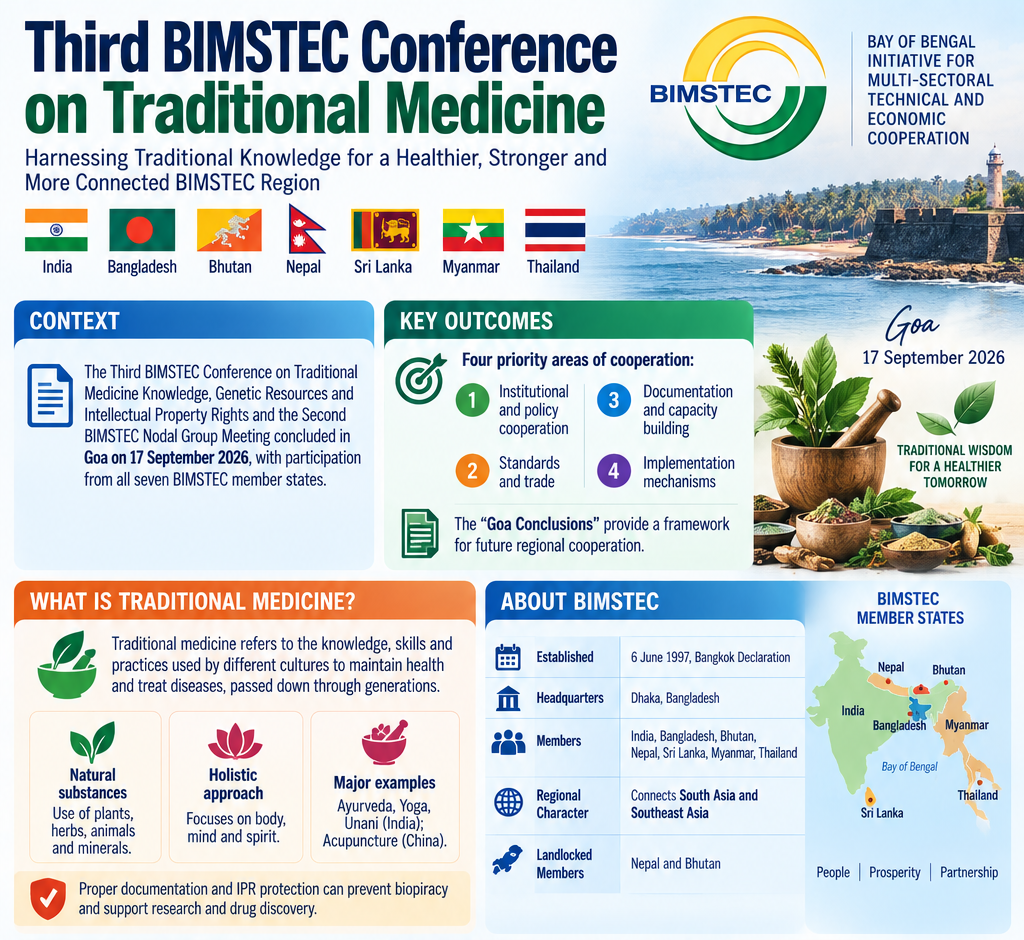
Recently, The Third BIMSTEC Conference on Traditional Medicine Knowledge, Genetic Resources and Intellectual Property Rights and the Second BIMSTEC Nodal Group Meeting concluded in Goa on 17 September 2026, with participation from all seven BIMSTEC member states.
Key Outcomes:
The meeting identified four priority areas of cooperation:
-
-
- Institutional and policy cooperation
- Standards and trade
- Documentation and capacity building
- Implementation mechanisms
- Institutional and policy cooperation
-
Member states agreed to support one another in traditional medicine knowledge, genetic resources and Intellectual Property Rights (IPR). The resulting “Goa Conclusions” provide a framework for future regional cooperation.
What is Traditional Medicine?
Traditional medicine refers to the old methods and knowledge related to health that have been passed down through generations within a society or culture. It includes the knowledge, skills, and practices used by different cultures to maintain health and treat diseases. Beyond healthcare, traditional medicine is also important because traditional knowledge can contribute to drug discovery and pharmaceutical research.
Key Points:
-
-
- Natural substances: It involves the use of medicines made from plants, herbs, animals, and minerals.
- Holistic approach: It focuses not only on treating the symptoms of a particular disease but also on restoring the balance of the body, mind, and spirit.
- Major examples: In India, Ayurveda, Yoga, and Unani, and in China, acupuncture, are well-known traditional medical systems.
- Proper documentation and IPR (Intellectual Property Rights) protection can help prevent biopiracy and unauthorized commercial exploitation, while scientific validation can help integrate traditional medicine responsibly with modern healthcare.
- Natural substances: It involves the use of medicines made from plants, herbs, animals, and minerals.
-
About BIMSTEC:
BIMSTEC stands for Bay of Bengal Initiative for Multi-Sectoral Technical and Economic Cooperation.
|
Aspect |
Details |
|
Established |
6 June 1997, Bangkok Declaration |
|
Headquarters |
Dhaka, Bangladesh |
|
Members |
India, Bangladesh, Bhutan, Nepal, Sri Lanka, Myanmar, Thailand |
|
Regional Character |
Connects South Asia and Southeast Asia |
|
Landlocked Members |
Nepal and Bhutan |
Significance for India:
-
-
- Act East Policy: BIMSTEC connects India's South Asian neighbourhood with Southeast Asia.
- Neighbourhood First: It strengthens regional cooperation with India's neighbouring countries.
- Connectivity: It complements projects such as the Kaladan Multimodal Transit Transport Project and India–Myanmar–Thailand Trilateral Highway.
- Health Diplomacy: Traditional medicine provides an avenue for India to share its AYUSH expertise.
- IPR & Biodiversity: Regional cooperation can protect traditional knowledge and genetic resources while promoting legitimate research and trade.
- Act East Policy: BIMSTEC connects India's South Asian neighbourhood with Southeast Asia.
-
India and Traditional Medicine:
India's AYUSH framework includes Ayurveda, Yoga & Naturopathy, Unani, Siddha and Homoeopathy. The WHO Global Centre for Traditional Medicine at Jamnagar, Gujarat further strengthens India's role in promoting evidence-based traditional medicine.
Key Challenges:
-
-
- Validation: Many traditional therapies require stronger scientific and clinical evidence.
- Standardisation: Differences in regulations, formulations and quality standards can hinder cooperation.
- IPR & Biopiracy: Traditional knowledge requires effective documentation and legal protection.
- Sustainability: Unsustainable extraction of medicinal plants can threaten biodiversity.
- Research & Capacity: Uneven infrastructure and limited investment can constrain collaborative research.
- Validation: Many traditional therapies require stronger scientific and clinical evidence.
-
Conclusion:
Traditional medicine can become a significant avenue for health cooperation, biodiversity conservation, economic integration and cultural connectivity within BIMSTEC. The Goa Conclusions provide a foundation for translating shared traditional knowledge into structured regional cooperation.



