
Context:
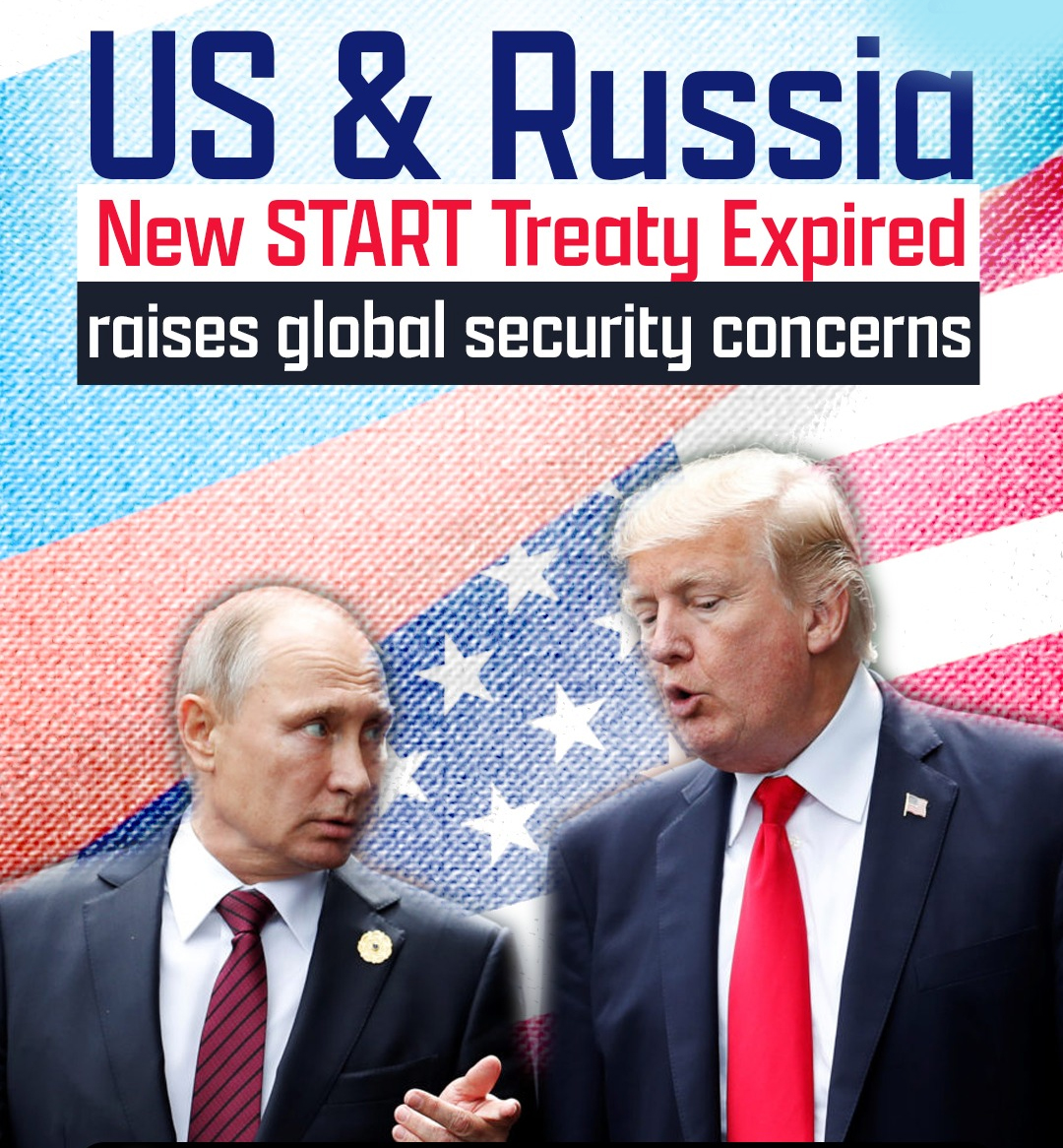
The New Strategic Arms Reduction Treaty (New START), the last remaining nuclear arms control agreement between the United States and Russia expired on 5 February 2026. Russia has offered a one-year extension, but there has been no formal response from the United States. The impending expiration has raised global concerns about the future of nuclear arms control and the risk of a renewed arms race.
About the New START Treaty:
-
-
- Background: Signed in 2010 in Prague by U.S. President Barack Obama and Russian President Dmitry Medvedev, the treaty entered into force on 5 February 2011. It was extended in 2021 for a further five-year period.
- Purpose: The treaty limits both countries to 1,550 deployed strategic nuclear warheads and 700 deployed delivery systems, including intercontinental ballistic missiles (ICBMs), submarine-launched ballistic missiles (SLBMs), and heavy bombers. It also places caps on total deployed and non-deployed launchers.
- Verification Mechanisms: New START incorporated mutual inspections, notifications, and regular data exchanges to reduce mistrust and enhance transparency.
- Suspension of Participation: In February 2023, Russia suspended certain aspects of the treaty, particularly on-site inspections, while continuing to adhere to the numerical limits. The United States also partially suspended compliance-related notifications in response.
- Background: Signed in 2010 in Prague by U.S. President Barack Obama and Russian President Dmitry Medvedev, the treaty entered into force on 5 February 2011. It was extended in 2021 for a further five-year period.
-
Significance and Benefits:
-
-
- Strategic Stability: New START ensured predictability in U.S.–Russia strategic relations and reduced the risk of uncontrolled nuclear competition.
- Transparency: Regular data exchanges and inspections lowered the likelihood of accidental escalation and misinterpretation.
- Arms Reduction Legacy: The treaty contributed to a significant reduction in global nuclear warheads—from tens of thousands during the Cold War to around 12,000 today.
- Confidence-Building: Clearly defined limits helped sustain a degree of trust even amid heightened tensions, including the Russia–Ukraine conflict.
- Strategic Stability: New START ensured predictability in U.S.–Russia strategic relations and reduced the risk of uncontrolled nuclear competition.
-
Challenges and Current Issues:
-
-
- Lack of Extension: The absence of agreement on an extension or a successor treaty has created uncertainty regarding binding nuclear limits.
- Erosion of Verification: The suspension of inspections has weakened monitoring mechanisms and mutual confidence.
- Geopolitical Context: Efforts to bring other nuclear-armed states, particularly China, into arms control frameworks have so far proved unsuccessful.
- Lack of Extension: The absence of agreement on an extension or a successor treaty has created uncertainty regarding binding nuclear limits.
-
Implications of Expiry:
-
-
- Potential Arms Race: Without legal constraints, the United States and Russia may expand their nuclear arsenals, increasing the risk of competition.
- Loss of Transparency: Reduced verification measures could heighten the chances of miscalculation and strategic misunderstanding.
- Global Nuclear Governance at Risk: The lapse of New START may undermine the broader global arms control architecture and the norms underpinning the Nuclear Non-Proliferation Treaty (NPT).
- Multilateral Dynamics: Other nuclear-armed states may feel pressured to expand or modernise their arsenals, complicating future disarmament efforts.
- Potential Arms Race: Without legal constraints, the United States and Russia may expand their nuclear arsenals, increasing the risk of competition.
-
Conclusion:
The possible lapse of the New START Treaty represents a critical juncture in global security. Its absence would threaten strategic stability and weaken the existing arms control framework. Extending the treaty, negotiating a successor agreement, or pursuing inclusive multilateral arms control mechanisms is essential to prevent escalation and preserve international peace and security.



