
Centre Temporarily Suspends Fortified Rice Distribution
Context:
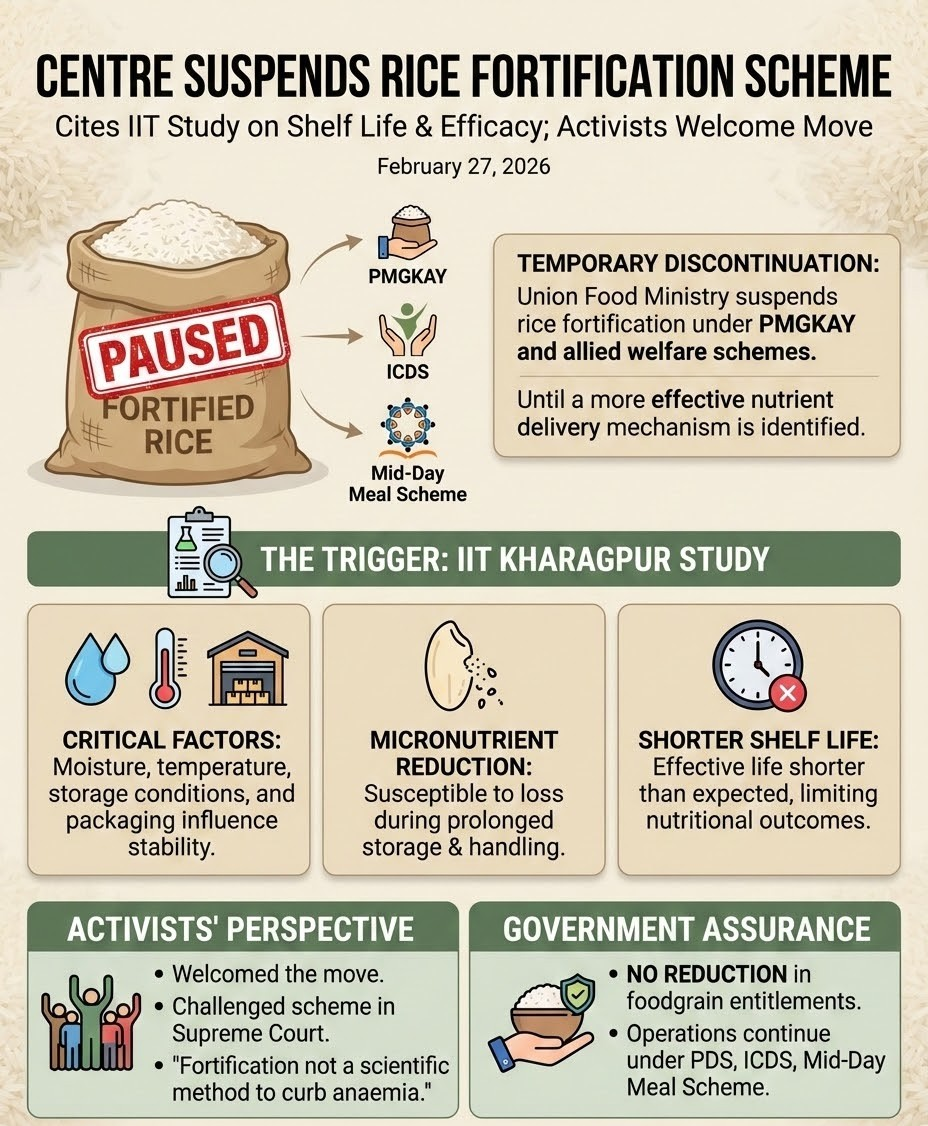
Recently, The Central Government has temporarily suspended the distribution of fortified rice under the Pradhan Mantri Garib Kalyan Anna Yojana (PMGKAY) and other welfare schemes such as the Targeted Public Distribution System (TPDS), Integrated Child Development Services (ICDS) and PM-POSHAN (formerly Mid-Day Meal Scheme).
Reasons behind suspension:
The suspension stems from findings that prolonged storage in the central pool — often for 2–3 years — under varying moisture, temperature and humidity conditions leads to nutrient degradation. The IIT study highlighted that such losses undermine the intended health benefits. The government has clarified that foodgrain entitlements remain unchanged; beneficiaries will receive non-fortified rice until improved mechanisms are developed.
About Fortified Rice:
Fortified rice is regular rice enriched with essential micronutrients — iron, folic acid and Vitamin B12 — to improve its nutritional quality and combat hidden hunger, particularly among women and children. The process involves producing Fortified Rice Kernels (FRKs) by blending rice flour with micronutrient premix through extrusion technology. These kernels are mixed with polished rice in a 1:100 ratio, enhancing the nutritional value without altering taste or appearance.
Associated Schemes:
The initiative was integrated into major food and nutrition programmes:
-
-
- PMGKAY: Provides free/subsidised foodgrains.
- TPDS (under NFSA): Ensures subsidised grains via ration shops.
- PM-POSHAN: Provides mid-day meals in schools.
- ICDS: Delivers supplementary nutrition through Anganwadi centres.
- PMGKAY: Provides free/subsidised foodgrains.
-
The rollout was completed nationwide by March 2024, fully funded by the Centre, with continuation approved till December 2028.
Aim of the Fortification Initiative:
The primary objective was to reduce micronutrient malnutrition and iron-deficiency anaemia by 2024 through a cost-effective, scalable public health intervention. Making fortified rice mandatory in welfare schemes was intended to systematically improve nutrition outcomes among vulnerable populations.
Steps in the Fortification Process:
-
-
- Production of FRKs: Rice flour mixed with micronutrients is shaped into grain-like kernels.
- Blending: FRKs are blended with regular rice in a 1:100 ratio.
- Distribution: The fortified rice is supplied through PDS-linked schemes nationwide.
- Production of FRKs: Rice flour mixed with micronutrients is shaped into grain-like kernels.
-
Current Challenges:
-
-
- Extended storage duration in government warehouses.
- Nutrient instability due to environmental conditions.
- Logistical constraints in large-scale procurement and distribution.
- These factors reveal the gap between policy ambition and ground-level implementation.
- Extended storage duration in government warehouses.
-
Way Forward:
Fortification remains crucial for addressing hidden hunger, but delivery systems must ensure nutrient retention until consumption. Future strategies may include improved packaging, decentralised blending near distribution points, or complementary nutrition interventions such as supplementation and dietary diversification.
Conclusion:
The temporary suspension reflects a pragmatic recalibration of nutrition policy. While fortified rice remains a valuable public health tool, ensuring its effectiveness requires robust storage and delivery mechanisms. The focus now is to align nutritional objectives with logistical realities without compromising food security for vulnerable populations.



