
Telangana Gig and Platform Workers (Registration, Social Security and Welfare) Bill, 2026
Context:
Recently, the Telangana government has introduced the ‘Telangana Gig and Platform Workers (Registration and Welfare) Bill, 2026’. After Rajasthan, Telangana has become the second state in the country to bring such legislation. This bill is a significant step towards safeguarding the rights of workers in the rapidly growing ‘gig economy’.
Key Provisions of the Bill:
The ‘Telangana Gig and Platform Workers (Registration and Welfare) Bill, 2026’ includes several detailed provisions to ensure worker protection and define the accountability of aggregators:
-
-
-
Registration and Identification:
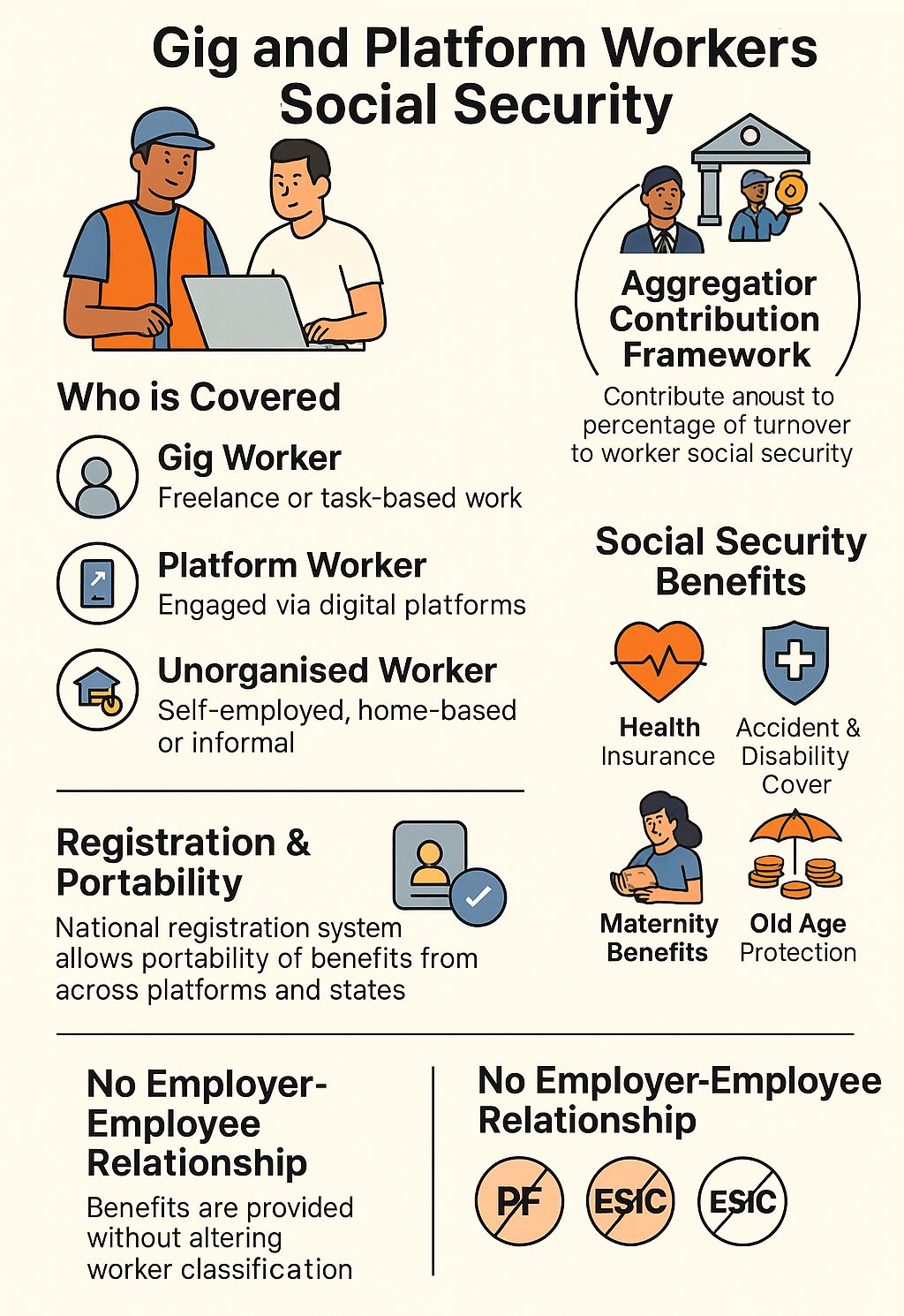
- Mandatory Registration: All gig and platform workers must register with the state government.
- Unique ID: After registration, each worker will be assigned a unique ID, valid across all platforms, enabling them to directly access government schemes.
- Aggregator Responsibility: Aggregators must submit the database of their existing workers to the Board within 60 days of the law coming into force.
- Mandatory Registration: All gig and platform workers must register with the state government.
-
Social Security and Welfare Fund:
- Welfare Fee: Aggregators must contribute a fee ranging from 1% to 2% on each transaction (payment).
- Utilization of Fund: The collected amount will be used for welfare measures such as accident insurance, health benefits, pensions, marriage assistance, and maternity benefits.
- Additional Funding Sources: The fund may also include government grants, Corporate Social Responsibility (CSR) funds, and donations.
- Welfare Fee: Aggregators must contribute a fee ranging from 1% to 2% on each transaction (payment).
-
Working Conditions and Transparency:
- Algorithm Transparency: Companies must clearly disclose how their automated systems determine work allocation, ratings, and payments.
- Protection Against Unfair Termination: No worker can be removed from work without a valid reason and a 7-day prior notice.
- Safe Working Environment: Aggregators must ensure a safe workplace free from any form of discrimination (based on caste, religion, gender, etc.).
- Algorithm Transparency: Companies must clearly disclose how their automated systems determine work allocation, ratings, and payments.
-
Grievance Redressal Mechanism:
- Internal Committee: Platforms with more than 100 workers must establish an internal dispute resolution committee.
- Three-Tier System: A structured mechanism has been provided, ranging from a district-level grievance officer to a state-level Appellate Authority.
- Internal Committee: Platforms with more than 100 workers must establish an internal dispute resolution committee.
-
Penalties for Violations:
- Financial Penalty: Violations of rules may attract fines ranging from ₹50,000 to ₹2 lakh.
- Stringent Provisions: Failure to pay the welfare fee may lead to imprisonment of up to one year, or a fine, or both.
- Financial Penalty: Violations of rules may attract fines ranging from ₹50,000 to ₹2 lakh.
-
-
Challenges:
-
-
- Job Insecurity: Gig workers do not have permanent contracts. Companies retain ‘hire and fire’ powers, allowing them to remove workers without prior notice.
- Lack of Social Security: They are treated as ‘independent contractors’ rather than ‘employees’, which deprives them of benefits like PF, pension, gratuity, paid leave, and health insurance.
- Income Uncertainty: Earnings depend entirely on the number of orders or tasks. Rising fuel costs and reduced commissions by companies are lowering their real income.
- Algorithmic Control: Work allocation and ratings are determined by ‘invisible’ algorithms. Low ratings or inactivity may lead to account suspension.
- Lack of Legal Recognition: Current labour laws do not clearly define gig workers, limiting their access to labour courts or legal remedies.
- Job Insecurity: Gig workers do not have permanent contracts. Companies retain ‘hire and fire’ powers, allowing them to remove workers without prior notice.
-
Conclusion:
This bill by Telangana is a progressive step towards ensuring ‘decent work’ for gig workers. However, its effective implementation will depend on the autonomy of the welfare board and the transparency with which aggregators comply with the law. It can serve as a model for other states, helping protect India’s vast gig workforce from exploitation.



