
Tar Balls Management (Draft) Rules, 2026
Context:
Recently, the Ministry of Environment, Forest and Climate Change (MoEFCC) released the ‘Draft Tar Balls Management Rules, 2026’. This is the first dedicated national framework aimed at protecting India’s vast coastline from the growing threats of oil spills and tar balls.
About Tar Balls:
-
-
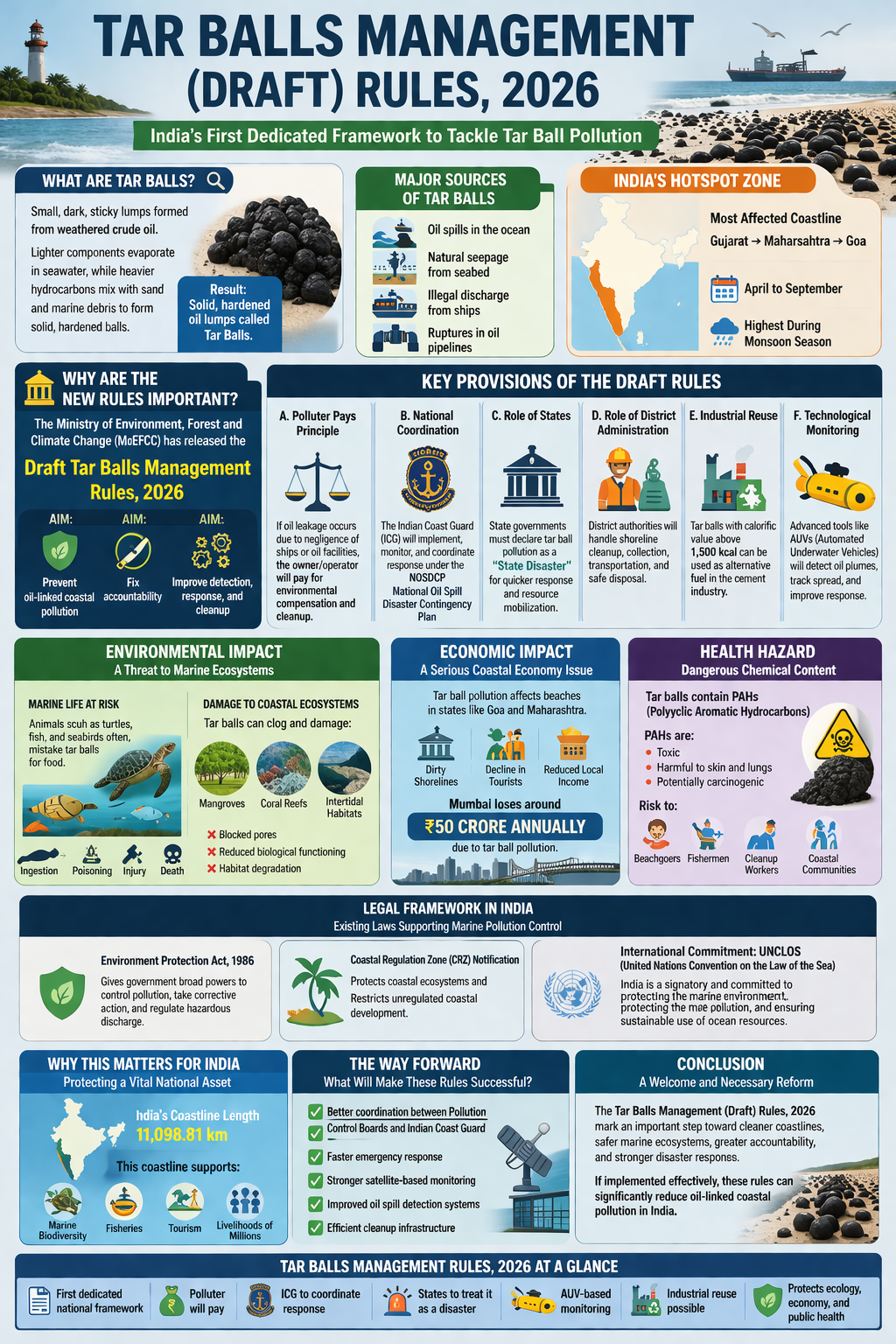
- Tar balls are small, sticky, dark-colored lumps formed from crude oil due to the process of weathering in seawater. When oil spills occur in the ocean, the lighter components evaporate under the influence of waves and wind, while heavier hydrocarbons combine with sand and marine debris to form solid, hardened balls.
- Their major sources include oil spills, natural seepage from the seabed, illegal discharge from ships, and ruptures in oil pipelines. Along India’s western coast—especially from Gujarat to Goa—tar balls are commonly deposited on shores between April and September, particularly during the monsoon season.
- Tar balls are small, sticky, dark-colored lumps formed from crude oil due to the process of weathering in seawater. When oil spills occur in the ocean, the lighter components evaporate under the influence of waves and wind, while heavier hydrocarbons combine with sand and marine debris to form solid, hardened balls.
-
Key Provisions of the Rules:
The draft emphasizes fixing accountability and establishing an integrated management system:
-
-
- Polluter Pays Principle: If oil leakage occurs due to negligence of an oil facility or ship, the owner will bear full responsibility for environmental compensation.
- National Coordination: The Indian Coast Guard (ICG) will be responsible for implementing and monitoring the National Oil Spill Disaster Contingency Plan (NOSDCP).
- Role of States and Districts: State governments must declare tar ball pollution as a “State Disaster,” while district administrations will handle cleanup and transportation from coastlines.
- Industrial Use: Tar balls with a calorific value exceeding 1,500 kcal can be used as fuel in the cement industry.
- Technological Monitoring: Advanced technologies like Automated Underwater Vehicles (AUVs) will be used to detect oil plumes.
- Polluter Pays Principle: If oil leakage occurs due to negligence of an oil facility or ship, the owner will bear full responsibility for environmental compensation.
-
Environmental and Economic Impact:
-
-
- Tar balls pose a serious threat to marine ecosystems. Marine organisms such as turtles and fish often mistake them for food, leading to ingestion and death. They also clog the pores of mangroves and coral reefs, damaging their structure and biological functioning.
- Economically, their impact is highly negative, especially in coastal states like Goa and Maharashtra, where tourism is affected. Reports suggest that Mumbai alone suffers an annual loss of around ₹50 crore due to tar ball pollution. Additionally, tar balls contain Polycyclic Aromatic Hydrocarbons (PAHs), which are harmful to human health and can have carcinogenic effects.
- Tar balls pose a serious threat to marine ecosystems. Marine organisms such as turtles and fish often mistake them for food, leading to ingestion and death. They also clog the pores of mangroves and coral reefs, damaging their structure and biological functioning.
-
Legal Framework:
India has several legal provisions to control marine pollution:
-
-
- Environment Protection Act, 1986: Provides broad powers for pollution control and enables the government to take necessary action.
- Coastal Regulation Zone (CRZ) Notification: Lays down rules to protect coastal ecosystems and prevent unregulated development.
- International Framework: India is a signatory to UNCLOS (United Nations Convention on the Law of the Sea), which provides guidelines for protecting the marine environment and ensuring sustainable use of resources.
- Environment Protection Act, 1986: Provides broad powers for pollution control and enables the government to take necessary action.
-
Conclusion:
India’s 11,098.81 km long coastline is a vital resource for biodiversity as well as the livelihood of millions of people. The Tar Balls Management Rules, 2026 are a welcome step; however, their success will depend on better coordination between Pollution Control Boards and the Indian Coast Guard, along with strengthening satellite-based monitoring systems.



