
Context:
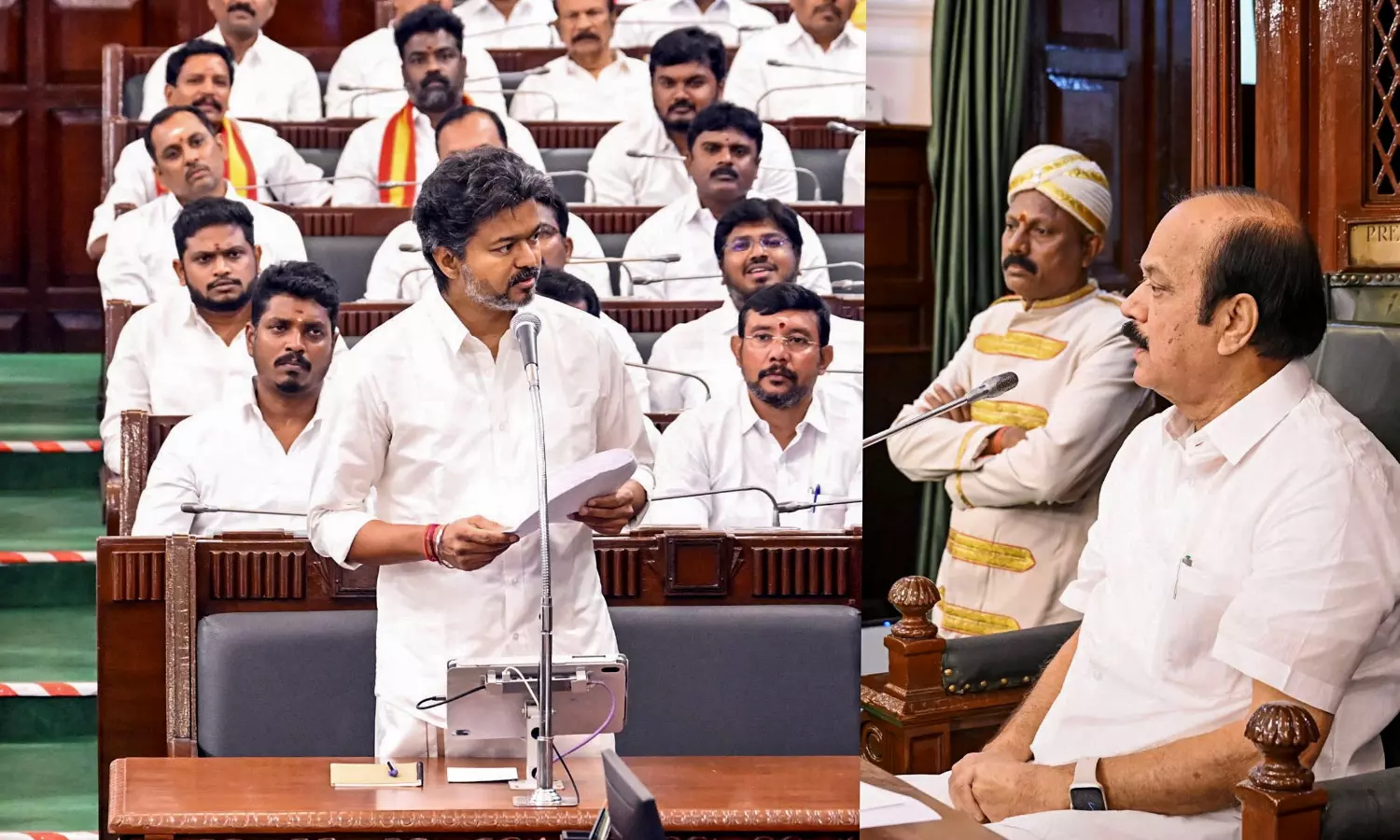
Recently, The Tamil Nadu Legislative Assembly has unanimously passed a resolution making ‘Tamil Thai Vazhthu’, the State Song of Tamil Nadu, mandatory at the beginning of official programmes in educational institutions, government offices, PSUs and public institutions.
What is ‘Tamil Thai Vazhthu’?
-
-
- It is an invocation to Mother Tamil.
- It is derived from the 1891 Tamil work Manonmaniam by Manonmaniam Sundaranar.
- Its rendition at government functions has been a long-standing practice in Tamil Nadu since the 1970s.
- It was officially recognised as the State Song of Tamil Nadu in 2021.
- It is an invocation to Mother Tamil.
-
Thus, the song represents both Tamil linguistic heritage and regional cultural identity.
Ministry of Home Affairs (MHA) Direction:
-
-
- The controversy also relates to a 9 July 2026 communication of the Ministry of Home Affairs (MHA) concerning the ceremonial sequence of national and State songs.
- According to reports, where all three are rendered, the sequence is:
- State Song → Vande Mataram → Jana Gana Mana
- State Song → Vande Mataram → Jana Gana Mana
- This is significant because Tamil Nadu’s decision to begin official programmes with Tamil Thai Vazhthu broadly corresponds with the reported MHA clarification.
- The controversy also relates to a 9 July 2026 communication of the Ministry of Home Affairs (MHA) concerning the ceremonial sequence of national and State songs.
-
Constitutional Dimensions:
-
-
- Fundamental Duties – Article 51A(a)
- Article 51A(a) requires citizens to respect the National Anthem and National Flag.
- However, the Constitution does not give a State Song the same constitutional status as the National Anthem.
- Article 51A(a) requires citizens to respect the National Anthem and National Flag.
-
State Executive Power – Article 162
- Article 162 defines the extent of State executive power. Therefore, prescribing ceremonial practices for State-controlled institutions and functions can generally fall within the State’s administrative domain, subject to constitutional and statutory limitations.
- Article 162 defines the extent of State executive power. Therefore, prescribing ceremonial practices for State-controlled institutions and functions can generally fall within the State’s administrative domain, subject to constitutional and statutory limitations.
-
Distribution of Powers
- Article 246 read with the Seventh Schedule establishes the division of legislative powers between the Union and States.
- The issue therefore raises a broader question regarding the autonomy of States in regulating their institutions and cultural practices.
- Article 246 read with the Seventh Schedule establishes the division of legislative powers between the Union and States.
- Fundamental Duties – Article 51A(a)
-
State Song vs National Symbols:
|
Symbol |
Status |
|
Jana Gana Mana |
National Anthem |
|
Vande Mataram |
National Song |
|
Tamil Thai Vazhthu |
State Song |
A State Song cannot be treated as constitutionally equivalent to the National Anthem.
At the same time, there is no general constitutional rule that prohibits a State from prescribing its own ceremonial protocol for State functions.
Fundamental Rights: Institutional Duty vs Individual Compulsion
A crucial constitutional distinction is between:
-
-
- Institutional obligation: An institution is required to begin its programme with Tamil Thai Vazhthu.
- Individual compulsion: Every person present is required to sing it.
- The former primarily concerns institutional protocol, whereas the latter could raise questions under:
- Article 19(1)(a) – Freedom of speech and expression
- Article 25 – Freedom of conscience and religion
- Article 19(1)(a) – Freedom of speech and expression
- The Supreme Court’s Bijoe Emmanuel v. State of Kerala (1986) judgment is relevant. The Court recognised that respect for national symbols does not automatically justify compelled expression where genuine freedom of conscience is involved.
- Institutional obligation: An institution is required to begin its programme with Tamil Thai Vazhthu.
-
Thus:
Mandatory institutional rendition does not necessarily mean compulsory individual singing.
Conclusion:
The Tamil Nadu resolution reflects India’s constitutional balance between unity and diversity. The issue is not simply about the order of songs; it concerns the larger relationship between national symbols, State autonomy, cultural identity and individual constitutional freedoms.



