
Context:
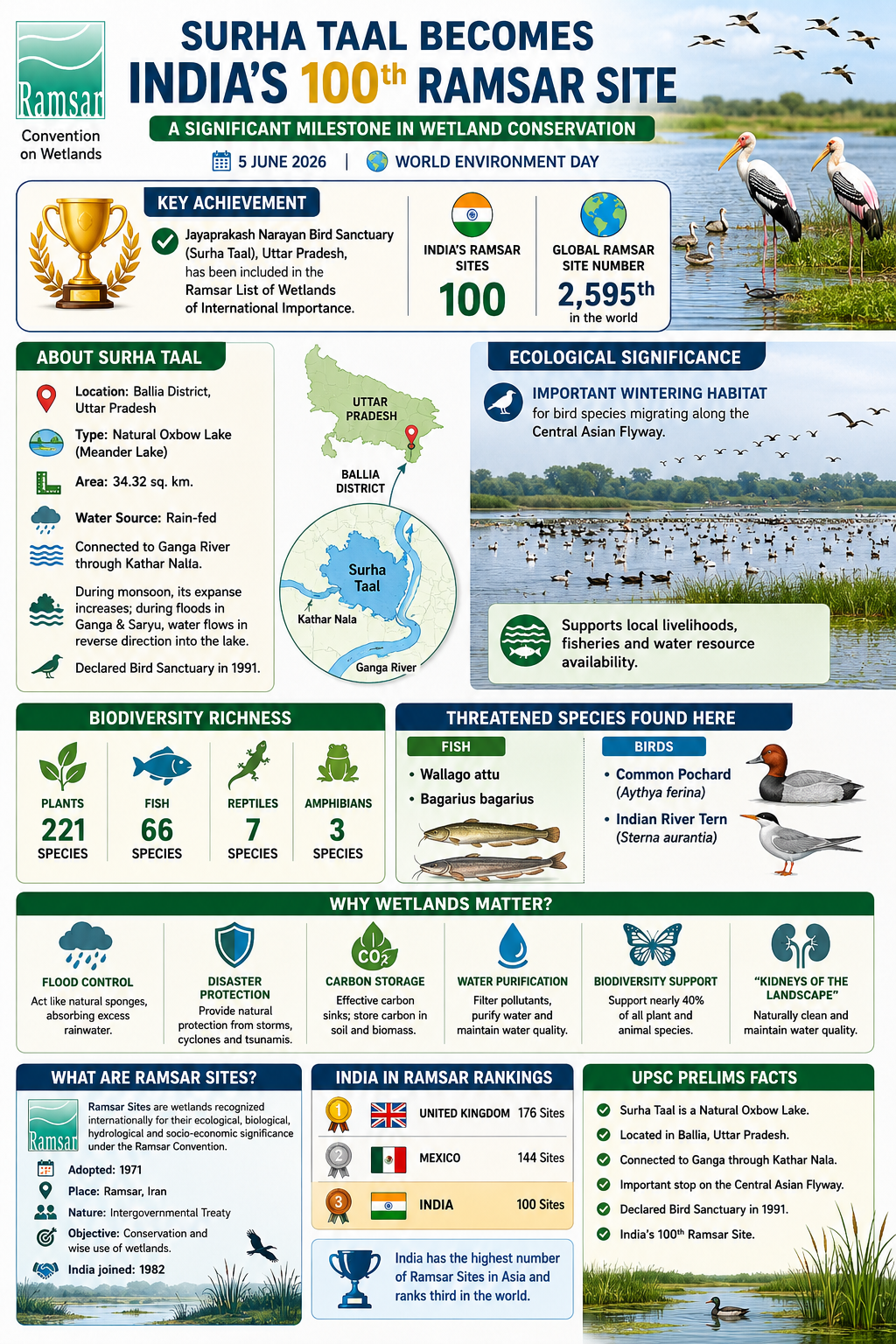
On the occasion of World Environment Day (5 June 2026), Jayaprakash Narayan Bird Sanctuary (Surha Tal), located in Ballia district of Uttar Pradesh, has been included in the Ramsar List as a Wetland of International Importance. With this addition, the number of Ramsar Sites in India has increased to 100 (the 2,595th Ramsar Site in the world). This achievement reflects India's commitment to wetland conservation policies and biodiversity protection.
About Jayaprakash Narayan Bird Sanctuary (Surha Tal):
-
-
- Jayaprakash Narayan Bird Sanctuary (Surha Tal) is a natural oxbow lake located in Ballia district of Uttar Pradesh. Situated in the Gangetic plains, it covers an area of approximately 34.32 square kilometres. It is a rain-fed lake connected to the Ganga River through a water channel known as the Kathar Nala. During the monsoon season, its expanse increases significantly, and at times, when floods occur in the Ganga and Saryu rivers, water flows in the reverse direction into the lake.
- Surha Tal is a natural perennial meander lake that serves as an important wintering habitat for bird species migrating along the Central Asian Flyway.
- It was declared a Bird Sanctuary in 1991. In addition, the area provides an important habitat for numerous fish species, aquatic vegetation, and other wetland-dependent fauna. The wetland also plays a significant role in supporting local livelihoods, fisheries, and water resource availability.
- The site hosts 221 plant species, 66 fish species, seven reptile species, and three amphibian species. Among the fish species are the threatened Wallago attu and Bagarius bagarius, while the wetland's diverse waterbird population includes threatened species such as the Common Pochard (Aythya ferina) and the Indian River Tern (Sterna aurantia).
- Jayaprakash Narayan Bird Sanctuary (Surha Tal) is a natural oxbow lake located in Ballia district of Uttar Pradesh. Situated in the Gangetic plains, it covers an area of approximately 34.32 square kilometres. It is a rain-fed lake connected to the Ganga River through a water channel known as the Kathar Nala. During the monsoon season, its expanse increases significantly, and at times, when floods occur in the Ganga and Saryu rivers, water flows in the reverse direction into the lake.
-
About Wetlands:
-
-
- A wetland is a marshy or waterlogged area where the soil remains completely saturated with water throughout the year or for certain months of the year.
- Wetlands constitute only about 6 percent of the Earth's land surface, yet they provide habitat and breeding grounds for nearly 40 percent of all plant and animal species.
- They also provide natural protection to approximately 60 percent of the global population living in coastal areas by reducing the impacts of storms, cyclones, and tsunamis.
- Wetlands act like natural sponges, absorbing excess rainwater and thereby reducing the risk of floods.
- As effective carbon sinks, wetlands store carbon in both soil and biomass.
- Due to their ability to filter pollutants, purify water, and maintain water quality, wetlands are often referred to as the “Kidneys of the Landscape.”
- A wetland is a marshy or waterlogged area where the soil remains completely saturated with water throughout the year or for certain months of the year.
-
What are Ramsar Sites?
-
-
- Ramsar Sites are wetlands recognized internationally for their ecological, biological, hydrological, and socio-economic significance under the Ramsar Convention.
- The Ramsar Convention is an intergovernmental treaty adopted in 1971 in the city of Ramsar, Iran, with the objective of promoting the conservation and wise use of wetlands. India became a contracting party to the Convention in 1982.
- Globally, there are around 2,595 designated wetlands under the Ramsar Convention of 1971. India has the highest number of Ramsar Sites in Asia and ranks third in the world after the United Kingdom (176) and Mexico (144).
- Ramsar Sites are wetlands recognized internationally for their ecological, biological, hydrological, and socio-economic significance under the Ramsar Convention.
-
Major Challenges:
-
-
- Encroachment and pressure from agricultural expansion.
- Excessive exploitation of fisheries resources.
- Proliferation of aquatic weeds.
- Increasing impact of pollution and waste disposal.
- Changes in water availability due to climate change.
- Encroachment and pressure from agricultural expansion.
-
These challenges can be addressed only through effective management, active participation of local communities, and scientific conservation strategies.
Conclusion:
The declaration of India’s 100th Ramsar Site is not merely a symbolic achievement; it also highlights the growing importance of wetland conservation in the country. Going forward, transforming this recognition into a genuine conservation success will require prioritizing sustainable management, community participation, and a scientific approach. Only then can wetlands continue to play their vital role in ensuring biodiversity conservation, water security, and climate resilience.



