
Supreme Court verdict of OBC creamy layer
Context:
The Supreme Court of India recently clarified that OBC creamy layer status cannot be determined solely on the basis of parental income. The ruling came in a batch of appeals filed by the Union government concerning candidates who were denied OBC reservation benefits in the Civil Services Examination after authorities counted their parents’ salary income to classify them as creamy layer.
Background:
The creamy layer concept was introduced by the Supreme Court in Indra Sawhney v. Union of India (1992) to exclude socially advanced sections among OBCs from reservation benefits.
Key features:
-
-
- OBCs receive 27% reservation in central government jobs and educational institutions.
- Advanced sections within OBCs are excluded as “creamy layer.”
- The income ceiling for creamy layer is currently ₹8 lakh per year.
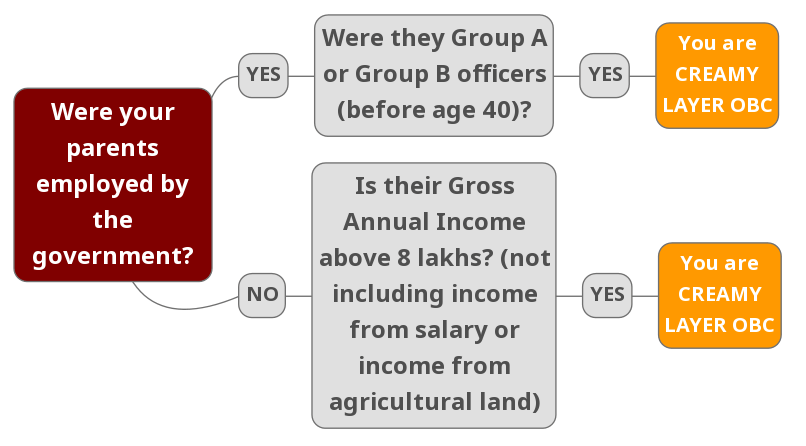
- The government issued an Office Memorandum (1993) outlining the criteria for determining creamy layer, including occupation, social status, and income.
- OBCs receive 27% reservation in central government jobs and educational institutions.
-
Issue before the Court:
-
-
- The dispute arose because some UPSC candidates from OBC communities were denied reservation benefits after authorities counted the salary income of parents working in Public Sector Undertakings (PSUs), banks, or private organisations while applying the creamy layer test.
- Several High Courts (Delhi, Madras, and Kerala) ruled in favour of the candidates. The Union government challenged these decisions in the Supreme Court.
- The dispute arose because some UPSC candidates from OBC communities were denied reservation benefits after authorities counted the salary income of parents working in Public Sector Undertakings (PSUs), banks, or private organisations while applying the creamy layer test.
-
Key Observations of the Supreme Court:
-
-
- The Supreme Court clarified that parental income or salary alone cannot determine whether an OBC candidate belongs to the creamy layer. Authorities must consider multiple factors while making this determination, including the status of the parents in the organisational hierarchy, the nature of their occupation, and the category of posts they hold.
- The Court emphasised that the policy of excluding the creamy layer is primarily based on social status rather than purely on income levels. It noted that advancement within the service hierarchy reflects social mobility and progress, which cannot be accurately judged by income alone, since salary levels may fluctuate over time.
- The Supreme Court clarified that parental income or salary alone cannot determine whether an OBC candidate belongs to the creamy layer. Authorities must consider multiple factors while making this determination, including the status of the parents in the organisational hierarchy, the nature of their occupation, and the category of posts they hold.
-
Significance of the Judgment:
-
-
- Wider Access to Reservation: The ruling may expand eligibility for OBC reservation, especially for candidates whose parents work in PSUs or the private sector.
- Clarification of Reservation Rules: It resolves a long-standing confusion regarding the income/wealth test used to determine creamy layer status.
- Strengthening Social Justice: The judgment reinforces the idea that reservation addresses social and educational backwardness, not merely economic disadvantage.
- Wider Access to Reservation: The ruling may expand eligibility for OBC reservation, especially for candidates whose parents work in PSUs or the private sector.
-
Conclusion:
The Supreme Court’s ruling that parental income alone cannot determine creamy layer status reaffirms the principle that reservation policy is fundamentally based on social status and historical disadvantage. By emphasising a status-based approach, the judgment seeks to ensure that affirmative action benefits reach genuinely backward sections within OBC communities, while preventing arbitrary exclusion.



