
Context:
On 22 September 2026, the Supreme Court examined a petition challenging the Prevention of Insults to National Honour (Amendment) Act, 2026, along with government directions concerning the rendition of Vande Mataram.
Key observations by Court:
-
-
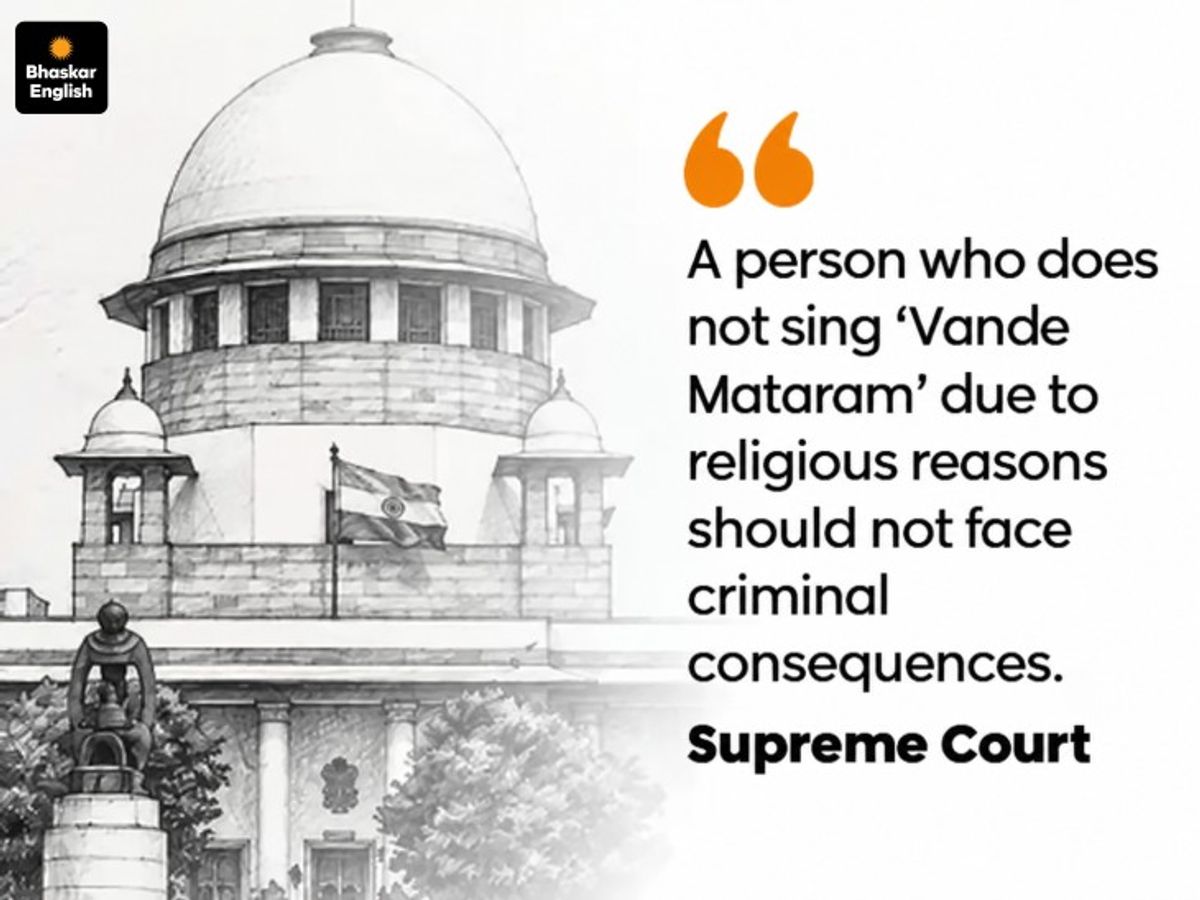
- The Court observed that while a democratically elected government may determine the scope and length of the National Song, it cannot violate religious freedom or impose penal consequences on genuine conscientious objectors who decline to sing one or more stanzas.
- A three-judge Bench headed by Chief Justice of India Surya Kant sought the Union government's response on this matter.
- The Court referred to the landmark Bijoe Emmanuel v. State of Kerala judgment. Three schoolchildren belonging to the Jehovah's Witnesses faith did not sing the National Anthem due to their religious beliefs but stood respectfully while it was played.
- The Supreme Court protected their rights, recognising freedom of conscience and religious belief. The present case examines the relevance of this principle to Vande Mataram.
- The Court observed that while a democratically elected government may determine the scope and length of the National Song, it cannot violate religious freedom or impose penal consequences on genuine conscientious objectors who decline to sing one or more stanzas.
-
Background:
-
-
- The petition was filed by Carnatic vocalist and author T. M. Krishna, challenging the 2026 amendment and administrative directions issued by the Ministry of Home Affairs.
- The petitioner argued that the amended law and executive directions effectively require the playing and mass singing of all six stanzas of Vande Mataram at public functions. Non-compliance, according to the petition, could attract imprisonment of up to three years, fine, or both.
- The petition was filed by Carnatic vocalist and author T. M. Krishna, challenging the 2026 amendment and administrative directions issued by the Ministry of Home Affairs.
-
Constitutional Issues:
-
-
- Article 19(1)(a): Freedom of Expression: Freedom of speech and expression can include the freedom not to express a particular sentiment. Compulsory singing therefore raises questions concerning individual autonomy and compelled expression.
- Articles 25 and 26: Religious Freedom: Article 25 guarantees freedom of conscience and freedom of religion, while Article 26 protects certain rights of religious denominations. The Court indicated that national protocols cannot override these constitutional protections.
- Secularism: The petitioner argued that compulsory rendition of devotional portions of the song could affect the constitutional principle of secularism. The Court, however, noted that religious references in a national symbol do not automatically determine whether a constitutional system is secular.
- Article 19(1)(a): Freedom of Expression: Freedom of speech and expression can include the freedom not to express a particular sentiment. Compulsory singing therefore raises questions concerning individual autonomy and compelled expression.
-
National Song vs National Anthem:
-
-
- Vande Mataram, composed by Bankim Chandra Chattopadhyay, is India's National Song, while Jana Gana Mana is the National Anthem.
- Article 51A(a) expressly requires citizens to respect the Constitution, National Flag and National Anthem; it does not specifically mention the National Song.
- Vande Mataram, composed by Bankim Chandra Chattopadhyay, is India's National Song, while Jana Gana Mana is the National Anthem.
-
Key Issue:
The central distinction is between:
-
-
- Deliberately insulting or disrupting a national symbol; and
- Peacefully refusing to participate due to genuine conscientious or religious objections.
- The Court indicated that the latter cannot automatically attract criminal prosecution.
- Deliberately insulting or disrupting a national symbol; and
-
Significance:
-
-
- Protects freedom of conscience.
- Highlights limits on criminalisation.
- Reinforces constitutional secularism.
- Tests executive action against Fundamental Rights.
- Clarifies the relationship between national identity and individual liberty.
- Protects freedom of conscience.
-
Conclusion:
The case highlights that national honour and constitutional liberty are not necessarily contradictory. Respect for national symbols must operate within the framework of Fundamental Rights, particularly freedom of conscience and religious freedom.



