
Context:
Recently, the Supreme Court of India described child trafficking and commercial sexual exploitation as a “deeply disturbing reality” in the country, highlighting their entrenched, organised, and systemic nature, which continues to persist despite the presence of multiple legal safeguards.
About the Judgment:
-
-
- The Supreme Court laid down important guidelines for trial courts to evaluate evidence involving minor victims in cases of trafficking and prostitution with greater sensitivity and realism. The Court urged a departure from rigid, technical, or overly formal standards of proof, recognising the unique vulnerabilities of child victims.
- It observed that such crimes are part of a wider and deeply embedded pattern of organised exploitation, sustained by complex criminal networks that thrive even in the presence of legislative protections.
- The Court emphasised that trial courts must take into account the socio-economic and cultural vulnerabilities of minor victims, particularly those belonging to marginalised communities, as these factors often inhibit their ability to clearly articulate their experiences. It also noted that organised trafficking networks operate through deceptive, layered, and compartmentalised structures, making precise and consistent narration of events extremely difficult for victims.
- Importantly, the judgment clarified that a victim’s failure to immediately resist, protest, or escape exploitation should not be treated as a ground to discredit testimony. Minor inconsistencies, the Court held, must be assessed with judicial sensitivity, contextual understanding, and human realism, rather than suspicion.
- The Supreme Court laid down important guidelines for trial courts to evaluate evidence involving minor victims in cases of trafficking and prostitution with greater sensitivity and realism. The Court urged a departure from rigid, technical, or overly formal standards of proof, recognising the unique vulnerabilities of child victims.
-
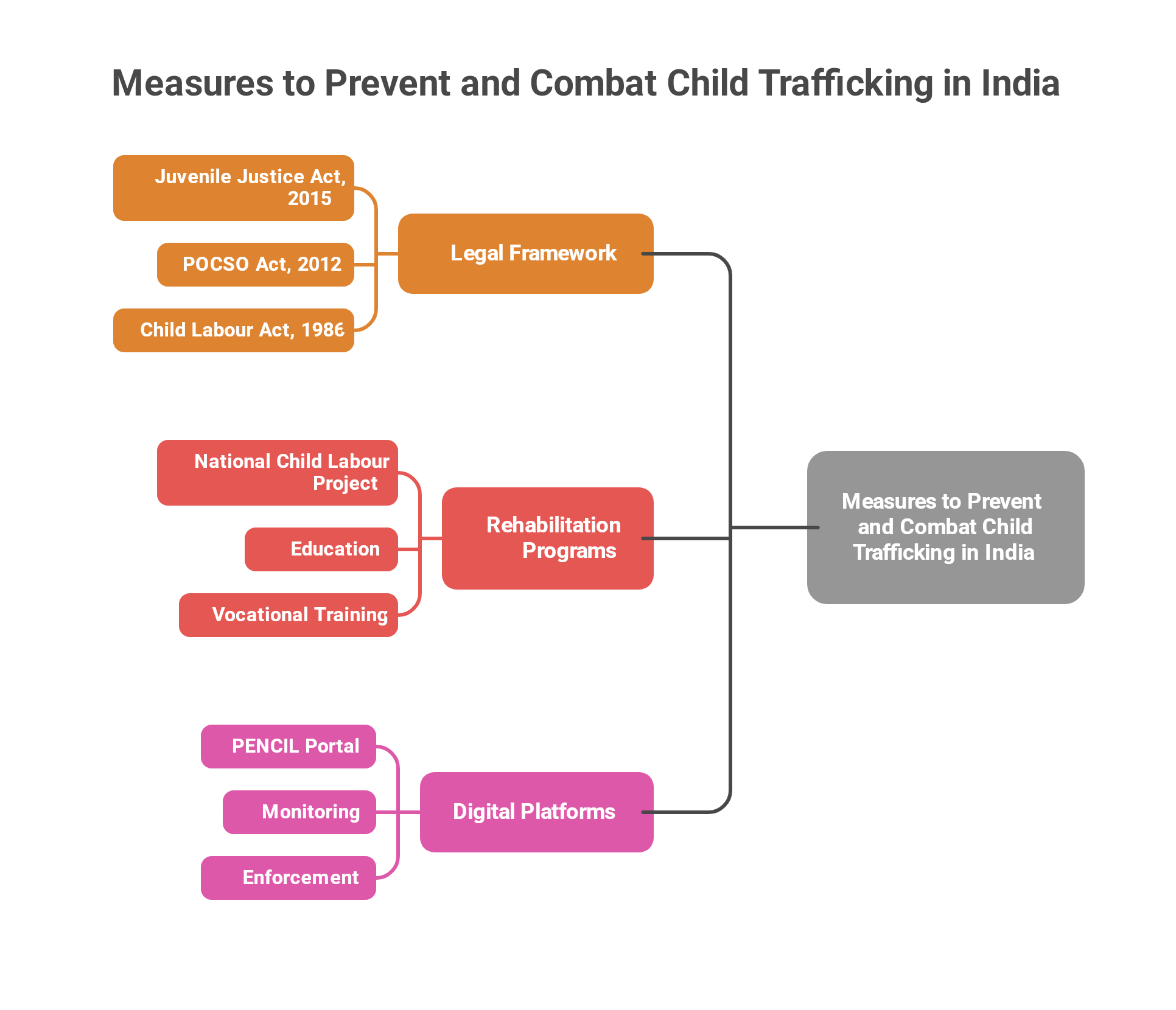
Measures to Prevent and Combat Child Trafficking in India:
-
-
- Juvenile Justice (Care and Protection of Children) Act, 2015: Provides for care, protection, rehabilitation, and reintegration of trafficked and vulnerable children.
- Protection of Children from Sexual Offences (POCSO) Act, 2012: Offers a comprehensive legal framework to protect children from sexual abuse, with child-friendly investigation and trial procedures.
- Child and Adolescent Labour (Prohibition and Regulation) Act, 1986: Prohibits employment of children below 14 years and bans hazardous occupations for adolescents aged 14–18.
- National Child Labour Project (NCLP): Implements district-level rehabilitation programmes, including education, vocational training, and mainstreaming of rescued child labourers.
- PENCIL Portal: A digital platform aimed at ensuring effective enforcement of child labour laws and monitoring the implementation of rehabilitation schemes.
- Juvenile Justice (Care and Protection of Children) Act, 2015: Provides for care, protection, rehabilitation, and reintegration of trafficked and vulnerable children.
-
Together, these legal, administrative, and technological measures—when complemented by judicial sensitivity—seek to create a protective ecosystem that prevents exploitation, strengthens enforcement, and supports rehabilitation.
Conclusion:
The judgment underscores the urgent need for a victim-centric and sensitive judicial approach in cases of child trafficking and sexual exploitation. By recognising the structural complexities of organised crime and the deep vulnerabilities of child victims, the Court reinforces the principle that justice must balance legal rigour with social realities. Procedural technicalities, it affirms, should never obstruct the goals of protection, rehabilitation, and substantive social justice for minors.



