
Context:
Recently, the Supreme Court clarified that its March 11, 2026 judgment on OBC creamy layer criteria cannot automatically reopen completed recruitment, appointments, promotions or seniority positions. However, the ruling will apply to the pending service allocation of candidates selected through CSE 2025.
What is the Creamy Layer?
-
-
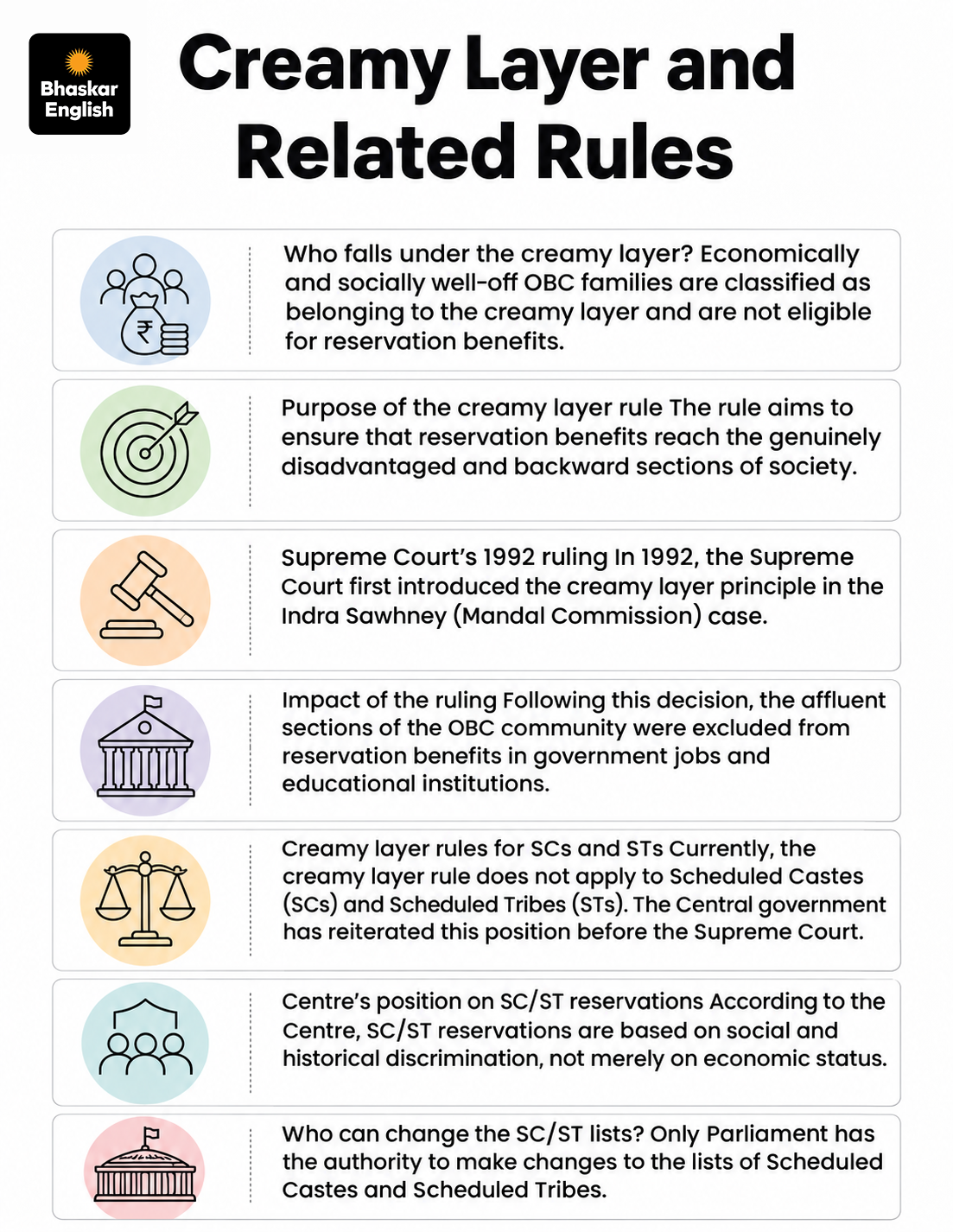
- The creamy layer refers to the relatively well-off and advanced sections among Other Backward Classes (OBCs) who are excluded from reservation benefits. The objective is to ensure that reservation benefits reach genuinely disadvantaged sections.
- In the Indra Sawhney case (1992), the Supreme Court upheld 27% OBC reservation in central government jobs and introduced the principle of excluding the creamy layer. Later, the government issued an Office Memorandum (OM) in 1993 to identify creamy layer candidates.
- The creamy layer refers to the relatively well-off and advanced sections among Other Backward Classes (OBCs) who are excluded from reservation benefits. The objective is to ensure that reservation benefits reach genuinely disadvantaged sections.
-
Background of the Case:
-
-
- The controversy started when OBC candidates were denied Non-Creamy Layer (NCL) benefits because their parents' salaries from Public Sector Undertakings (PSUs), banks and private organisations crossed the prescribed income limit.
- Candidates argued that salary alone should not decide their creamy layer status because the nature and status of their parents' jobs must also be considered.
- The controversy started when OBC candidates were denied Non-Creamy Layer (NCL) benefits because their parents' salaries from Public Sector Undertakings (PSUs), banks and private organisations crossed the prescribed income limit.
-
What Did the Supreme Court Rule on March 11, 2026?
-
-
- A bench of Justices P.S. Narasimha and R. Mahadevan ruled that parental salary and agricultural income cannot be mechanically used alone to determine creamy layer status.
- The Court held that the nature, position and category of parents' employment must also be considered. It also clarified that the 2004 DoPT clarification cannot override the original 1993 Office Memorandum.
- Treating similarly placed employees differently only because they work in different sectors may violate the principle of equality under Articles 14 and 16.
- A bench of Justices P.S. Narasimha and R. Mahadevan ruled that parental salary and agricultural income cannot be mechanically used alone to determine creamy layer status.
-
Why Did the Centre Approach the Supreme Court?
The Central Government was concerned that applying the March judgment to all past appointments could disturb existing seniority, promotions, recruitment results and service allocations.
Therefore, it sought clarification on whether the judgment would apply retrospectively and requested additional time to establish equivalence between government and PSU posts.
What Did the Supreme Court Clarify on November 6, 2026?
-
-
- The Supreme Court clarified that its March judgment would not automatically reopen appointments, promotions or seniority lists already finalised before March 11, 2026.
- The Court explained that the earlier judgment granted relief to specific candidates and did not order a nationwide revision of past recruitment. However, candidates whose cases are already pending before courts or tribunals can seek relief on the basis of their individual merits.
- The Supreme Court clarified that its March judgment would not automatically reopen appointments, promotions or seniority lists already finalised before March 11, 2026.
-
Impact on UPSC CSE 2025:
The result of CSE 2025 was declared on March 6, 2026, but service allocation was still pending when the Supreme Court delivered its March judgment. Therefore, the Court directed that the new creamy layer criteria must apply to OBC candidates selected through CSE 2025.
Significance:
The judgment balances social justice with administrative stability. It protects completed appointments from unnecessary disputes while ensuring fair implementation of OBC reservation. The government should establish clear and transparent creamy layer criteria and ensure equal treatment of similarly placed candidates.
Conclusion:
The Supreme Court's decision highlights that reservation policies must promote equality and social justice without unnecessarily disturbing settled administrative arrangements. It also emphasises the need for transparent rules to ensure that reservation benefits reach genuinely deserving sections.



