
Context:
Recently, The Supreme Court has issued notice to the Centre and the Election Commission of India (ECI) on a petition alleging that Chief Election Commissioner Gyanesh Kumar took certain decisions unilaterally without the concurrence of the other Election Commissioners. The petition also questioned changes associated with Form 6 during the Special Intensive Revision (SIR) of electoral rolls. The Court said that if the records establish that decisions were taken outside the prescribed decision-making process, it could annul such decisions.
What is Form 6?
-
-
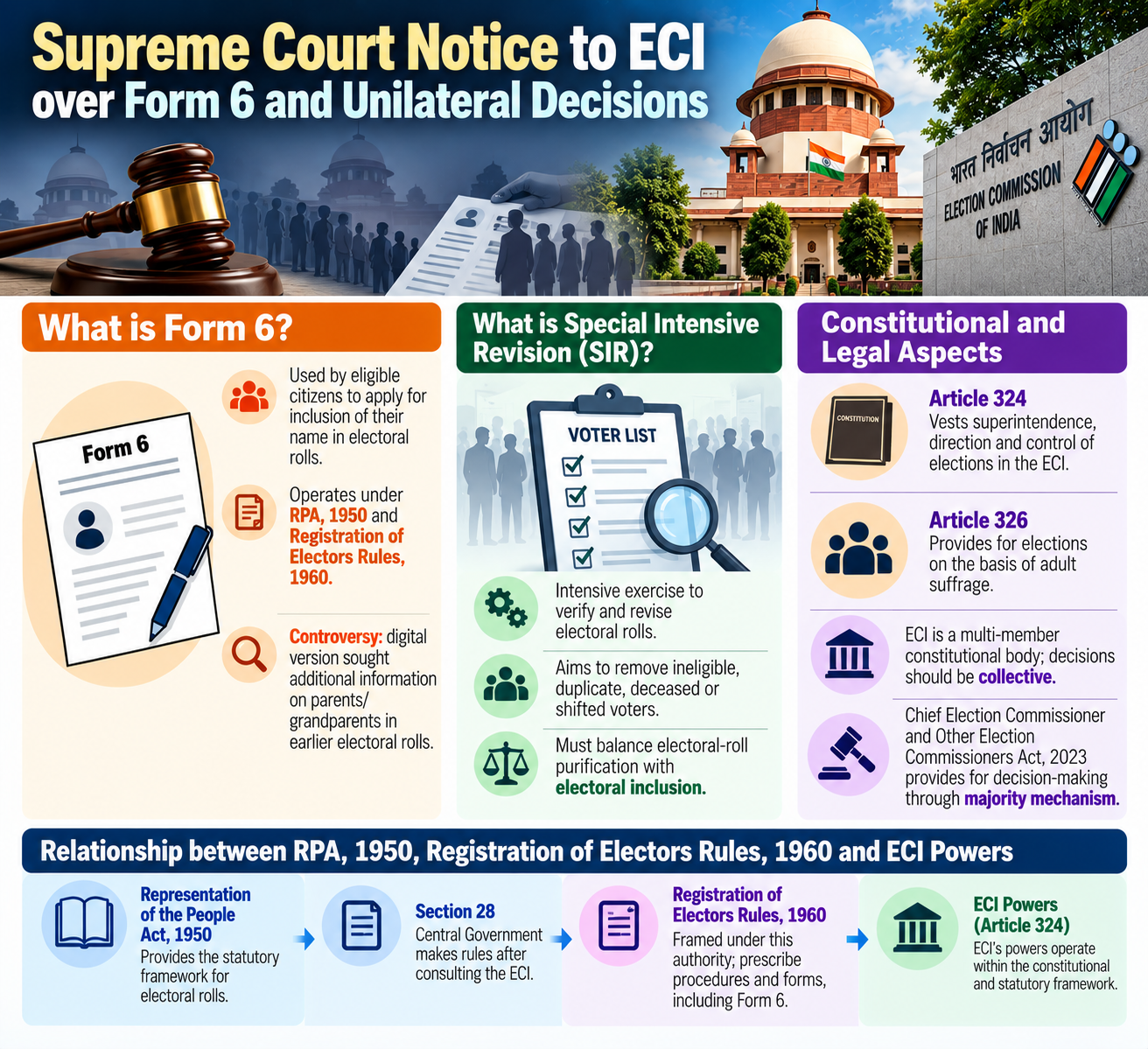
- Form 6 is used by eligible citizens to apply for inclusion of their names in the electoral rolls. It operates under the framework of the Representation of the People Act, 1950 and the Registration of Electors Rules, 1960.
- The controversy arose after modifications to the digital version of Form 6 reportedly sought additional information concerning whether an applicant's parents or grandparents appeared in earlier electoral rolls, particularly in the context of the Special Intensive Revision (SIR) of electoral rolls.
- Form 6 is used by eligible citizens to apply for inclusion of their names in the electoral rolls. It operates under the framework of the Representation of the People Act, 1950 and the Registration of Electors Rules, 1960.
-
What is Special Intensive Revision (SIR)?
-
-
- SIR is an intensive exercise to verify and revise electoral rolls. Its objective is to identify and remove ineligible, duplicate, deceased or shifted voters while ensuring that eligible citizens remain enrolled.
- However, excessive documentary or procedural requirements can potentially create barriers for genuine voters, particularly first-time voters. Thus, electoral-roll purification must be balanced with electoral inclusion.
- SIR is an intensive exercise to verify and revise electoral rolls. Its objective is to identify and remove ineligible, duplicate, deceased or shifted voters while ensuring that eligible citizens remain enrolled.
-
Constitutional and Legal aspects:
-
-
- The controversy raises important questions regarding Article 324 of the Constitution, which vests the superintendence, direction and control of elections in the ECI. It also relates to Article 326, which establishes elections on the basis of adult suffrage.
- The ECI is a multi-member constitutional body. Its institutional legitimacy depends on collective decision-making and adherence to the statutory framework. The Chief Election Commissioner and Other Election Commissioners Act, 2023 provides for decision-making through the prescribed majority mechanism where members disagree.
- Therefore, unilateral exercise of institutional powers can raise concerns regarding checks and balances, accountability and institutional independence.
- The controversy raises important questions regarding Article 324 of the Constitution, which vests the superintendence, direction and control of elections in the ECI. It also relates to Article 326, which establishes elections on the basis of adult suffrage.
-
Relationship between RPA, 1950, Registration of Electors Rules, 1960 and ECI powers:
-
-
- The Representation of the People Act, 1950 provides the statutory framework concerning electoral rolls. Under Section 28, the Central Government makes rules for implementing the Act after consulting the ECI. The Registration of Electors Rules, 1960 were consequently framed under this authority and prescribe procedures and forms, including Form 6.
- The ECI exercises constitutional powers under Article 324 and performs important functions relating to electoral rolls, but such powers must operate within the constitutional and statutory framework. The present controversy therefore concerns the balance between ECI's functional autonomy and adherence to legally prescribed procedures.
- The Representation of the People Act, 1950 provides the statutory framework concerning electoral rolls. Under Section 28, the Central Government makes rules for implementing the Act after consulting the ECI. The Registration of Electors Rules, 1960 were consequently framed under this authority and prescribe procedures and forms, including Form 6.
-
Conclusion:
The controversy highlights the need to balance electoral integrity with voter inclusion. A credible electoral system requires an independent ECI, collective institutional functioning, transparent procedures and protection against wrongful exclusion. The case is therefore significant for the broader constitutional principles of rule of law, institutional accountability and democratic legitimacy.



