
Context:
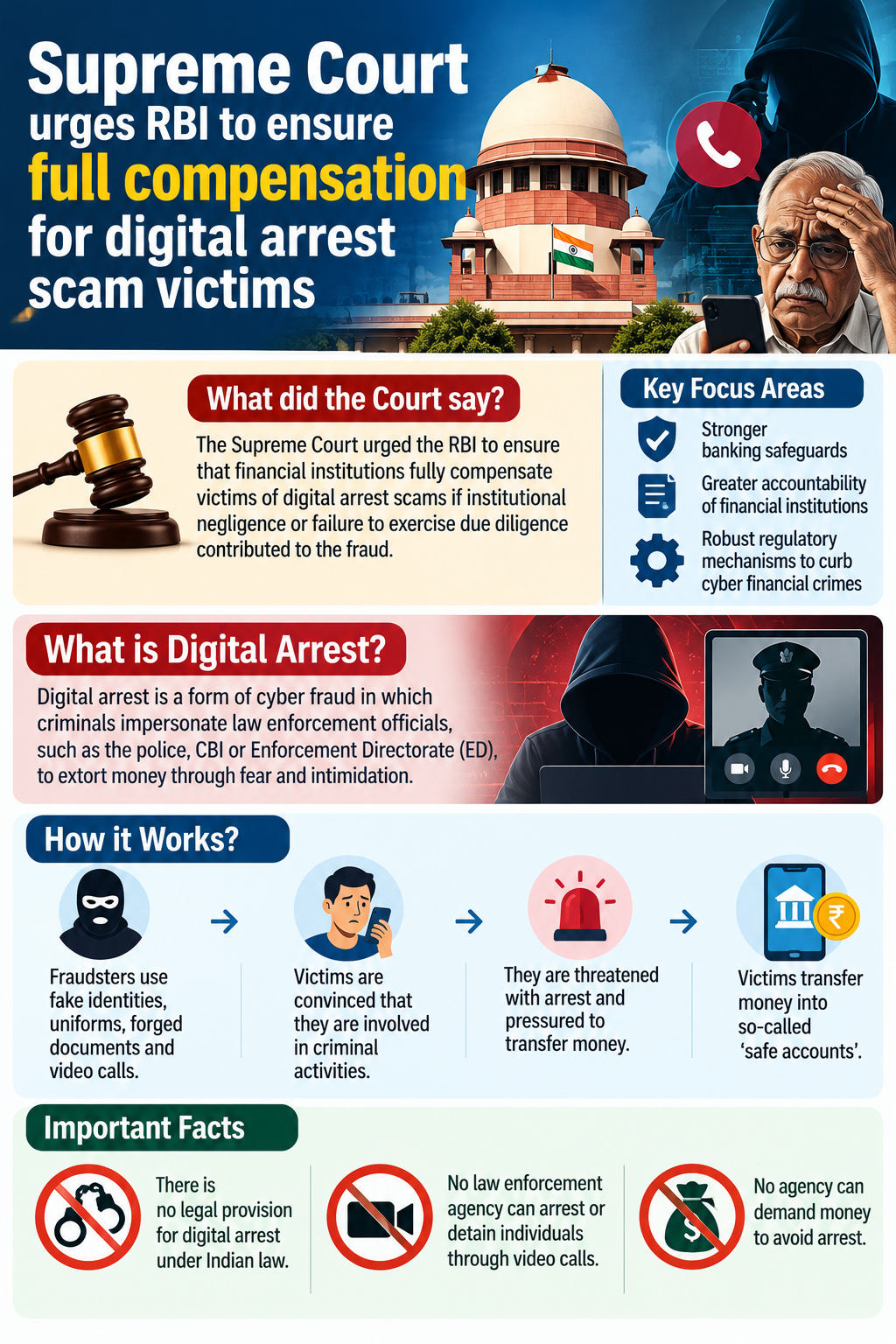
Recently, 2026, the Supreme Court urged the Reserve Bank of India (RBI) to ensure that financial institutions fully compensate victims of digital arrest scams if institutional negligence or failure to exercise due diligence contributed to the fraud. The Court emphasised the need for stronger banking safeguards, accountability and regulatory mechanisms to combat rising cyber financial crimes.
What is Digital Arrest?
-
-
- Digital arrest is a form of cyber fraud in which criminals impersonate law enforcement officials, such as the police, CBI or Enforcement Directorate (ED), to extort money through fear and intimidation.
- Fraudsters use fake identities, uniforms, forged documents and video calls to convince victims that they are involved in criminal activities.
- Victims are threatened with arrest and forced to transfer money into so-called safe accounts.
- There is no legal provision for digital arrest under Indian law. No law enforcement agency can arrest or detain individuals through video calls or demand money to avoid arrest.
- Digital arrest is a form of cyber fraud in which criminals impersonate law enforcement officials, such as the police, CBI or Enforcement Directorate (ED), to extort money through fear and intimidation.
-
Key Observations of the Supreme Court:
The Bench, headed by Chief Justice of India Surya Kant, made several important observations:
-
-
- Financial Accountability: Banks and financial institutions should compensate victims fully if their failure to exercise due diligence contributes to cyber fraud.
- Suspicious Transactions: Banks should identify unusual transactions that deviate from customers' normal transaction patterns and temporarily suspend them for verification.
- Automated Alerts: Suspicious transactions should trigger automated alerts to police authorities.
- Physical Verification: Appropriate physical verification should be conducted to establish the genuineness of suspicious transactions.
- Regulatory Oversight: The Court sought to examine the proposed RBI (KYC) Amendment Directions, 2026.
- State Accountability: States were directed to provide information regarding FIRs, investigations and prosecution in digital arrest cases.
- Financial Accountability: Banks and financial institutions should compensate victims fully if their failure to exercise due diligence contributes to cyber fraud.
-
Scale of Digital Arrest Fraud:
-
-
- More than ₹800 crore was reportedly lost to digital arrest fraud during the current year.
- Losses from such frauds were approximately ₹3,000 crore in the previous year.
- The government stated that digital arrest cases had declined by 50% compared to the previous year.
- More than 11 lakh requests for restoration of money had been received.
- More than ₹800 crore was reportedly lost to digital arrest fraud during the current year.
-
Institutional and Legal Measures:
|
Institution/Mechanism |
Role |
|
Indian Cyber Crime Coordination Centre (I4C) |
Coordinates cybercrime prevention and response. |
|
RBI |
Regulates financial institutions and banking safeguards. |
|
CERT-In |
Responds to cybersecurity incidents. |
|
Helpline 1930 |
Reporting financial cyber fraud. |
|
National Cyber Crime Portal |
Online cybercrime complaint registration. |
Major Challenges:
-
-
- Low digital and cyber awareness among citizens.
- Psychological manipulation and fear of arrest.
- Misuse of mule bank accounts for transferring stolen money.
- Weak institutional accountability and delayed financial recovery.
- Cross-border cybercrime networks and technological sophistication.
- Low digital and cyber awareness among citizens.
-
Way Forward:
-
-
- Strengthen RBI regulations and establish clear compensation mechanisms.
- Use AI-based systems to detect suspicious financial transactions.
- Improve KYC verification and monitoring of mule accounts.
- Strengthen coordination among banks, police and digital platforms.
- Promote cyber awareness through educational institutions and community programmes.
- Enhance international cooperation to tackle cross-border cybercrime.
- Strengthen RBI regulations and establish clear compensation mechanisms.
-
Conclusion:
Digital arrest represents a serious challenge to India's digital transformation and financial security. The Supreme Court's intervention highlights that cybersecurity cannot remain the sole responsibility of citizens. Financial institutions, regulatory authorities and digital platforms must share accountability. A combination of technological safeguards, effective regulation, institutional responsibility and public awareness is essential to building a secure and trustworthy digital economy.