
Context:
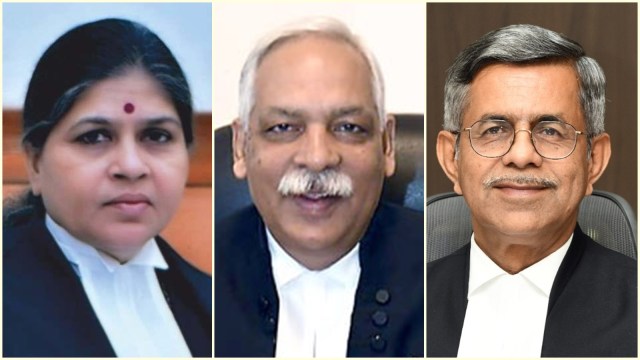
Recently, The Supreme Court Collegium has recommended the elevation of three High Court Chief Justices as judges of the Supreme Court. The three recommended judges are Justice Sunita Agarwal, Chief Justice of the Gujarat High Court; Justice Devendra Kumar Upadhyaya, Chief Justice of the Delhi High Court; and Justice Aparesh Kumar Singh, Chief Justice of the Telangana High Court.
Present Strength of Supreme Court:
-
-
- The Supreme Court currently has 34 serving judges against a sanctioned strength of 38, including the Chief Justice of India. If all three recommendations are approved and the judges take oath, the Court's working strength would increase to 37.
- The recommendation is therefore significant in the context of filling vacancies and strengthening the functioning of the apex court.
- The Supreme Court currently has 34 serving judges against a sanctioned strength of 38, including the Chief Justice of India. If all three recommendations are approved and the judges take oath, the Court's working strength would increase to 37.
-
Constitutional Basis of Judicial Appointments:
-
-
- Judges of the higher judiciary are formally appointed by the President of India.
- Article 124(2): Deals with appointment of Supreme Court judges by the President after constitutionally prescribed consultation.
- Article 217: Deals with appointment of High Court judges by the President after consultation with the CJI, Governor of the State and Chief Justice of the concerned High Court.
- The Constitution, however, does not expressly mention the term “Collegium System”. The present system evolved primarily through judicial interpretation.
- Judges of the higher judiciary are formally appointed by the President of India.
-
About Collegium System:
The Collegium System is a judge-led mechanism for recommending appointments and transfers in India’s higher judiciary. Although the Constitution provides for appointments by the President, judicial interpretation has progressively established judicial primacy in the process.
Evolution through the Three Judges Cases:
-
-
- The Collegium evolved through three landmark judgments:
- First Judges Case (1981): S.P. Gupta v. Union of India held that “consultation” did not mean concurrence, giving greater weight to the executive in appointments.
- Second Judges Case (1993): Supreme Court Advocates-on-Record Association v. Union of India reversed the earlier position and established judicial primacy. The opinion of the CJI was given institutional significance through consultation with senior judges.
- Third Judges Case (1998): On a Presidential Reference, the Supreme Court clarified the Collegium mechanism. For Supreme Court appointments, it comprises the CJI and four senior-most judges. For High Court appointments, recommendations originate from the Chief Justice and two senior-most judges of the concerned High Court.
- First Judges Case (1981): S.P. Gupta v. Union of India held that “consultation” did not mean concurrence, giving greater weight to the executive in appointments.
- The attempt to replace the Collegium through the 99th Constitutional Amendment and National Judicial Appointments Commission (NJAC) was struck down by the Supreme Court in 2015, with the Court reaffirming judicial independence as part of the basic structure.
- The Collegium evolved through three landmark judgments:
-
Issues with the Collegium System:
The system has generated debate over transparency, accountability, selection criteria and diversity. At the same time, judicial primacy has been viewed as an institutional safeguard for maintaining independence of the judiciary.
Way Forward:
There is a need for greater transparency in selection criteria, timely publication of reasons for recommendations, institutional accountability and efficient coordination between the judiciary and executive, while preserving judicial independence.



