
Context:
Recently, the Supreme Court of India sought the Central Government's response to a petition filed by Kapil Sibal, an Independent Rajya Sabha Member and Senior Advocate, challenging the interpretation of the Tenth Schedule (Anti-Defection Law).
Why is the Petition Significant?
-
-
- The petition challenges the provision under the Tenth Schedule which states that if at least two-thirds of the members of a legislature party agree to merge with another political party, they are exempt from disqualification under the Anti-Defection Law.
- Kapil Sibal argues that this provision has become a legal loophole, allowing elected representatives to manipulate the people's electoral mandate through engineered mergers. According to him, such mergers can convert a legislative majority into a minority, or vice versa, without seeking a fresh mandate from the electorate, thereby undermining democratic principles.
- The petition challenges the provision under the Tenth Schedule which states that if at least two-thirds of the members of a legislature party agree to merge with another political party, they are exempt from disqualification under the Anti-Defection Law.
-
Background:
-
-
- The issue came into prominence following the 2022 Goa political developments, when 8 out of 10 Congress MLAs joined the BJP by invoking the merger provision.
- Similarly, in 2026, the Lok Sabha Speaker recognized the merger of six Shiv Sena (UBT) MPs with the Shinde-led Shiv Sena. Both matters are currently under judicial scrutiny and raise important constitutional questions regarding the scope and interpretation of the Anti-Defection Law.
- The issue came into prominence following the 2022 Goa political developments, when 8 out of 10 Congress MLAs joined the BJP by invoking the merger provision.
-
About the Tenth Schedule (Anti-Defection Law):
-
-
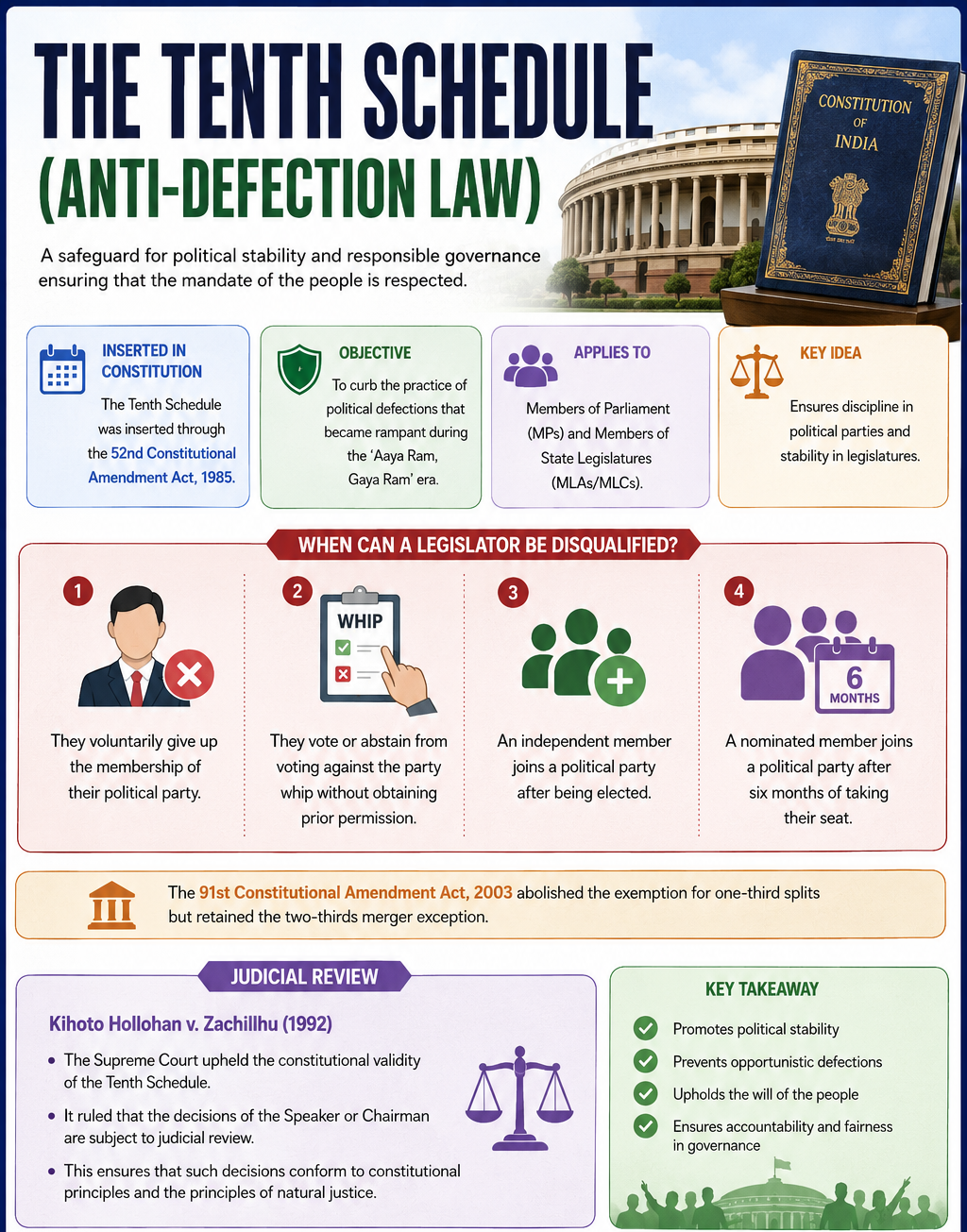
- The Tenth Schedule was inserted into the Constitution through the 52nd Constitutional Amendment Act, 1985.
- Its objective was to curb the practice of political defections during the "Aaya Ram, Gaya Ram" era.
- It applies to Members of Parliament (MPs) and Members of State Legislatures (MLAs/MLCs).
- The Tenth Schedule was inserted into the Constitution through the 52nd Constitutional Amendment Act, 1985.
-
When Can a Legislator Be Disqualified?
-
-
- A legislator may be disqualified if:
- They voluntarily give up the membership of their political party.
- They vote or abstain from voting against the party whip without obtaining prior permission.
- An independent member joins a political party after being elected.
- A nominated member joins a political party after six months of taking their seat.
- They voluntarily give up the membership of their political party.
- The 91st Constitutional Amendment Act, 2003 abolished the exemption for one-third splits but retained the two-thirds merger exception.
- A legislator may be disqualified if:
-
Judicial Review:
In Kihoto Hollohan v. Zachillhu (1992), the Supreme Court upheld the constitutional validity of the Tenth Schedule. It also ruled that the decisions of the Speaker or Chairman are subject to judicial review, ensuring that they conform to constitutional principles and the principles of natural justice.
Challenges and the Way Forward:
Experts believe that:
-
-
- The merger provision is frequently misused to avoid disqualification.
- This leads to political instability and weakens public faith in democracy.
- Delays in deciding disqualification petitions and concerns regarding the impartiality of the Speaker further complicate the process.
- To make the Anti-Defection Law more effective, the following reforms have been suggested:
- Clearly define and tighten the merger provision.
- Introduce a time-bound mechanism for deciding disqualification petitions.
- Consider appointing an Independent Adjudicatory Authority instead of the Speaker to decide such cases.
- These reforms would help safeguard the people's electoral mandate while ensuring political stability and constitutional accountability.
- The merger provision is frequently misused to avoid disqualification.
-
Conclusion:
The Supreme Court's examination of the merger exception under the Anti-Defection Law could have far-reaching implications for India's parliamentary democracy. The outcome of this case may redefine the balance between party discipline, legislative autonomy and the sanctity of the people's mandate. Therefore, it is a significant constitutional issue with important implications for democratic governance and constitutional reforms in India.



