
Superbugs in Urban Sewers: India’s First AMR Wastewater Study
Context:
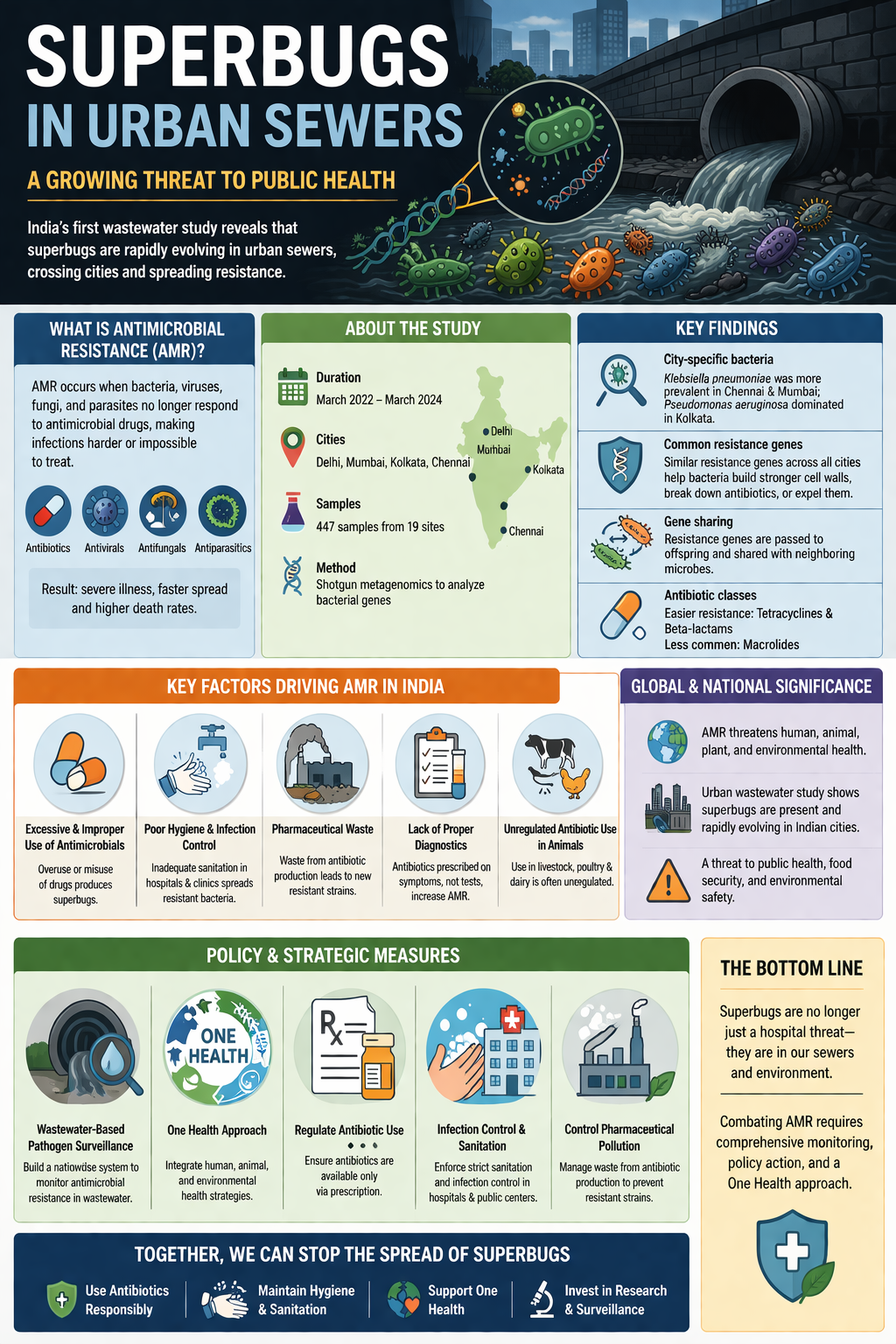
Recently, CSIR-Centre for Cellular and Molecular Biology (CCMB), Hyderabad, in collaboration with partner institutions, conducted India’s first study on antimicrobial resistance (AMR) in urban wastewater. The study revealed that superbugs are rapidly evolving in urban sewers.
About Antimicrobial Resistance (AMR):
According to the World Health Organization (WHO), AMR is one of the biggest global health challenges today. It occurs when bacteria, viruses, fungi, and parasites no longer respond to antimicrobial drugs, including antibiotics, antivirals, and antifungals. As a result, infections become difficult or impossible to treat, leading to severe illnesses, faster disease spread, and higher mortality.
About the Study:
-
-
- The study was conducted from March 2022 to March 2024 in four major metro cities- Delhi, Mumbai, Kolkata, and Chennai. Its primary objective was to understand how bacteria in the wastewater of these cities alter their genes to evade antibiotics.
- During the study, 447 samples from 19 sites were collected. Researchers used shotgun metagenomics to analyze the bacterial genes in detail.
- The study was conducted from March 2022 to March 2024 in four major metro cities- Delhi, Mumbai, Kolkata, and Chennai. Its primary objective was to understand how bacteria in the wastewater of these cities alter their genes to evade antibiotics.
-
Key Findings:
-
-
- City-specific bacteria: The distribution of bacteria varied across cities- Klebsiella pneumoniae was more prevalent in Chennai and Mumbai, while Pseudomonas aeruginosa dominated in Kolkata.
- Common resistance genes: Despite differences in bacterial species, antibiotic resistance genes were similar across all cities. These genes allow bacteria to build stronger cell walls, break down antibiotics, or expel them from the cell.
- Gene sharing: Resistance genes are not only passed to offspring but also shared with neighboring microbes.
- Antibiotic classes: Bacteria developed resistance more easily against tetracyclines and beta-lactams, whereas resistance against macrolides was less common.
- City-specific bacteria: The distribution of bacteria varied across cities- Klebsiella pneumoniae was more prevalent in Chennai and Mumbai, while Pseudomonas aeruginosa dominated in Kolkata.
-
Key Factors Driving AMR in India:
-
-
- Excessive and improper use of antimicrobials: Overuse or misuse of drugs produces superbugs.
- Poor hygiene and infection control: Inadequate sanitation in hospitals and clinics facilitates the spread of resistant bacteria.
- Pharmaceutical waste: Waste from antibiotic production contributes to the emergence of new resistant strains.
- Lack of proper diagnostics: Prescribing antibiotics based only on symptoms, without tests, increases AMR.
- Unregulated antibiotic use in animals: While human antibiotic use is monitored, antibiotics in animal husbandry, poultry, and dairy are often unregulated.
- Excessive and improper use of antimicrobials: Overuse or misuse of drugs produces superbugs.
-
Global and National Significance of AMR:
-
-
- AMR is not only a threat to human health but also affects animals, plants, and the environment.
- The urban wastewater study shows that superbugs are present and rapidly evolving in Indian cities.
- AMR is not only a threat to human health but also affects animals, plants, and the environment.
-
Policy and Strategic Measures:
-
-
- Wastewater-based pathogen surveillance: Develop a nationwide system to monitor antimicrobial resistance in wastewater.
- One Health approach: Integrate human, animal, and environmental health strategies.
- Regulate antibiotic use: Ensure antibiotics are available only via prescription.
- Infection control and sanitation: Implement strict sanitation and infection control standards in hospitals and public health centers.
- Control pharmaceutical pollution: Manage waste from antibiotic production to prevent the emergence of resistant strains.
- Wastewater-based pathogen surveillance: Develop a nationwide system to monitor antimicrobial resistance in wastewater.
-
Conclusion:
In India, AMR is no longer just a medical issue- it has become a crisis affecting public health, food security, and environmental safety. The study warns that superbugs are not confined to hospitals—they are present in urban sewers and the environment as well. Tackling this challenge requires comprehensive monitoring, policy interventions, and a One Health approach. This research will serve as a guide for AMR management and policy-making in India in the coming years.



