
Context:
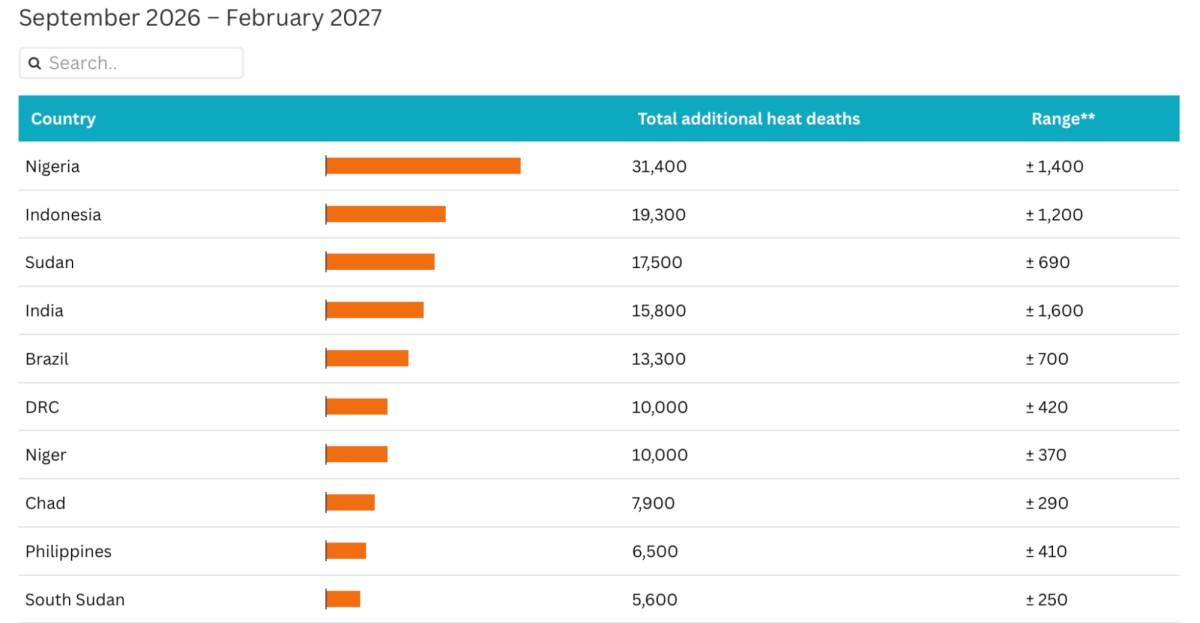
Recently, A Climate Impact Lab report has projected around 15,800 additional heat-related deaths in India between September 2026 and February 2027 due to the ongoing exceptionally strong El Niño event. Globally, around 4.51 lakh additional heat-related deaths are projected during the first six months of the event.
What is El Niño?
-
-
- El Niño is the warm phase of the El Niño–Southern Oscillation (ENSO). It occurs when sea-surface temperatures in the central and eastern equatorial Pacific Ocean become unusually warm, disrupting normal atmospheric circulation and influencing weather patterns worldwide.
- A “Super El Niño” is an informal term used for an exceptionally strong El Niño event.
- El Niño is the warm phase of the El Niño–Southern Oscillation (ENSO). It occurs when sea-surface temperatures in the central and eastern equatorial Pacific Ocean become unusually warm, disrupting normal atmospheric circulation and influencing weather patterns worldwide.
-
Mechanism:
-
-
- Normal Conditions: Under normal conditions, trade winds blow from east to west across the equatorial Pacific. Warm water accumulates near Indonesia and Australia, while cold deep water upwells near the western coast of South America.
- During El Niño: Trade winds weaken or reverse, allowing warm surface water to shift eastward. This reduces cold-water upwelling and releases large amounts of heat into the atmosphere.
- Bjerknes Feedback: Warming of the eastern Pacific further weakens the pressure gradient and trade winds, reinforcing ocean warming. This creates a positive feedback loop known as the Bjerknes feedback.
- Normal Conditions: Under normal conditions, trade winds blow from east to west across the equatorial Pacific. Warm water accumulates near Indonesia and Australia, while cold deep water upwells near the western coast of South America.
-
Impact on India:
El Niño can influence the Indian monsoon, often causing weaker or uneven rainfall. In 2026, India's southwest monsoon had a rainfall deficit of around 15% below normal up to September 22, according to the report.
Major concerns include:
-
-
- Increased heat stress and mortality
- Drought and water scarcity
- Agricultural losses
- Greater electricity demand
- Stress on ecosystems
- Increased wildfire risk
- Increased heat stress and mortality
-
Hotter weather also increases cooling demand, putting additional pressure on India's power sector.
Global Impacts:
El Niño can produce contrasting effects across regions:
-
-
- Australia and Indonesia: droughts and wildfires
- Parts of South America: heavy rainfall and flooding
- Southeast Asia: heat and rainfall disruption
- India: possible monsoon disruption and increased heat stress
- Global: higher average temperatures
- Australia and Indonesia: droughts and wildfires
-
Climate Change Linkage:
-
-
- The Climate Impact Lab describes the current event as a “postcard from our future”, suggesting that El Niño-related temperatures provide an indication of conditions that climate change may increasingly produce in the future.
- However, El Niño is a natural climate phenomenon, while long-term global warming is primarily driven by anthropogenic greenhouse-gas emissions. Climate change can amplify the severity of heat extremes occurring during natural climate variability.
- The Climate Impact Lab describes the current event as a “postcard from our future”, suggesting that El Niño-related temperatures provide an indication of conditions that climate change may increasingly produce in the future.
-
Way Forward:
India needs stronger heat-action plans, early-warning systems, climate-resilient healthcare, urban cooling strategies, water conservation, resilient agriculture and reliable electricity supply. Greater monitoring of El Niño's impacts on marine, freshwater and terrestrial ecosystems is also required.
Conclusion:
The projected heat mortality associated with the strong El Niño highlights the interaction between natural climate variability, extreme heat and climate vulnerability. For India, strengthening adaptation and early-warning systems is essential to reduce mortality and economic losses from increasingly severe climate extremes.



