
Context:
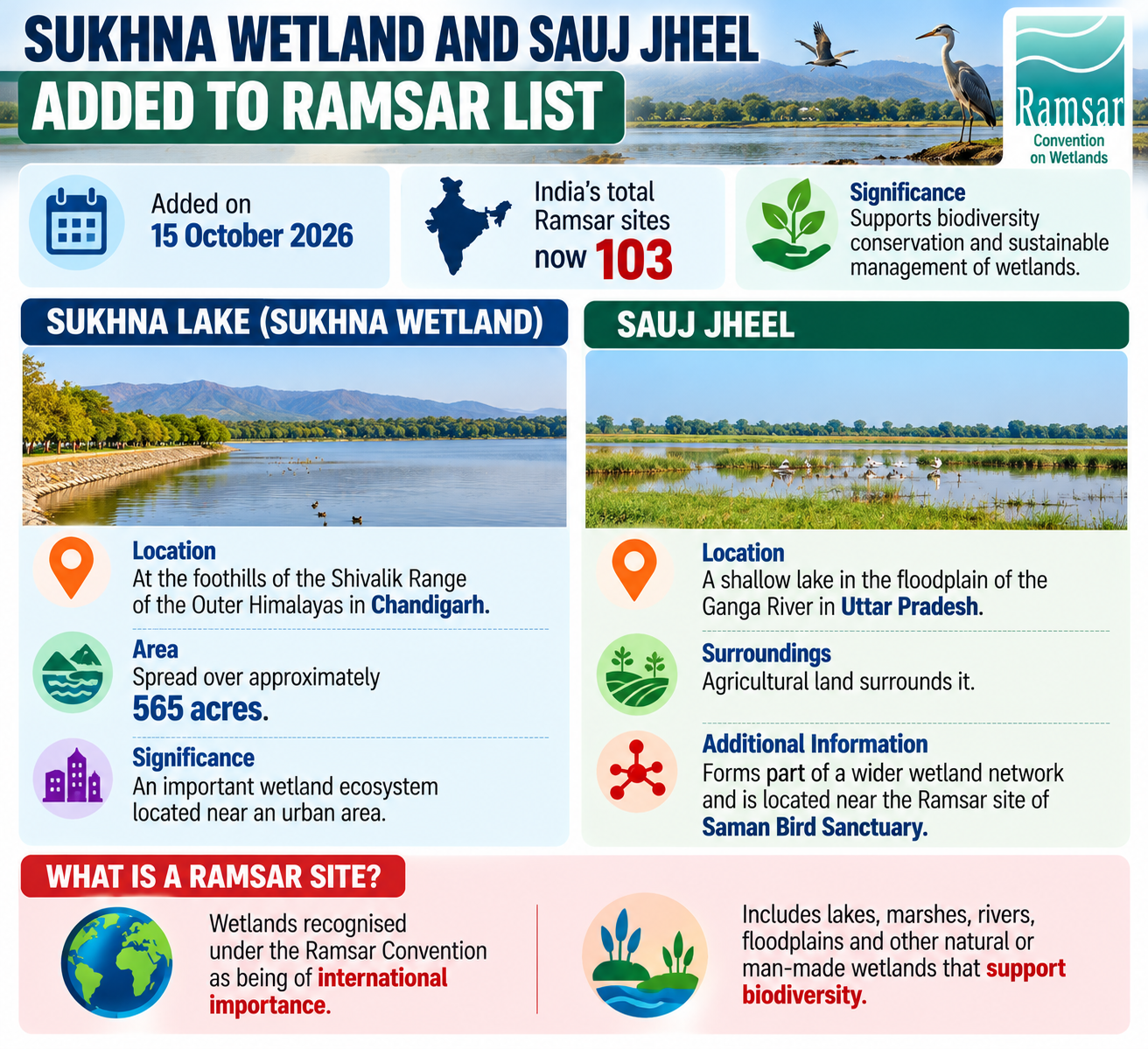
On 15 October 2026, Sukhna Wetland in Chandigarh and Sauj Jheel in Uttar Pradesh were included in the Ramsar List of Wetlands of International Importance. As a result, the total number of Ramsar sites in India increased to 103. This achievement is significant for biodiversity conservation and the sustainable management of wetlands in India.
Sukhna Lake (Sukhna Wetland):
-
-
- Geographical Location: Sukhna Lake is located at the foothills of the Shivalik Range of the Outer Himalayas in Chandigarh. Spread over approximately 565 acres, this wetland is an important ecosystem located near an urban area.
- Ecological Significance:
- It provides feeding, breeding, resting and wintering habitats for migratory birds travelling along the Central Asian Flyway.
- Endangered species such as the Common Pochard (Aythya ferina), Pallas's Fish Eagle (Haliaeetus leucoryphus) and Black Pond Turtle (Geoclemys hamiltonii) are found here.
- It helps regulate the flow of water and sediment entering from the surrounding catchment area.
- It is an important centre for recreation, environmental education and connecting Chandigarh's residents with natural resources.
- It provides feeding, breeding, resting and wintering habitats for migratory birds travelling along the Central Asian Flyway.
- Geographical Location: Sukhna Lake is located at the foothills of the Shivalik Range of the Outer Himalayas in Chandigarh. Spread over approximately 565 acres, this wetland is an important ecosystem located near an urban area.
-
Sauj Jheel:
-
-
- Geographical Location: Sauj Jheel is a shallow lake located in the floodplain of the Ganga River in Uttar Pradesh. Agricultural land surrounds it. It forms part of a wider wetland network and is located near the Ramsar site of Saman Bird Sanctuary.
- Ecological Significance:
- Aquatic and wetland vegetation, such as the lotus (Nelumbo nucifera) and wild sugarcane (Saccharum spontaneum), is found here.
- The lake regularly provides habitat to more than 30,000 waterbirds.
- BirdLife International has recognised it as an Important Bird and Biodiversity Area (IBA).
- Bird species such as the Vulnerable Sarus Crane (Grus antigone) and Greater Spotted Eagle (Clanga clanga) are found here.
- Aquatic and wetland vegetation, such as the lotus (Nelumbo nucifera) and wild sugarcane (Saccharum spontaneum), is found here.
- Geographical Location: Sauj Jheel is a shallow lake located in the floodplain of the Ganga River in Uttar Pradesh. Agricultural land surrounds it. It forms part of a wider wetland network and is located near the Ramsar site of Saman Bird Sanctuary.
-
What Is the Ramsar Convention?
-
-
- The Ramsar Convention is an international treaty concerning the conservation and wise use of wetlands. It was adopted on 2 February 1971 in the Iranian city of Ramsar and came into force in 1975. India became a party to the Convention in 1982.
- Its objective is to maintain the ecological character of wetlands, conserve biodiversity and promote the sustainable use of natural resources.
- The Ramsar Convention is an international treaty concerning the conservation and wise use of wetlands. It was adopted on 2 February 1971 in the Iranian city of Ramsar and came into force in 1975. India became a party to the Convention in 1982.
-
Major Challenges:
-
-
- Siltation: Soil and sediment entering Sukhna Lake from its catchment area can affect its water-holding capacity.
- Invasive Species: The spread of non-native plant species poses a threat to local biodiversity.
- Human Pressure: Urbanisation, tourism, pollution and agricultural activities can adversely affect natural habitats.
- Habitat Degradation and Destruction: Urbanisation, land reclamation, encroachment and infrastructure development affect the natural habitats of wetlands.
- Pressure on Biodiversity: Unregulated fishing and the movement of livestock in Sauj Jheel can affect the habitats of birds and other wildlife.
- Lack of Effective Management and Monitoring: Inadequate regular monitoring of wetlands, limited availability of scientific data, poor coordination among different departments and ineffective implementation of conservation plans are also major challenges.
- Siltation: Soil and sediment entering Sukhna Lake from its catchment area can affect its water-holding capacity.
-
Measures Required for Conservation:
-
-
- Promote soil and moisture conservation in catchment areas.
- Conduct regular monitoring of water quality and biodiversity.
- Control invasive species and restore natural habitats.
- Introduce measures such as seasonal fishing restrictions and controls on the use of fine-mesh fishing nets in Sauj Jheel.
- Promote conservation and environmental awareness through the participation of local communities.
- Promote soil and moisture conservation in catchment areas.
-
Conclusion:
The designation of Sukhna Lake and Sauj Jheel as Ramsar sites is an important achievement in India's efforts to conserve wetlands. However, international recognition will be meaningful only when the ecological integrity of these wetlands is maintained through scientific management, effective monitoring and public participation. This will contribute to achieving the goals of sustainable development, water security and biodiversity conservation.



