
Why in News?
The recent interim report of the Supreme Court-appointed National Task Force (NTF) on student mental health and suicides has stated that student suicides in India should not be viewed merely as a mental health issue but as a structural and institutional problem.
Background:
-
-
-
- According to the Supreme Court, over 13,000 student suicides were reported in 2022, accounting for 7.6% of all suicides in India and exceeding farmer suicides during the same year. Despite various UGC guidelines, counselling initiatives, and the National Suicide Prevention Strategy, student suicides continue to rise.
- To address these crises, The Task Force was constituted by the Supreme Court in Amit Kumar & Ors. v. Union of India (2026) amid rising student suicides across educational institutions. The NTF was tasked with examining the causes, reviewing existing legal and institutional mechanisms, and suggesting preventive measures.
- According to the Supreme Court, over 13,000 student suicides were reported in 2022, accounting for 7.6% of all suicides in India and exceeding farmer suicides during the same year. Despite various UGC guidelines, counselling initiatives, and the National Suicide Prevention Strategy, student suicides continue to rise.
-
-
Key Findings of the Report:
-
-
-
- The report argues that student suicides are often rooted in structural issues such as social discrimination, academic exclusion, financial distress, institutional neglect, and lack of support systems.
- Key findings include:
- India lacks a dedicated statutory framework for suicide prevention in higher educational institutions.
- Existing measures are largely advisory and reactive rather than preventive and enforceable.
- Over 13,600 SC, ST, and OBC students dropped out of Central Universities, IITs, and IIMs between 2018 and 2023.
- Nearly 46% of surveyed students were first-generation learners facing academic, financial, and social challenges.
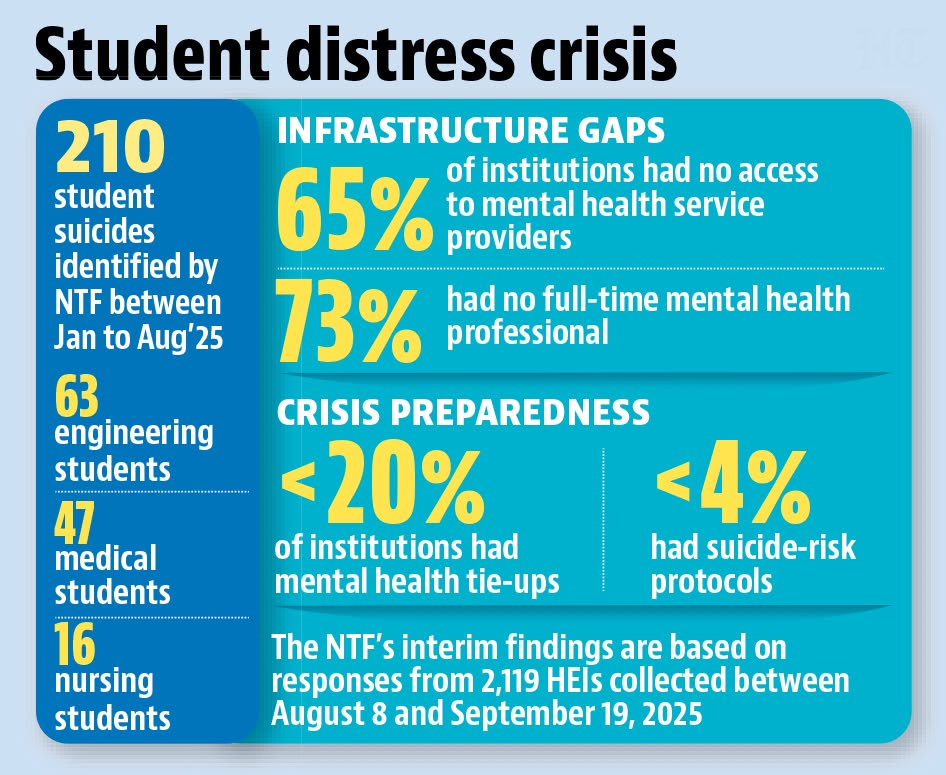
- More than 70% of institutions lack full-time mental health professionals, while fewer than 4% have suicide-risk management protocols.
- Students reported discrimination based on caste, language, socio-economic background, and inadequate scholarship support.
- India lacks a dedicated statutory framework for suicide prevention in higher educational institutions.
- The report argues that student suicides are often rooted in structural issues such as social discrimination, academic exclusion, financial distress, institutional neglect, and lack of support systems.
-
-
Judicial Interpretation:
In Sukdeb Saha v. State of Andhra Pradesh (2025), the Supreme Court held that mental well-being is an integral part of the Right to Life under Article 21. The Court also noted the absence of a unified legal framework for student suicide prevention and issued interim guidelines for educational institutions until comprehensive legislation is enacted.
Key Recommendations:
-
-
-
- Fill faculty vacancies, including reserved-category posts, within a fixed timeframe.
- Establish round-the-clock medical and psychological support in residential institutions.
- Make reporting of student suicides mandatory for educational institutions.
- Develop institutional suicide-risk management protocols.
- NCRB should separately record school and higher education student suicides.
- Create a legally enforceable framework for suicide prevention and student well-being.
- Fill faculty vacancies, including reserved-category posts, within a fixed timeframe.
-
-
Conclusion:
The NTF underscores that student suicides are not merely individual mental health failures but manifestations of deeper systemic inequities. Addressing the crisis requires legal reforms, inclusive campuses, effective support systems, and institutional accountability to ensure that higher education remains accessible, equitable, and safe for all students.
Why was the National Task Force (NTF) on student mental health and suicides constituted?
Answer:
The Supreme Court constituted the NTF in the case of Amit Kumar & Ors. v. Union of India to examine the causes of rising student suicides, review existing mechanisms, and recommend measures for prevention and student well-being.
What was the Supreme Court's observation in Sukdeb Saha v. State of Andhra Pradesh (2025)?
Answer:
In Sukdeb Saha v. State of Andhra Pradesh, the Supreme Court held that mental well-being is an integral part of Article 21 (Right to Life and Personal Liberty) and emphasized the need for a comprehensive legal framework to prevent student suicides.
What is the objective of the Mental Healthcare Act (MHCA), 2017?
Answer:
The MHCA, 2017 aims to provide a rights-based framework for mental healthcare by ensuring dignity, autonomy, access to treatment, and protection of the rights of persons with mental illness.
What is meant by the "Right to Access Mental Healthcare" under MHCA, 2017?
Answer:
The Act guarantees every person access to affordable and quality mental healthcare services provided or funded by the government without discrimination.
What are Advance Directives under the Mental Healthcare Act, 2017?
Answer:
Advance Directives allow individuals to specify in advance their preferred treatment and nominate a representative to make decisions on their behalf if they lose the capacity to do so.
How does the MHCA, 2017 protect the rights of persons with mental illness?
Answer:
The Act prohibits cruel, inhuman, and degrading treatment, guarantees confidentiality of medical records, promotes community living, and mandates equal treatment of mental and physical illnesses, including insurance coverage.
What institutions have been established under the MHCA, 2017 for oversight and grievance redressal?
Answer:
The Act establishes Mental Health Review Boards (MHRBs) to protect patient rights and hear complaints, and Central and State Mental Health Authorities to regulate mental health establishments and maintain standards of care.



