
Strategic Partnership between India and the Netherlands
Why in News?
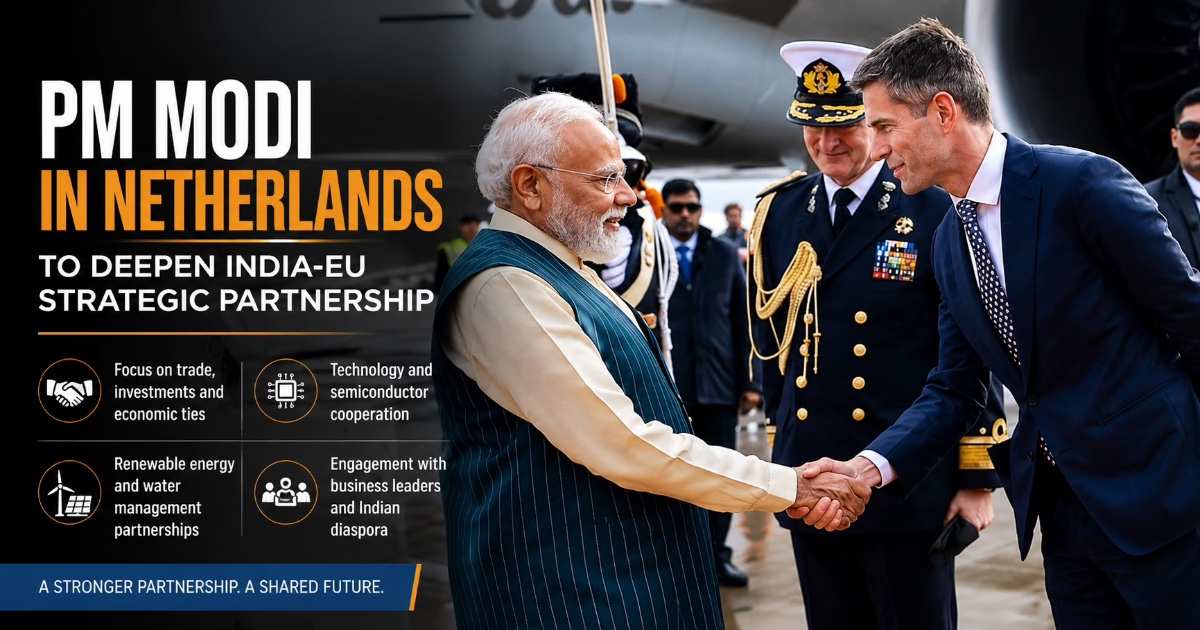
Prime Minister Narendra Modi visited the Netherlands on 16–17 May 2026 on an official visit. During the visit, both countries upgraded their bilateral relations to the level of a “Strategic Partnership.” The two countries signed 17 important agreements for the development of secure future supply chains and infrastructure.
Key Strategic Agreements:
-
-
-
High Technology and Semiconductor Sovereignty
- ASML–Tata Electronics Agreement: India’s Tata Electronics signed an important Memorandum of Understanding (MoU) with the Dutch global semiconductor giant ASML. ASML holds a global monopoly in the manufacturing of advanced lithography machines. This partnership will strengthen India’s first commercial semiconductor fab plant in Dholera, Gujarat.
- Strategic Roadmap (2026–2030): Both countries issued a five-year framework for joint research in the fields of Artificial Intelligence (AI), quantum computing, space exploration, and critical minerals.
- ASML–Tata Electronics Agreement: India’s Tata Electronics signed an important Memorandum of Understanding (MoU) with the Dutch global semiconductor giant ASML. ASML holds a global monopoly in the manufacturing of advanced lithography machines. This partnership will strengthen India’s first commercial semiconductor fab plant in Dholera, Gujarat.
-
Water Management and Climate Adaptation:
- Kalpasar Project: India’s Ministry of Jal Shakti and the Dutch Ministry of Infrastructure signed a Letter of Intent for technical cooperation on Gujarat’s Kalpasar Project. Under this, Dutch flood control and land reclamation technologies will be used to construct a freshwater reservoir in the Gulf of Khambhat.
- Centre of Excellence at IIT Delhi: A “Centre of Excellence on Water” has been established at IIT Delhi to address challenges in sustainable water science and wastewater management.
- Kalpasar Project: India’s Ministry of Jal Shakti and the Dutch Ministry of Infrastructure signed a Letter of Intent for technical cooperation on Gujarat’s Kalpasar Project. Under this, Dutch flood control and land reclamation technologies will be used to construct a freshwater reservoir in the Gulf of Khambhat.
-
Cultural Diplomacy and Defence Cooperation:
- Return of Chola-era Artefacts: The Government of the Netherlands formally handed over 11th-century Chola copper plates to India. These artefacts were taken to Europe from Nagapattinam in 1712. This is considered a major success of India’s cultural diplomacy and soft power.
- Defence Co-production: Both countries agreed on a defence roadmap for joint manufacturing of defence equipment, technology transfer (ToT), and the establishment of joint ventures.
- Return of Chola-era Artefacts: The Government of the Netherlands formally handed over 11th-century Chola copper plates to India. These artefacts were taken to Europe from Nagapattinam in 1712. This is considered a major success of India’s cultural diplomacy and soft power.
-
-
Economic and Bilateral Trade Relations:
The Netherlands is currently one of the most important economic pillars for India within the European Union (EU):
-
-
- FDI Investment: The Netherlands is the fourth-largest foreign direct investor in India, with cumulative investments exceeding USD 55.6 billion.
- Bilateral Trade: In the financial year 2024–25, bilateral trade between the two countries reached USD 27.8 billion.
- Trade Gateway: The Netherlands’ Port of Rotterdam serves as the main gateway for Indian goods entering the European continent.
- FDI Investment: The Netherlands is the fourth-largest foreign direct investor in India, with cumulative investments exceeding USD 55.6 billion.
-
Key Benefits for India:
-
-
- Technological Self-Reliance: Dutch cooperation in semiconductors and AI will form a crucial foundation for India’s ‘Atmanirbhar Bharat’ and ‘Digital India’ initiatives.
- Climate Resilience: Dutch expertise in drainage and coastal management will help protect coastal cities like Mumbai and Chennai from climate change risks.
- Indo-Pacific Security: Both countries support a free, open, and rules-based Indo-Pacific region, which is crucial for global maritime trade and security.
- Technological Self-Reliance: Dutch cooperation in semiconductors and AI will form a crucial foundation for India’s ‘Atmanirbhar Bharat’ and ‘Digital India’ initiatives.
-
Conclusion:
This new phase of India–Netherlands relations is not limited to trade transactions, but represents the building of a future-ready technological and environmental partnership. With shared goals in semiconductor sovereignty, food security, and climate resilience, this strategic partnership is emerging as a strong pillar in global geopolitics.



