
Context
Somaliland, a self-declared republic since 1991 after breaking away from Somalia, has re-entered global focus following Israel’s recognition in December 2025, becoming the first UN member state to formally recognise Somaliland’s independence.
Though long unrecognised internationally, Somaliland’s strategic geography—particularly its proximity to the Bab-el-Mandeb Strait—has made it a critical node in evolving Red Sea and Horn of Africa geopolitics.
About Somaliland
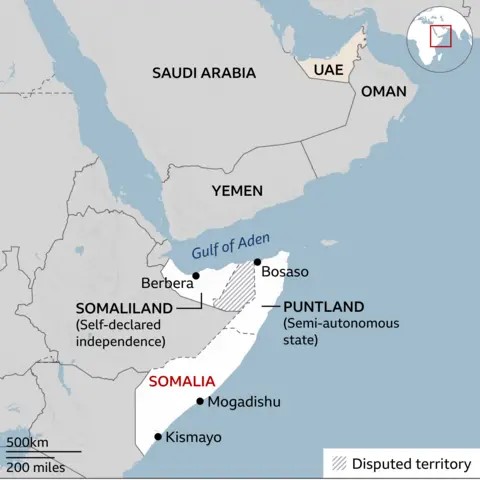
Somaliland, officially the Republic of Somaliland, is a self-declared sovereign state located in the Horn of Africa. While it functions as a fully independent entity with its own government, currency, and military, it is internationally recognised as an autonomous region of Somalia.
Significance of Somaliland
Somaliland lies along the Gulf of Aden, overlooking one of the world’s most vital maritime choke points connecting the Indian Ocean to the Red Sea and the Suez Canal. Nearly 12% of global trade passes through this route, making stability and access critical for energy supplies, commercial shipping, and naval operations.
Rising attacks on Red Sea shipping by Yemen’s Houthi rebels have further heightened the region’s strategic importance.
Berbera Port and Military Infrastructure
At the core of Somaliland’s strategic value is the Berbera Port and airfield, developed since 2016 by the United Arab Emirates under a long-term concession.
Recent upgrades have enabled the port to host large naval vessels, drones, and military aircraft, transforming it from a primarily commercial hub into a potential military logistics base. Analysts note a gradual shift from trade-centric interests to broader security and force-projection objectives.
Israel and UAE Interest
For Israel, Somaliland offers a strategic vantage point to monitor and potentially counter Houthi activities in Yemen, thereby expanding surveillance and operational reach across the Red Sea region. This move also complements Israel–UAE security cooperation under the Abraham Accords.
The UAE, while refraining from formal recognition, has not opposed Israel’s move, prioritising strategic access and security interests over potential diplomatic costs.
Regional and Global Reactions
- Somalia condemned the recognition as a violation of its sovereignty and cancelled agreements with the UAE.
- Turkey, a key Somali ally, expressed concern that fragmentation could undermine its military and economic investments.
- Egypt opposed moves that could weaken its Red Sea security interests.
- China opposed the development due to Somaliland’s ties with Taiwan and its alignment with Israel.
The United States defended Israel’s right to recognition but remained cautious about following suit, balancing regional alliances and broader geopolitical considerations.
Conclusion
As insecurity in the Red Sea intensifies and great-power rivalries deepen, Somaliland’s future is likely to be shaped less by its democratic credentials and more by how regional and global powers balance security imperatives with norms of sovereignty and territorial integrity.



