
Context:
India’s Special Economic Zones (SEZs), once envisioned as engines of export-led growth, are currently under significant stress. According to recent data shared by the Ministry of Commerce and Industry in the Lok Sabha, 466 units have shut down across seven major SEZs between FY21 and FY25. This decline comes amid global economic uncertainties, pandemic-related disruptions, and growing competition from emerging manufacturing hubs such as Vietnam and Malaysia.
Key Statistics (FY21–FY25):
-
- 466 SEZ units shut down in the last five years.
- 100 units closed in FY25 alone, with the post-COVID period seeing the highest number of exits.
- Employment declined marginally to 31.77 lakh in FY25, from 31.94 lakh in FY24.
- Exports doubled, rising from ₹7.59 lakh crore (FY21) to ₹14.63 lakh crore (FY25).
- Investments increased from ₹6.17 lakh crore to ₹7.82 lakh crore over the same period.
- 466 SEZ units shut down in the last five years.
Challenges Facing India’s SEZs:
1. Weak R&D and Technological Upgradation
SEZs continue to lag in high-value manufacturing due to limited investments in innovation, automation, and R&D infrastructure.
2. Rising Global Competition
Countries such as Vietnam are attracting FDI through:
-
-
- Stronger investment-protection agreements
- More attractive fiscal incentives
- Efficient logistics and trade-facilitation systems
- Stronger investment-protection agreements
-
These advantages are diverting global manufacturing away from India’s SEZs.
3. Negative Perceptions and Limited Branding
A survey conducted by ICRIER indicates that many global investors view Indian SEZs as:
-
-
- Bureaucratically rigid
- Policy-uncertain
- Less cost-competitive
- Bureaucratically rigid
-
4. Productivity Challenges
Labour-intensive sectors, especially gems and jewellery have faced:
-
-
- A sharp reduction in operating units
- Declining export share (15.7% in FY21)
- A sharp reduction in operating units
-
This is due to both withdrawal of incentives and global demand shifts.
Government Initiatives:
The Ministry of Commerce and Industry has been working on comprehensive SEZ reforms over the last three years.
Key measures include:
-
-
- Allowing reverse job work to enhance manufacturing flexibility.
- Regulatory changes aimed at simplifying compliance.
- Digitised customs processes to reduce delays.
- Allowing reverse job work to enhance manufacturing flexibility.
-
Transformation under the DESH Framework:
Broader sectoral and regulatory reforms are underway as part of the Development of Enterprise and Services Hub (DESH) initiative, intended to reorient SEZs into globally competitive hubs.
Recent Amendments (2025)
-
-
- Reduced land-requirement norms for semiconductor/electronics SEZs from 50 hectares to 10 hectares.
- Permission for domestic sales with applicable duties for electronics units.
- Greater flexibility regarding encumbrance-free land requirements.
- Reduced land-requirement norms for semiconductor/electronics SEZs from 50 hectares to 10 hectares.
-
About Special Economic Zones (SEZs):
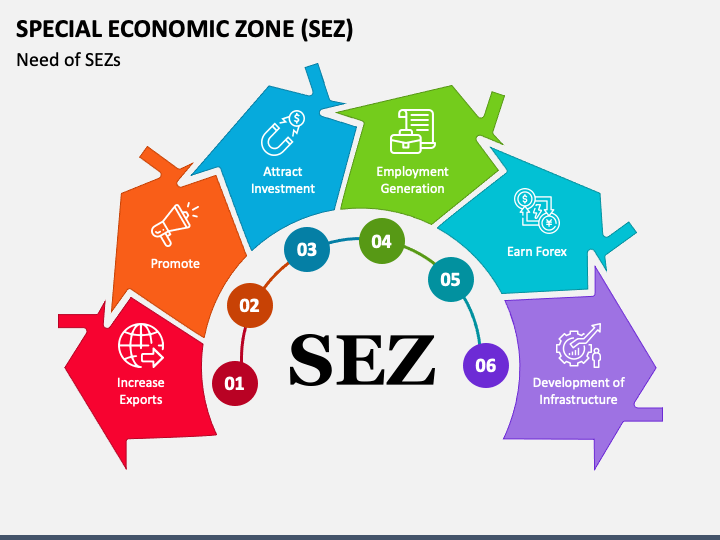
Special Economic Zones are duty-free enclaves considered outside India’s customs territory for the purpose of trade operations, manufacturing, and services.
They aim to:
-
-
- Promote exports
- Attract foreign investment
- Generate employment
- Create globally competitive industrial clusters
- Promote exports
-
Evolution of SEZs in India:
-
- 1965: India established Asia’s first Export Processing Zone (EPZ) at Kandla, Gujarat. EPZs later came up in Surat, Mumbai, Cochin, Chennai, Visakhapatnam, Falta, and Noida.
- 2000: The Government introduced the SEZ Policy, converting all eight EPZs into SEZs with world-class infrastructure and competitive incentives.
- 2005: Parliament enacted the SEZ Act, 2005, effective from 10 February 2006, supported by SEZ Rules—creating a comprehensive legislative and administrative framework.
- 1965: India established Asia’s first Export Processing Zone (EPZ) at Kandla, Gujarat. EPZs later came up in Surat, Mumbai, Cochin, Chennai, Visakhapatnam, Falta, and Noida.
Conclusion:
India’s SEZs stand at a critical juncture. While widespread closures reflect deeper structural issues, the rise in exports and investment demonstrates strong underlying potential. With sustained reforms, improved ease of doing business, enhanced technological capabilities, and strategic sectoral focus, SEZs can continue to evolve into powerful engines of employment, investment, and export growth, contributing significantly to India’s ambition of becoming a global manufacturing and supply-chain hub.



