
Context:
Recently, The International Union for Conservation of Nature (IUCN), in its first-ever global ecosystem-level assessment of coral reefs under the IUCN Red List of Ecosystems, has warned that all 13 coral reef ecoregions in South Asia face a Critically Endangered risk when projected marine heat stress over the next 50 years is considered. Four of these ecoregions are located in India.
Major Findings of the Report:
-
-
- The assessment covers approximately 8,282.6 sq km of coral reefs across India, Bangladesh, Sri Lanka, the Maldives and the Chagos Archipelago, representing around 4% of the world's coral reef area.
- The study found that, based on historical observations alone, seven South Asian ecoregions were classified as Vulnerable, four as Endangered and two as Critically Endangered. However, when projected marine heat stress under IPCC climate scenarios is included, all 13 ecoregions move into the Critically Endangered category.
- The assessment covers approximately 8,282.6 sq km of coral reefs across India, Bangladesh, Sri Lanka, the Maldives and the Chagos Archipelago, representing around 4% of the world's coral reef area.
-
Four Coral Reef Ecoregions in India:
The four Indian coral reef ecoregions identified in the assessment are:
-
-
- Andaman and Nicobar Islands.
- Lakshadweep Islands.
- Gulf of Mannar and Palk Bay (southern coast).
- Gulf of Kutch (western coast).
- India contributed 162 out of 350 monitoring sites across South Asia, accounting for approximately 46.3% of the regional monitoring network.
- Andaman and Nicobar Islands.
-
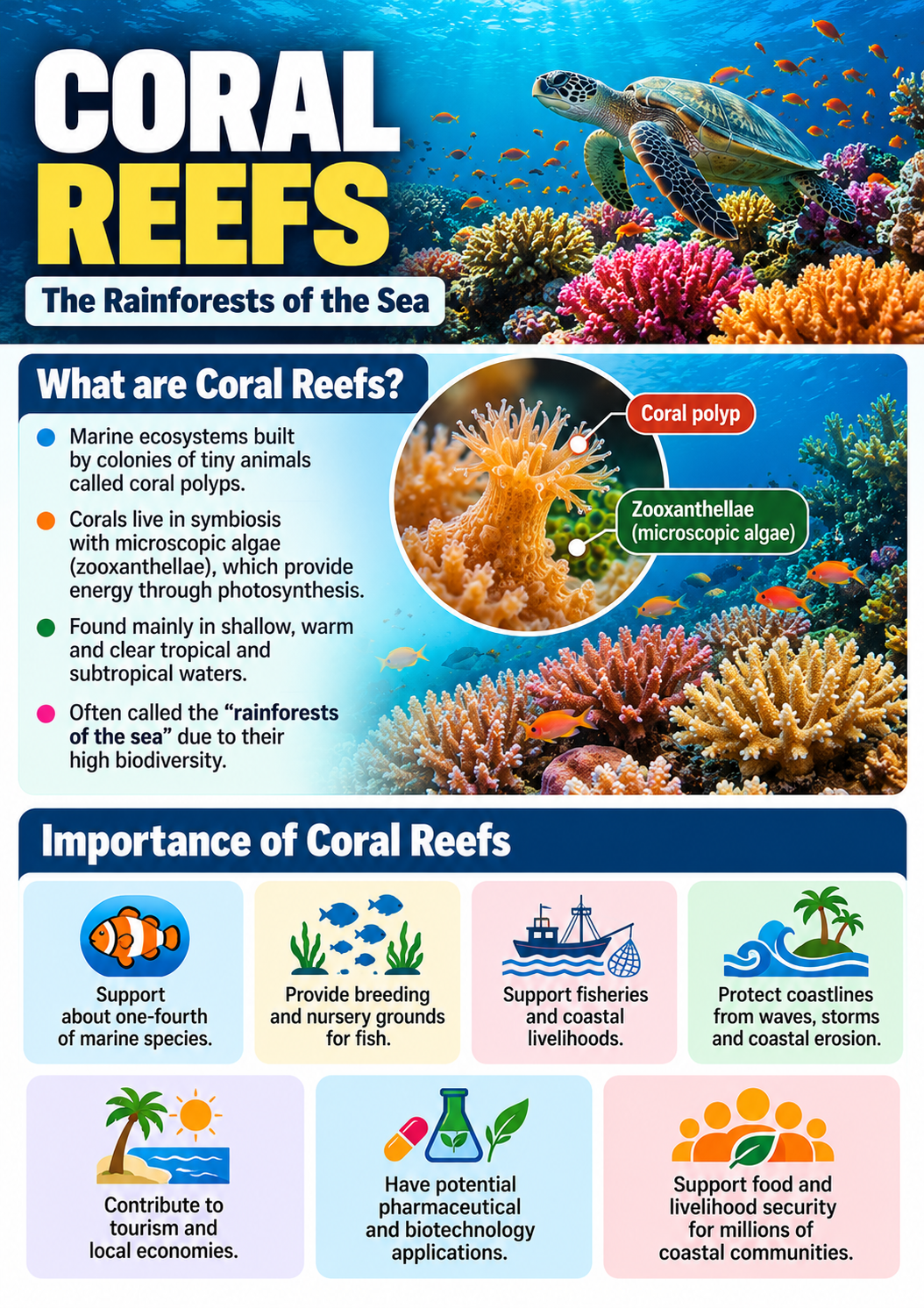
What are Coral Reefs?
-
-
- Coral reefs are underwater ecosystems formed by colonies of tiny marine organisms called coral polyps, which secrete calcium carbonate to build reef structures. They are often called the "Rainforests of the Sea" because of their exceptionally rich biodiversity.
- Coral reefs cover less than 1% of the ocean floor but support approximately 25% of marine fish species. They provide food, coastal protection, tourism opportunities and livelihoods to millions of people.
- Coral reefs are underwater ecosystems formed by colonies of tiny marine organisms called coral polyps, which secrete calcium carbonate to build reef structures. They are often called the "Rainforests of the Sea" because of their exceptionally rich biodiversity.
-
Major Threats to Coral Reefs:
The assessment identifies several interacting threats, including marine heatwaves, rising ocean temperatures, mass coral bleaching, ocean acidification, overfishing, destructive fishing practices, coastal development, dredging, plastic pollution, sedimentation and unsustainable tourism.
What is Coral Bleaching?
-
-
- Coral bleaching occurs when corals experience environmental stress, particularly unusually high sea temperatures, and expel the symbiotic algae called zooxanthellae living in their tissues. These algae provide food through photosynthesis and give corals their characteristic colours.
- As a result, corals turn white. If stressful conditions persist, they may die, leading to the degradation of entire reef ecosystems.
- Coral bleaching occurs when corals experience environmental stress, particularly unusually high sea temperatures, and expel the symbiotic algae called zooxanthellae living in their tissues. These algae provide food through photosynthesis and give corals their characteristic colours.
-
Implications for India:
The degradation of coral reefs can adversely affect marine biodiversity, fisheries, coastal livelihoods and tourism. It also reduces natural protection against coastal erosion, cyclones and storm surges. Coral reef destruction can disrupt marine food chains and threaten the livelihoods of coastal and island communities.
Government Initiatives:
India has undertaken several measures for marine ecosystem conservation, including:
-
-
- Wildlife Protection Act, 1972: Provides legal protection to several marine species associated with coral reef ecosystems.
- Environment Protection Act, 1986: Provides a framework for environmental protection.
- Coastal Regulation Zone (CRZ) Notification: Regulates activities along coastal stretches.
- National Coastal Mission: Supports conservation and management of coastal and marine ecosystems.
- Marine Protected Areas: Protect ecologically important marine habitats.
- Zoological Survey of India (ZSI): Conducts marine biodiversity surveys, coral monitoring and scientific research.
- Wildlife Protection Act, 1972: Provides legal protection to several marine species associated with coral reef ecosystems.
-
Way Forward:
India needs to strengthen Marine Protected Areas, promote scientific monitoring of coral ecosystems and undertake coral restoration using resilient coral species. Regulation of coastal construction, sustainable fishing, control of marine pollution and community participation are equally important. At the global level, reducing greenhouse gas emissions and limiting warming close to 1.5°C remain essential for coral reef survival.
Conclusion:
The IUCN assessment highlights the growing vulnerability of South Asian coral reef ecosystems to climate change. Their conservation is essential for protecting marine biodiversity, coastal livelihoods and ecological security. India must integrate climate mitigation, marine conservation and sustainable coastal development to safeguard these valuable ecosystems.



