
Context
Recently, India celebrated the Somnath Swabhiman Parv (1026–2026), a landmark commemoration marking 1,000 years since the first major attack on the historic Somnath Temple in Gujarat.
About the Somnath Temple:
-
-
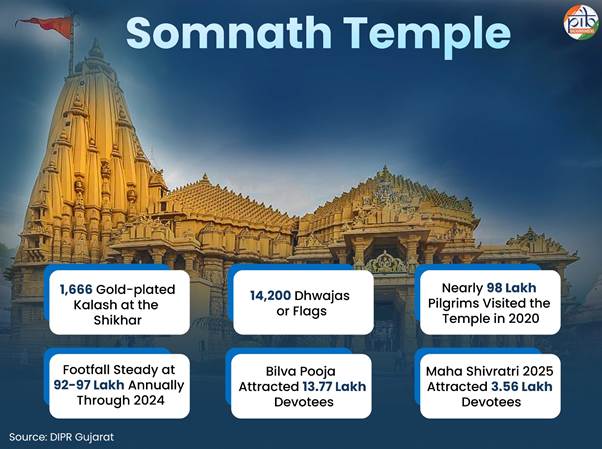
- The Somnath Temple is a Hindu shrine dedicated to Lord Shiva, located at Prabhas Patan near Veraval in the Gir Somnath district of Gujarat, along India’s western coast.
- It is revered as the first among the twelve Jyotirlingas (Dwadasha Jyotirlinga) sacred shrines where Shiva is worshipped in the form of a radiant column of light.
- The name Somnath means “Lord of the Moon”, linked to ancient mythological traditions in which Chandra (the Moon God) worshipped Shiva to regain his lost lustre.
- The Somnath Temple is a Hindu shrine dedicated to Lord Shiva, located at Prabhas Patan near Veraval in the Gir Somnath district of Gujarat, along India’s western coast.
-
Historical Background:
-
-
- The temple site has been a prominent pilgrimage centre since ancient times, with references in classical texts such as the Skanda Purana and Bhagavata Purana.
- Its history is marked by repeated cycles of destruction and reconstruction. The first major recorded attack occurred in 1026 CE by Mahmud of Ghazni, initiating a pattern in which the shrine was destroyed by invaders and rebuilt by successive generations.
- Over the medieval period, multiple rulers and dynasties destroyed and reconstructed the temple, transforming it into a powerful symbol of faith, resilience, and cultural continuity.
- The temple site has been a prominent pilgrimage centre since ancient times, with references in classical texts such as the Skanda Purana and Bhagavata Purana.
-
Modern Reconstruction:
-
-
- The modern reconstruction of the temple was initiated under the leadership of Sardar Vallabhbhai Patel after India’s independence.
- The rebuilt temple was completed and consecrated in May 1951.
- The modern reconstruction of the temple was initiated under the leadership of Sardar Vallabhbhai Patel after India’s independence.
-
Architecture:
-
-
- The Somnath Temple is constructed in the Chaulukya (Māru-Gurjara) architectural style, characteristic of Gujarat’s temple traditions.
- The structure features intricate stone carvings, a towering shikhara (spire) rising about 155 feet, and essential temple components such as the garbhagriha (sanctum sanctorum) and mandapas (assembly halls).
- The temple complex faces the Arabian Sea and is located near the Triveni Sangam, the confluence of the Kapila, Hiran, and Saraswati rivers—enhancing its sacred geography and pilgrimage significance.
- The Somnath Temple is constructed in the Chaulukya (Māru-Gurjara) architectural style, characteristic of Gujarat’s temple traditions.
-
Significance of the Millennium Commemoration:
-
-
- Civilisational Symbolism
- The Swabhiman Parv highlights the enduring spirit of Indian civilisation, demonstrating how a sacred site repeatedly destroyed has been repeatedly restored through collective resolve and devotion.
- This narrative resonates with broader themes of spiritual resilience, cultural pride, and national identity, making the commemoration significant beyond its religious dimensions.
- The Swabhiman Parv highlights the enduring spirit of Indian civilisation, demonstrating how a sacred site repeatedly destroyed has been repeatedly restored through collective resolve and devotion.
- National Integration
- Events such as the Shaurya Yatra and the widespread participation in devotional activities illustrate how the commemoration transcends regional religious observance to emerge as a symbol of national unity and cultural affirmation.
- Events such as the Shaurya Yatra and the widespread participation in devotional activities illustrate how the commemoration transcends regional religious observance to emerge as a symbol of national unity and cultural affirmation.
- Civilisational Symbolism
-
Conclusion:
The Somnath Swabhiman Parv encapsulates a millennium of unbroken faith, cultural resilience, and spiritual continuity. Beyond its architectural grandeur, the Somnath Temple stands as a profound civilisational symbol, reflecting India’s enduring capacity to overcome adversity, renew faith, and preserve its heritage across centuries.



