
Solid Waste Management (SWM) Rules, 2026
Context:
Recently, the Ministry of Environment, Forest and Climate Change (MoEFCC) has notified the ‘Solid Waste Management Rules, 2026’. These rules will come into effect from April 1, 2026, and will replace the existing Solid Waste Management (SWM) Rules, 2016 framework. This step marks a significant shift towards strengthening India’s commitment to ‘Zero Waste’ and a ‘Circular Economy’.
Key Features of SWM Rules, 2026:
-
-
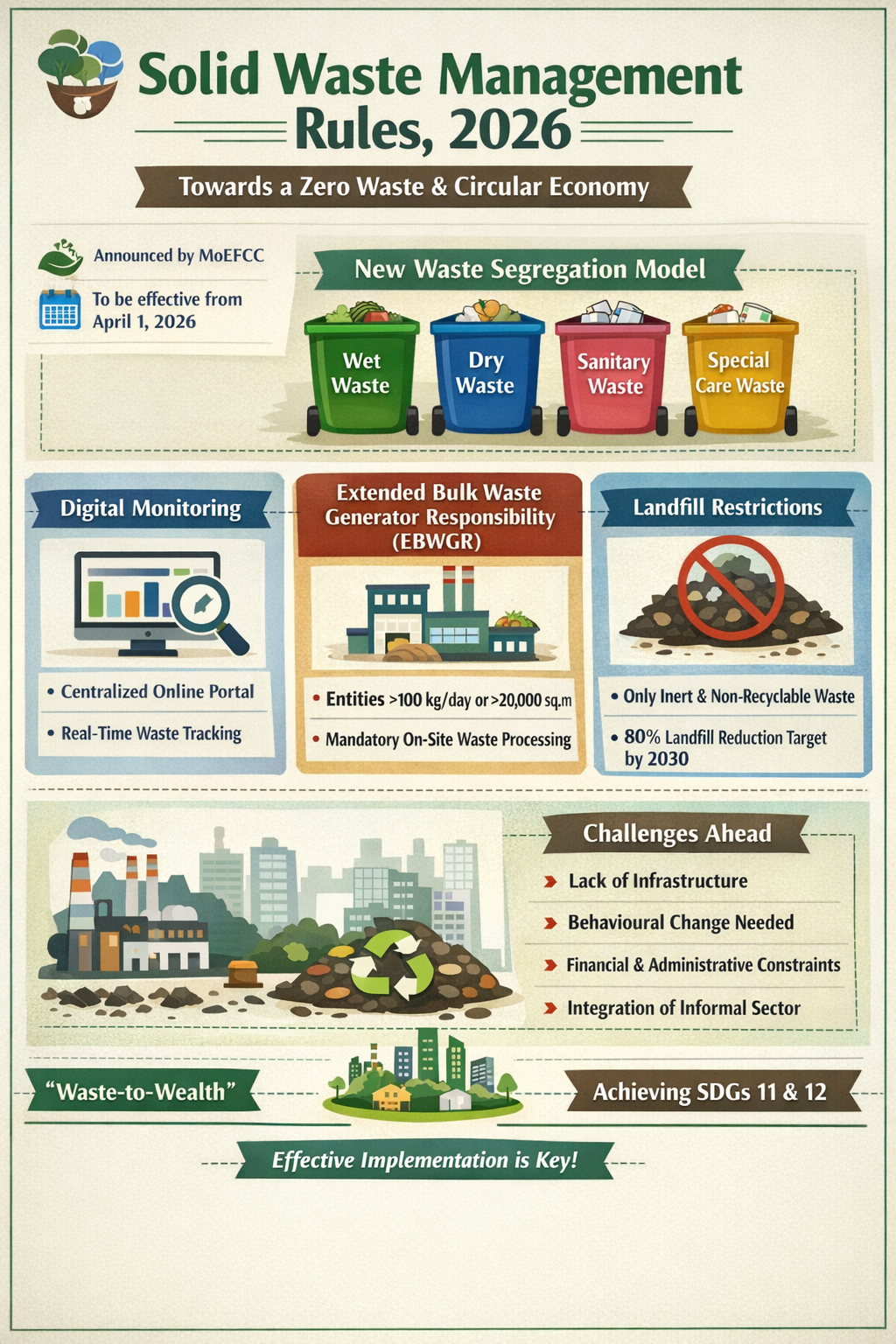
- New Segregation Model: Earlier rules categorized waste into three types, but under the 2026 rules, it will now be mandatory to segregate waste into four categories:
- Wet waste (Bio-degradable)
- Dry waste (Non-biodegradable/Recyclable)
- Sanitary waste
- Special care waste
- Wet waste (Bio-degradable)
- This multi-level segregation will help in scientific waste management, improve recycling efficiency, and reduce dependence on landfills.
- Digital Monitoring and Central Portal: To ensure accountability, the Central Pollution Control Board (CPCB) will launch a centralized online portal. The entire process—from waste generation to its final disposal—will be digitally tracked. Real-time data monitoring will replace manual reporting.
- Extended Bulk Waste Generator Responsibility (EBWGR): Entities generating more than 100 kg of waste per day or occupying an area larger than 20,000 square meters will be classified as ‘bulk waste generators’. They will be required to process wet waste within their premises or fulfill their responsibility through EBWGR certificates.
- Strict Restrictions on Landfills: The new rules restrict the use of landfills only to ‘inert’ and non-recyclable waste. The target is to reduce waste going to landfills by up to 80% by 2030.
- Industrial Responsibility and Refuse Derived Fuel (RDF): Industries such as cement and power will be mandated to use Refuse Derived Fuel (RDF). Over the next six years, industries must replace 15% of their fossil fuel consumption with RDF.
- New Segregation Model: Earlier rules categorized waste into three types, but under the 2026 rules, it will now be mandatory to segregate waste into four categories:
-
Challenges:
-
-
- Lack of Infrastructure: Smaller urban local bodies lack adequate resources and technical capacity for four-level segregation and processing.
- Behavioural Change Challenge: Active public participation is essential for waste segregation at source, which remains limited.
- Financial and Administrative Constraints:
- Urban Local Bodies (ULBs) have limited financial resources
- Gap between policy formulation and implementation
- Urban Local Bodies (ULBs) have limited financial resources
- Integration of Informal Sector: In India, rag pickers form a large informal network, which still needs to be integrated into the formal system.
- Technological and Data Gaps: Ensuring data quality and technological capability will be crucial for the success of the digital portal.
- Lack of Infrastructure: Smaller urban local bodies lack adequate resources and technical capacity for four-level segregation and processing.
-
Conclusion:
The Solid Waste Management Rules, 2026 are not merely about cleanliness but are also a part of India’s fight against climate change. With the principle of ‘Waste-to-Wealth’, these rules can play a significant role in achieving Sustainable Development Goals (SDG 11 and 12). Effective implementation will require better coordination among the central, state, and local governments.



