
Context:
In a landmark development in India’s labour and social security landscape, over 1.03 crore new workers have registered under the Employees’ State Insurance Corporation (ESIC) as part of a focussed effort to expand social security coverage among the country’s formal and informal workforce. This surge is a direct outcome of the Scheme to Promote Registration of Employers and Employees (SPREE) scheme.
Background:
The Employees’ State Insurance Corporation (ESIC) is a statutory social security organisation under the Ministry of Labour and Employment, established to provide comprehensive benefits including medical care, sickness benefits, maternity benefits, disability and dependent benefits to workers and their families under the ESI Act, 1948.
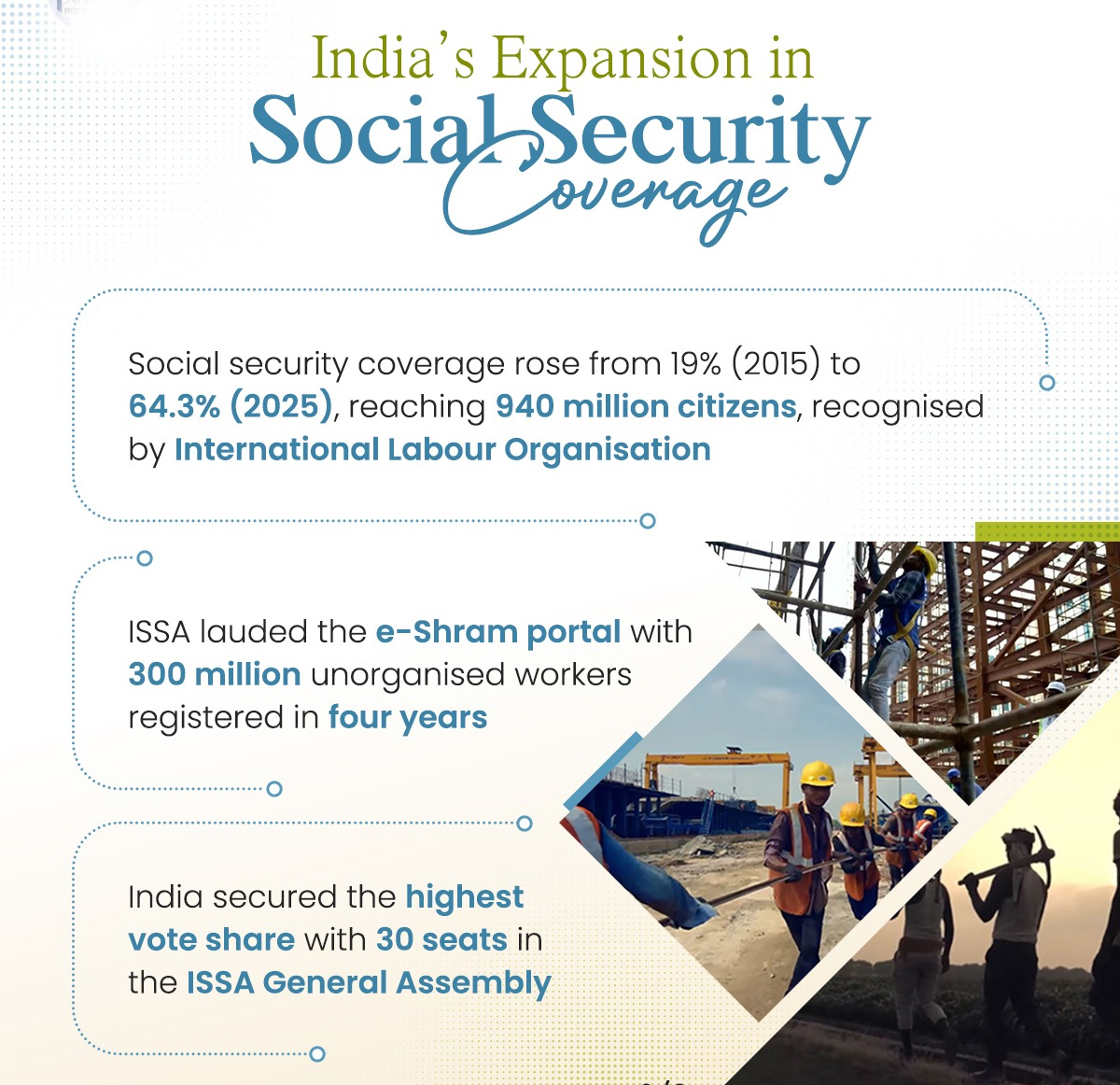
Traditionally, social security coverage in India has been limited, especially for workers in the unorganised and small enterprise sectors. Addressing this gap has been a persistent policy priority — one elevated by reforms under the Code on Social Security, 2020 and subsequent schemes such as SPREE Scheme.
About The SPREE Scheme:
-
-
- The Scheme to Promote Registration of Employers and Employees (SPREE) was introduced on July 1, 2025, aiming to bring unregistered employers and workers under the social security umbrella. The scheme offered a one‑time opportunity for those inadvertently left outside ESIC coverage to register without retrospective liabilities or punitive actions for past non‑compliance.
- Under SPREE, entities and employees who had not previously enrolled could register digitally through portals such as the ESIC portal, Shram Suvidha, and MCA portal, with registration taking effect from the date declared by the employer.
- By January 11, 2026, the scheme had recorded registrations of roughly 1.17 lakh new employers and 1.03 crore new employees under ESIC.
- The Scheme to Promote Registration of Employers and Employees (SPREE) was introduced on July 1, 2025, aiming to bring unregistered employers and workers under the social security umbrella. The scheme offered a one‑time opportunity for those inadvertently left outside ESIC coverage to register without retrospective liabilities or punitive actions for past non‑compliance.
-
Significance of the Milestone:
-
-
- Expansion of Social Security Coverage: This massive enrolment reflects a significant broadening of India’s social security net, potentially extending healthcare, sickness benefits, maternity leave, and disability cover to millions of previously unreached workers.
- Formalisation of Workforce: The inclusion of such a large cohort under the ESIC framework signals progress towards formalising the workforce — a key objective of labour reforms aimed at balancing flexibility with protection.
- Reforms and Compliance Incentives: By removing fears of backward liabilities and punitive penalties, SPREE encouraged voluntary compliance, aligning with modern regulatory approaches that prioritise incentivised registration over punitive enforcement.
- Alignment with Labour Code Reforms: The expansion dovetails with India’s new Labour Codes, consolidating multiple legacy laws into unified frameworks for employment, social security, and welfare. These reforms emphasise comprehensive worker benefits, streamlined compliance, and broader coverage, aligning labour market regulation with evolving work patterns.
- Expansion of Social Security Coverage: This massive enrolment reflects a significant broadening of India’s social security net, potentially extending healthcare, sickness benefits, maternity leave, and disability cover to millions of previously unreached workers.
-
Conclusion:
The registration of 1.03 crore new workers with ESIC represents a milestone in India’s journey towards universal social security coverage. It underscores the impact of targeted policy interventions and social security reforms in formalising employment and protecting worker welfare. By leveraging digital portals, removing retrospective burdens, and incentivising voluntary compliance, the ESIC has markedly broadened its reach — a step with far‑reaching implications for labour welfare and economic inclusion in India’s rapidly transforming job market.



